For Davis it’s all about #1

Mark Davis explained where he stands vis-à-vis the A’s now and into the future during an interview with Tim Kawakami.

As I’ve said, I’m not against the A’s, I’m not for the A’s, I (sic) just for whatever’s best for our organization.

I don’t think anything else needs to be added here.

JPA board looks for new exec director candidates as Houston is voted down

A vote on former Assemblyman and Dublin mayor Guy Houston’s candidacy for the vacant JPA executive director position was postponed last month. The vote was finally taken yesterday and, as expected, Houston was rejected. Reasoning mostly centered on Houston’s anti-labor stances, with many eyebrows raised at fraud charges levied at Houston a few years back. Robert Bobb’s consultancy is on board with the JPA, leaving a rather gaping hole in the org chart below.

Org chart supplied by The Robert Bobb Group

Org chart supplied by The Robert Bobb Group

The job may go to former Rose Bowl head Scott McKibben, or someone else willing to slum for the measly quarter of a million the JPA will pay to whoever accepts the position. Regardless of candidate, the job should be filled in the next few months if the JPA is going to start negotiating with New City, Lew Wolff, or others looking to develop the Coliseum. It’s no small task.

Kephart provides update on Coliseum City, AEG rumors fly

Two articles – one a blog post by Mark Purdy, the other a SFBT piece by Cory Weinberg – provide a tiny amount of news on Coliseum City. Citing confidentiality agreements, New City and Renaissance head Floyd Kephart provided few new details. He did take time to trumpet that the project’s progress, which is better than no progress, I guess. The other “big” takeaways:

  • Kephart threw Colony Capital and HayaH under the bus for getting its documentation wrong.
  • He’s optimistic, saying that New City is “probably between 60 and 70 percent there.” That last 30-40% is a major sticking point, since it involves convincing at least the Raiders to sign on and a master developer as well.
  • Wolff had a discussion with Kephart. Kephart didn’t offer details to Wolff. Wolff reiterated his “wait-and-see” stance.
  • According to Purdy, both Wolff and Mark Davis would prefer to keep surface parking instead of building garages for various reasons.
  • The financing model – and whether includes paying off the Coliseum’s existing debt – remains unknown, at least publicly.

Next week the 90-day “project” will hit its midway point. Kephart is to be commended for getting the meetings, talking to potential principals, and for ably playing catchup, cleaning up the mess left for him by Colony. That still doesn’t mean there’s a deal in place, and Kephart may have to pull a rabbit out of his hat to convince Davis to commit. Private interests would be fools to give Davis any kind of revenue guarantee – that’s how Oakland get into this mess to begin with – since it could add considerable risk for them.

Meanwhile, the LA options for Davis may be dwindling. LA sportscaster Jeanne Zelasko said yesterday that the Rose Bowl and LA Coliseum want nothing to do with the Raiders, leaving Davis with possibly Dodger Stadium in the short term and perhaps Farmers Field in the long term. AEG, which bought a piece of the Lakers when Staples Center was built, is offering a similar “Lakers deal” to a prospective NFL team. AEG was even reportedly hiring a PR person for the NFL stadium effort, which the company is denying. Of course, it was AEG that asked for and received a six month extension to attract a team to Farmers Field.

Anyone following this story knows that Davis will have to give up some percentage of the team in exchange for tenancy in a new stadium anywhere, whether it’s Oakland, LA, or even San Antonio if a new stadium is built there. Here’s how I assess the Oakland vs. LA:

  • Oakland: Steadier fanbase, limited market potential, difficult financing plan, greater civic/government support
  • Los Angeles: Less stable fanbase, greater market potential, known financing plan, less civic/government support

I honestly don’t know how to handicap that. There are no deal terms available.

As for the parking issue, if you really want to read into this it’s quite possible that the Coliseum City alternative that Wolff is putting together is a low-density development like the original Fremont Pacific Commons plan. No high-rises, few parking garages. If true, that’s a huge departure from Coliseum City, though the infrastructure buildout would project to be much less intense, and therefore less expensive for Oakland/Alameda County since the public sector is expected to fund that part. Assuming that Wolff gets a chance to pitch his plan, it’ll be up to City/County to determine whether that’s good enough.

Timeline from KC years through today now available

Many of you have asked for it, I never got around to it. Until this week.

A timeline. That’s right, a timeline. Point your browser to https://newballpark.org/timeline and off you go.

It covers the years from when the Mack family sold the team to Arnold Johnson until now. It covers 60+ years and is 4,500+ words long, requiring a lot of curating and editing to get it down to that length. For the most part, I’ve included important events in the stadium saga. I’ve excluded much of the posturing and back-and-forth that, while entertaining, is ultimately unproductive.

I hope that this timeline helps you in terms of understanding the full scope of the struggle the A’s have always had in trying to finding a permanent home. Links are provided to my articles or outside articles. For now I’ve kept it to a simple bulleted list format. That may change to a linked list or an interactive format. For now I’m forcing you to scroll all the way down if you want to reach 2014. It’s worth reading the whole thing if you can. Appreciate the struggle.

If you have suggestions or you feel I’ve missed anything, comment away or send me a tweet.

As it looks now, SF’s Olympic bid is already doomed

San Francisco has a new Summer Olympics bid in the works. This time they’re targeting the 2024 Games as one of four cities competing for the US bid. The others are Boston, DC, and LA. The bid is Larry Baer’s quixotic dream, and if the region wins the Games he will rightly lauded for his efforts.

Already, the bid the appears to be off on the wrong foot. A $350 million pop-up stadium is to be the centerpiece, though it won’t be in land-starved SF. Instead the stadium and the Olympic village would be housed at the windy, cold Brisbane Baylands just south of the City. The former railyards there are a massive toxic site, needing years of cleanup before they’re ready to build. An EIR is in progress.

The Chronicle’s C.W. Nevius suggested Oakland as the better site, though it makes too much sense to actually happen. As Mark Purdy notes, the Bay Area’s unique brand of provincialism will probably ruin what should be a fully regional effort.

The problems in the Bay Area are simple:

  • Land is far too scarce and expensive to properly rein in the budget
  • The City of San Francisco lacks the outdoor venues to be a proper anchor
  • The previous bids were plagued by having multiple venues 2-3 hours away from SF

All of the places being discussed for a future stadium and village are brownfields like Baylands or former military sites like Hunters Point, Moffett Field, or Alameda NAS. Even Treasure Island has been discussed, and it too has the same infrastructural problems the others face. Tokyo, which won the 2020 Games, is seeing its budget blown to bits while trying to keep the bid compact – most planned venues are within only a few miles of the village).

The Bay Area, which has a gigantic body of water acting as both a physical and psychological barrier to residents and visitors, can’t dream of having a truly compact bid. Instead it needs to capitalize on the resource it has – a great number of existing venues that can host the Games with little need for new construction.

Bid specifics haven’t been released, but what I have seen so far concerns me. Besides the problematic Brisbane site, Coliseum City is mentioned as an adjunct. Meanwhile, $350 million would be spent on a disposable stadium. That’s utter nonsense. Phase the main stadium at Coliseum City correctly and you can save at least $1 billion while providing the Raiders the new home they want. Here’s how.

Phase I: Two main stands

Phase I: Two main stands

It starts with a technique used historically to build English soccer venues: build stands. One on each side of the field. The illustration above shows the track. Modern track meets and the Olympics require more buffer space around the track, which can be accommodated because the stands don’t have concrete poured all the way down to the field. The first 20-26 rows will be portable, similar to the east football seats for Mount Davis. The twin stands would cost $500-600 million to construct and hold 35-40,000 seats.

olympic-fb2a

Phase II: Fill in the ends temporarily


Next, put seats in the end zones and corners. Assuming that this stadium is ready for the Raiders by 2019, these seats don’t have to be on concrete risers. The space between the back of the football end zone and the track oval seats (brown) would be filled by additional rows that go all the way down to the field. There’s your Black Hole. New capacity: 62,000. That would work until…

olympic-fb2b

Phase III: Olympic configuration

After the final game of the Raiders 2023 season, remove the Black Hole seats and start adding temporary sections (green-brown) behind the oval seats. Capacity becomes 80,000 for the Games. After the games end in August, the temporary sections can be removed for football season. If the Raiders want to finish off the stadium in a revenue-maximizing manner, they can undertake a project after the 2024 season ends to remake the end zones.

Phase IV: New end zone sections (temporary sections outlined)

Phase IV: New end zone sections (temporary sections outlined)

The team could add field suites or a huge end zone lounge like what the Patriots are planning at Gillette Stadium. Final capacity: 63,000. This approach would avoid the pitfalls London faced when figuring out what to do with their Olympic Stadium. They did bidding on the post-Games venue after the Games ended, inevitably creating a much more time-consuming, expensive process of stadium redevelopment. If the Raiders are involved from the get-go, they get the venue they want with minimal disruption and cost to themselves. The total cost of this is probably $1 billion. Why? Because all of the important stadium amenities are packaged within the original stands, limiting the amount of square footage built. The two stands can also be built quickly, which should also limit cost.

BASOC’s 2016 bid famously suffered an embarrassing death at the hands of the 49ers, who showed no interest in a multi-use stadium. They had their own vision for a new stadium, eventually realizing it. The Raiders don’t really have a vision for a stadium, looking more towards fulfilling requirements. BASOC and Baer would be smart to recognize the Raiders’ needs as an opportunity. Then again, if the Raiders aren’t in the Bay Area long term, BASOC would have little reason to engage the Raiders.

It’s a shame. There is no market in the country with as many existing, ready-to-use venues for the Olympics as the Bay Area. By 2024 we could have:

  • An Olympic stadium and Village in Oakland with excellent built-in transit access
  • Levi’s, Stanford, Avaya, and Cal Memorial Stadium set up as soccer venues
  • Three major arenas (Warriors, SAP, Oracle), two college arenas (Haas, Maples), and two convention centers (Moscone, McEnery SJ) to handle indoor events
  • Limited new construction required

It would take SF allowing other communities to grab the spotlight. It would take Larry Baer actually being a champion to the region, which he is most certainly not. I too can’t see it happening. Dare to dream, Larry.


Wolff to meet with New City’s Kephart over Coliseum City on Monday

An early reason for Thanksgiving? Well, let’s not get ahead of ourselves yet. Floyd Kephart, the point man for the rejuvenated Coliseum City effort, has a meeting with Lew Wolff scheduled for Monday.

The encouraging news is that Kephart may have put together a plan to keep either the A’s and/or Raiders while paying off the outstanding Mt. Davis debt. That previously was not on the table, at least under the Raiders-centric plan.

birdseye-view_north

As of this writing, there are 58 days left in the recently-extended Coliseum City ENA. Kephart has to deliver at least one team and a master developer to sign on, otherwise CC is toast.

Or is it? Is there anything stopping yet another 3 or 6 months? Presumably the Raiders will have to decide whether to make a run for LA in January or February, when the NFL’s relocation window opens. Mark Davis, Stan Kroenke, and Dean Spanos will all be tempted to be first movers, if only to stake the first claim to LA despite the lack of concrete new stadium plans. What would happen if the relocation window and the ENA both expired with no action by Davis? Davis would be forced to work on a lease extension somewhere, whether at the Coliseum, Levi’s, AT&T Park, wherever. The JPA and the City of Oakland would prefer to keep the Raiders locked into a multiyear lease, which would buy them additional time while they waited for Coliseum City to magically pencil out. Naturally, Davis would be most comfortable with a year-to-year agreement. Inevitably, it all comes down to Davis being the first domino. Little else substantive can happen without his involvement, at least if Oakland wants to keep the Raiders within city limits.

A hidden issue for all three potential relocation candidates is the need for a practice facility and headquarters. The Chargers might be able to get away with keeping theirs temporarily in San Diego. The Raiders could also keep theirs in Alameda via a lease extension while flying down to LA for games, though the JPA may choose to slam the door in Davis’s face if he brings in the moving vans. Kroenke has vast land holdings, including that Hollywood Park purchase from earlier in the year, so if he wanted to build a facility in conjunction with the move, there’s little to stop him. However, that would take at least a year to complete with no temporary facility in place, and the NFL would prefer that these teams not use a local JC or high school in the interim.

Going back to Wolff, there’s little reason to think he’ll be significantly swayed by Kephart. Wolff already has his own designs on the Coliseum complex, so a third party would add needless complication. Kephart might have a third way that suits Wolff and New City’s investors, though it’s hard to see what that is. Perhaps if Wolff gets the complex to develop, while New City takes the area between the complex and the BART station and the “Area B” west of 880, all parties may be satisfied. It was always assumed that the $500-600 million funding gap made using all 800 acres necessary. Since the A’s would probably need only a fraction of that for the ballpark, there stands to be more wiggle room for all parties. For a project as large as this it’s not unusual to have several developers handling different sections and phases. Getting them all on the same page, making their respective contributions, and not getting too greedy – that’s the hard part.


Coliseum Authority casting a wider net for open General Manager job

With the Guy Houston hire apparently on the outs for political reasons, the Coliseum JPA still has an opening for a general manager to fill. Matter and Ross report that one candidate is Scott McKibben, a longtime newspaper industry veteran who in 2009 was tapped to run the Rose Bowl and Parade in 2009.

McKibben is also commissioner of A11FL, a startup spring football league with an unusual rule difference: all 11 players on offense are eligible receivers. That league was supposed to launch last spring, was forced to cancel for untold reasons, and may launch again next spring. Not sure how McKibben’s involvement with A11FL and other ventures could impact the Coliseum Authority gig, but I’d prefer to have a local guy who isn’t spinning plates in LA while trying to negotiate gigantic deals in Oakland.

Which brings me to Andy Dolich. He’s local. He’s visible and well-liked. He was mentioned in the M&R column. In 2012 I wrote this about Dolich:

Reading between the lines, it looks like Dolich is appealing to someone in the East Bay to become a frontman for the Coliseum City plan – if not now, when the plan has legs. That would be a great idea assuming that Coliseum City got off the ground. It’s always good to have someone who has credibility in the sports industry, a history of past successes, and local ties. In December 2010, Dolich floated the idea of a new multipurpose stadium in Oakland, one with the technology to be less of a “neither fish nor fowl” problem than the 60′s-era stadia. I deconstructed the concept and explained why it wouldn’t work. Dolich read my post and sent me an email, which led to a very pleasant exchange on stadia and arenas. I think I even promised to meet him for lunch to talk shop, which never happened, unfortunately.

The bottom line is that it’s nice to hear someone advocating for Oakland and the East Bay, even if his office is actually in the South Bay. Those putting together a Coliseum City plan wouldn’t hurt themselves by having Andy Dolich in a prominent position. To be clear, that’s probably at least a year down the road if it happens at all.

Perhaps the plan Dolich works on wouldn’t specifically be Coliseum City. He’d still be tasked with a major deal if an A’s-centric alternative plan were discussed. Dolich has been a staunch advocate of the Coliseum as the best site for the A’s and Raiders, even if his “multipurpose stadium” thinking was stretching advocacy to unreasonable proportions. There isn’t a bigger fan of the Coliseum area than Dolich, and unlike some other rumored candidates, he wouldn’t be taking the job as a stepping stone for other political endeavors. Dolich’s chief disadvantage is that he doesn’t have experience on the public side of the negotiating table, instead frequently representing teams. Then again, considering how Oakland has botched previous negotiations, maybe that isn’t such a bad thing.

If Dolich wants the job (he wanted the JPA’s PR consulting gig previously), he should be given every opportunity to get it.

Interview on Swingin’ A’s Podcast

Yesterday I did lengthy interview with Tony Frye (@GreenCollarBB) of Swingin’ A’s about all manner of stadium stuff. Since it came on the heels of the election, we talked a lot about that and the Raiders. We talked a good deal about the A’s too, and I tried to show how the two are interrelated and how the teams’ fates are intertwined as long as they’re in Oakland.

Swingin’ A’s Podcast Episode 4

My part of the interview comes about 36 minutes in and runs a whopping 50 minutes.

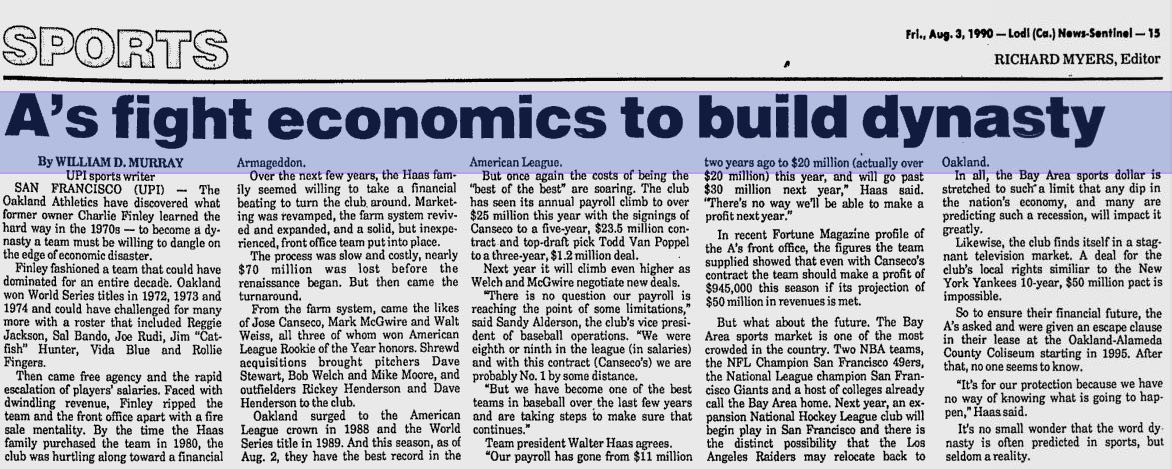
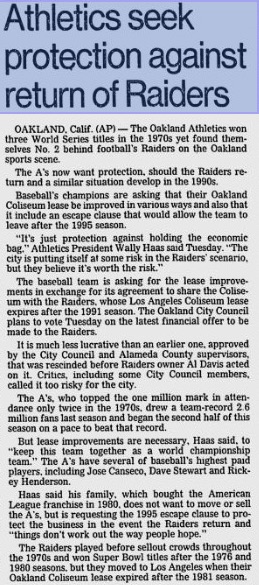
In the interview I discuss Walter Haas and Steve Schott, the latter a subject of a Frye blog post from earlier today. I focused on Haas, partly because of some renewed interest in what he did towards the end of his ownership tenure. Take a look at some of these articles:

A’s fight economics to build dynasty 

haas_1990-lodi

Athletics to move if Raiders return?

boca_raton-athletics_to_move

Athletics seek protection against return of Raiders

deseret-athletics_seek

While we remember Haas for his great generosity, winning teams, and partnership with Oakland, what has gotten lost was that when the winds started to swirl around the Raiders and their potential return to Oakland, Haas picked up on it early and voiced his worry about it. He soft-played it, didn’t want to make appear like he was threatening to move out of Oakland. He made it clear, however, that the team was losing money because of his family’s sacrifices. He was going to sell at some point if it got much worse, which it did. He ended up selling at a heavily discounted price because of the big debt load. Haas felt his business was threatened, so he reacted the way you’d expect a business owner to do – to try to protect his team. Some owners have taken this to unseemly extremes, and it’s unfortunate that Oakland has had to suffer the worst of that behavior from Al Davis and Charlie Finley.

I’ve mentioned this before and it bears repeating: it’s no coincidence that the A’s salad days occurred when the Raiders were gone. The three-peat A’s won the most, but turnout was not particular good and Finley whined about it frequently. With no competition from football on or off the field, Haas didn’t feel a threat. He allowed the Giants to explore the South Bay, in hindsight a strategic error on his part. Haas was as genial guy as ever existed in the Bay Area. But he was still a businessman who knew what was Priority #1 when backed into a corner.

Listen to the interview, rate it on iTunes, and give feedback here in the comments section. I had a good time talking to Tony, and I expect to do another one of these in February, after the Coliseum City ENA expires. Then we can talk next steps. For now, give this a listen.

P.S. – The day Frye asked me to do the interview, Mike Davie of Baseball Oakland wanted to be on too. He’ll have his own episode at some point with a lot of Oakland cheerleading and ownership bashing, I assume.

Davis, Raiders execs meet with San Antonio representatives in Alameda

Mark Davis is probably having a little more fun than Raiders fans these days, because even though their team started out the season 0-8 with 0-16 coming at them fast, at least Davis has a diversion. Davis took another trip to London a few weeks ago, he meets with LA boosters trying the lure the team back down near where he lives, he’s in the Bay Area for home games, and he met today with Henry Cisneros and his team from the Alamo city. Naturally, it’s all a matter of exchanging expensive lunch checks, so Davis is having a grand time while everyone else tries to get inside his head.

Prior to today’s meeting, a unnamed Raiders source indicated that the Alamodome, the last on-spec stadium in America, was considered “NFL-ready.” Clearly that means ready as an interim venue while a new one is built, which is sad considering that the Dome is barely 20 years old. Then again, the Georgia Dome is of similar vintage and that venue is considered outdated by the Falcons, so maybe it’s not that surprising after all.

The Alamodome was borne of a strategic mistake. The Spurs’ old home, the HemisFair Arena, had already been expanded once since its ABA days (by literally raising the roof). The time had come for a brand new arena. Instead of a purpose-built basketball venue, Cisneros led the charge to build a new domed stadium, which could have attracted an NFL team at some point. In the meantime, San Antonio became home to a new CFL expansion franchise during that league’s ill-fated venture in ‘Murica. When the CFL’s stateside project went bust the Alamodome was left without a tenant. A half-house configuration housed the Spurs in a manner that made a 20,000-strong crowd look sparse. The Pistons also did this at the Silverdome until they built their own arena. Eventually Spurs owner Peter Holt prevailed upon city fathers to build AT&T Center on the east side of town, leaving the Alamodome with only one tenant, a minor league football team. A few years ago, the University of Texas-San Antonio started up a new football program, so they moved in to the Dome. The only other permanent tenants is the Alamo Bowl.

Debates about the NFL-worthiness of the San Antonio market generally go nowhere. Yes, it would be one of the smallest markets in the NFL if the Raiders moved there. True, it lacks corporate strength. San Antonio is the eighth-largest city in the nation, but as a fast-growing new city it lacks the distinction of its biggest Texas rivals, let alone other major markets. Their one pro franchise, the Spurs, are the NBA’s shining example of how to run a team on a limited budget. In the market’s favor, it does know how to put on NCAA events with aplomb, and the Alamodome is perhaps the best temporary venue in the country. Good enough to be a real NFL market? Maybe, maybe not. Good enough to be a stalking horse? Definitely.

All Davis said after the meeting was:

Henry Cisneros said their job was to present San Antonio’s assets in strongest light and they did that.

In the normal stadium extortion game, this is when the home city, Oakland, would start throwing public funds at Davis. Since Oakland is in no position to do that, Davis has to try a different tack. Davis’s actions make sense when you understand that he’s trying to play three markets off each other to get the best deal possible – one that allows him to divest as little of the team and his own resources as he can stomach.

What can Oakland provide, given the weird state Coliseum City is in? The only thing nearly as precious as money… time. When Davis talked publicly about demolishing the Coliseum ASAP, he wasn’t joking. He’d like to get the Raiders into a new stadium ASAP. The easiest and quickest way is not to build a stadium alongside the existing Coliseum, but rather to demolish the old one and build on top of the old footprint. Doing so would eliminate the need to reroute power transmission lines and other utilities. More important, no EIR would be needed. When it comes to the rest of the project whether a new venue such as a ballpark or ancillary development, those phases would need an EIR. Fred Kephart is projecting a 2019 opening for a Coliseum City stadium. Davis surely wants a stadium by 2018 or even 2017 if it can be managed. That can’t happen with Coliseum City’s current projected timeline. It’s unclear if an LA stadium can be delivered by 2019. San Antonio? Texas builds stadia faster than California, that’s certain.

What about the A’s new lease, you ask? Aren’t they locked in until 2018? Nope. There’s language that accommodates the possibility of the Raiders pushing the A’s out of the Coliseum.

7.2.2. By Licensor. Licensee acknowledges that a plan may develop for construction of a new football stadium for the Oakland Raiders. Licensor shall keep Licensee reasonably informed of any information related thereto. If Licensor presents Licensee with a Raiders Construction Plan, Licensor and Licensee shall, for a period of thirty (30) days thereafter, negotiate in good faith for an amendment to this License that will account for the financial, operational and other consequences that Licensee would suffer from the construction and operation of such planned football stadium. Such negotiations shall not be necessary if the Raiders Construction Plan includes substantial demolition of the Stadium. If such good faith negotiations are unsuccessful or unnecessary, Licensor may terminate this License upon written notice of intent to terminate to Licensee, such termination to take effect sixty (60) days after the conclusion of the second (2d) Baseball Season that commences after such notice.

44.32. “Raiders Construction Plan” means a bona fide plan for construction of a new football stadium for the Oakland Raiders on current Complex property, adjacent to the current Complex property, or otherwise located sufficiently near to the Stadium such that it will materially impact Licensee’s operations, which bona fide plan must include, as pertains to such stadium project, a fully executed development agreement with a third-party developer and the Licensor for development of a new Raiders stadium, supported by a non-refundable deposit from the developer and received by the Licensor of at least Ten Million Dollars ($10,000,000.00).

The A’s are bound to at least 2018 if they choose to leave. Oakland and the JPA are not. Davis’s currency are his 51% stake in the team and the ability to dictate terms. If he can get a year ahead of projected opening dates, he could end up +$50 million in revenue just for that one year compared to staying at the Coliseum. The city that can deliver the earliest start date will definitely influence his thinking to some degree. No one in the media is talking about time, yet it’s every bit as important as site or financing model, at least in the near term.

P.S. – Davis is also playing a game among the NFL owners. Cowboys owner is on the NFL stadium committee, while Texans owner Bob McNair is on the league’s finance committee. Both owners and their respective committees will have a lot to say about potential relocations before any deals are signed. Davis could be sending a message to the Texas owners to play ball with him, or else face a San Antonio threat. It sounds like a terrible hand to play, but Davis doesn’t have much else with football’s Lodge. If he can influence them and other owners that the Raiders should be first banana in LA (despite various misgivings) it’s a hand well-played. Davis doesn’t have much to lose, plus he could help his friend Cisneros prove San Antonio’s viability. If you’re Cisneros, you don’t opportunities like this all the time, so you might as well give it a shot.

Election Aftermath 2014

A wise person would’ve turned off the lights and gone to sleep early, waiting to let the election news wash over them until the following morning. Not this guy. As the various county registrars were plagued by reporting delays traced back to a vendor in Florida (that’s your first clue right there), election observers sat at their computers, thumbs properly inserted.

Eventually we got our results. Though not certified, we have a pretty good sense where everything’s leading:

  1. Libby Schaaf is the apparent winner of the Oakland mayoral race.
  2. Sam Liccardo narrowly defeated Dave Cortese in San Jose’s mayoral race.
  3. Alameda County’s Measure BB passed with 69% of the vote, approving a 0.5% sales tax hike for 30 years.

Last week Schaaf did an interview with Athletics Nation in which she discussed current efforts to keep the A’s and other teams in town, as well as her own ideas on doing things differently. She said many of the right things about the City working with greater transparency. She criticized certain aspects of the Coliseum City plan, such as the fanciful replacement arena for the Warriors (who are working on their own arena in SF). Fans of the A’s and/or Raiders will definitely seize upon this:

AN: Do you see keeping the A’s and Raiders as mutually exclusive? What are some of the challenges that go along with keeping both teams in the city?

Schaaf: There is enough room for both teams, and my clear priority is keeping both teams. But from an economic point of view, the A’s have a larger economic benefit for Oakland that should always be kept in mind. They play more than 80 games a year, compared to 10. But I just want to be clear, I’m a very proud Oakland native; my parents were season-ticket holders for both the A’s and the Raiders throughout my life.

If Schaaf is going to work via a straight economic comparison of the two sports, there’s little doubt that the regular season of baseball is far more impactful than a football season. Football’s big payoff was to come via a Super Bowl, though that’s perhaps more of a pipe dream than Coliseum City itself. If Schaaf moves towards abandoning visions of a Super Bowl or retractable roof stadium, it would lead to much more productive discussions between the City and the Raiders. The team and the NFL don’t particularly care about Oakland’s Super Bowl fantasies, and the added cost ($200-300 million at today’s rates) makes an already difficult project even more prohibitive.

Schaaf also led off by saying there’s enough room for both teams, a common refrain from many candidates during the campaign. The problem is not a matter of physical room, it’s whether or not the assembled parcels and other resources can properly pay for the bulk of two stadia. Later on in the interview she emphasizes that the venue(s) will be built with someone else’s money, which is fine as long as someone else can figure out a way to make it pay for itself and turn a profit to boot.

For now Coliseum City remains lame duck mayor Jean Quan’s baby, one covered with the stench of desperation and imminent failure. Schaaf won’t be sworn in until January, which will leave probably one week for her to determine in concert with a new city council how to proceed. She can choose to carry on Quan’s work as Quan conceives the project, leave certain processes going (EIR) while regrouping to think up another strategy, or abandon the project altogether to come up with a completely different plan. How Schaaf proceeds will largely dictate how the A’s and Raiders act, since both teams are waiting for each other to vacate. Complicating matters is the NFL’s activity, which includes a special meeting of its stadium and finance committees to further plan potential Los Angeles relocation(s). In February the relocation window officially opens, which could allow the Rams and/or Raiders to apply to move. If that happens, it’s expected that the NFL will have the procedure in place for relocation candidates to move forward.

If the Raiders leave Oakland only one month into Schaaf’s tenure, her legacy won’t be defined by it. She has worked just about everywhere in Oakland government except as part of the JPA or with the JPA. She has been a sitting council member, sure, but that’s much different from working deals the way Rebecca Kaplan did recently or Schaaf’s old boss Ignacio De La Fuente did previously as members of both the City Council and the JPA. If Schaaf allows both the A’s and Raiders to leave with the Warriors already one foot out the door – now that could be terribly damaging to her. Quan has been scrambling to keep all three teams without a cohesive plan. Schaaf doesn’t want to repeat that. The Raiders leaving would allow Schaaf to devote resources to the A’s, an idea the JPA is already on board with. If the Raiders decide to stay in Oakland and partner with Coliseum City everything remains status quo, though Schaaf will also have the new task of negotiating a short-term lease with Mark Davis.

If the Raiders choose to nix LA and work on a new stadium in Oakland, Schaaf will have to decide if it makes sense to devote more resources towards an A’s ballpark. She expressed support for Howard Terminal, yet the A’s lease and stance leave the site out of the picture. Perhaps Schaaf could work with Doug Boxer and Don Knauss to better present a plan to pay for the ballpark at HT while smoothing over the bad relationship between Quan and Lew Wolff – it is a new regime, right? However, that may be a bridge too far for a site that neither Wolff nor MLB supports. Building a stadium in California is hard. If Schaaf can guide her city towards the realization that they’ll be more productive by putting more wood behind fewer arrows, they stand a better chance at turning that dream of a new stadium into a reality. Schaaf will have to remember one guiding principle: If she’s going to plan for a stadium with someone else’s money, chances are that someone else will have a lot more say about how that stadium gets built than a publicly-built stadium.

P.S. – One other thing. Without knowing that much about Schaaf’s work in her district, all the talk about her work ethic and positive attitude reminds me of fictional city bureaucrat Leslie Knope. Is that a reasonable comparison? Oakland could use Leslie Knope’s kind of determination. Maybe we’ll be able to see that now that the craziness of the campaign is over.