California Memorial Stadium Reopening

Six years ago I went to the first game at the new Stanford Stadium. Yesterday I went to the first game at the renovated California Memorial Stadium on the UC Berkeley campus, eager to compare and contrast the experiences. Both home teams lost their respective first home games. Both stadia received major upgrades in terms of amenities and comfort. That’s where the similarities end. Stanford Stadium is a modern facility that bears little resemblance to its forebear. Memorial Stadium was painstakingly renovated to maintain as much of its early 20th Century charm as possible. It’s with that key difference that I’ll start my review of CMS.
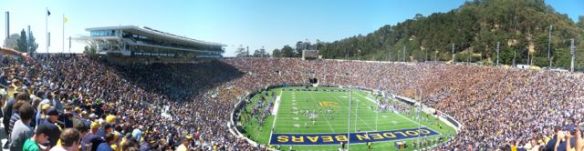
cal_memorial-16-panorama2_sm

Panorama from top of South End of California Memorial Stadium

Like many stadia built 80-100 years ago, CMS was a testament to classical form and simplified function. Slightly less than half of the oval seating bowl was built atop a hill on the east side. The other half was a concrete structure with arches and a single narrow concourse. All of the seats were wooden bleachers. A small press box was affixed at the top of the west side of the bowl. At one time 80,000 could be packed sardine-style into CMS.

Over the years CMS deteriorated noticeably, with huge cracks in the concrete and bleachers splintering everywhere. The stadium was situated directly on top of the Hayward fault line and the west half was not considered safe by modern seismic standards. Many calls were made to replace or refurbish the old girl, with nothing happening until the UC Board of Regents approved a $300+ million plan to rebuild the west side. The new half would contain three club areas, a new and wider general concourse, a large press box, and a training center for the athletic department that would be competitive with other major college sports programs.
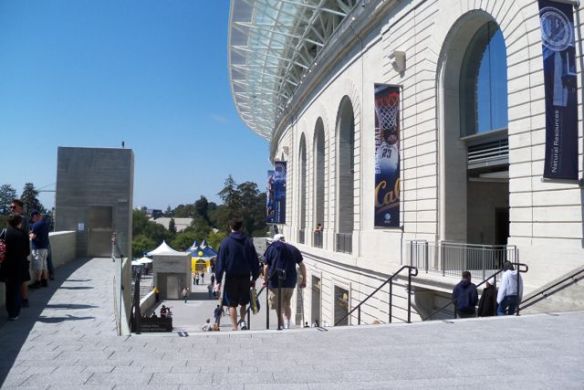
cal_memorial-23-stairs_down_southwest

Area outside West façade descends into additional public spaces, press box hanging above the bowl

The debate over whether the upgrades were worth it will continue for years to come, as Berkeley continues its internal struggle over academic priorities and costs to attend keep rising. What the fan is left with is a sense of history and legacy preserved, with modernity accentuating itself in specific areas.

The three level press box and club building is the big nod to the new landscape of college football, where everything is driven by intense media coverage and alumni with fat wallets. The building is a glass-and-steel structure, its frame forged and delivered in pieces and put together on top of the new concrete support structure that holds up the rest of the west bowl. There’s even a space beneath the press level where the camera positions are located that makes the building appear to float. Chicago’s Soldier Field renovation may come to mind, but the work done at CMS isn’t nearly as imposing or potentially upsetting.
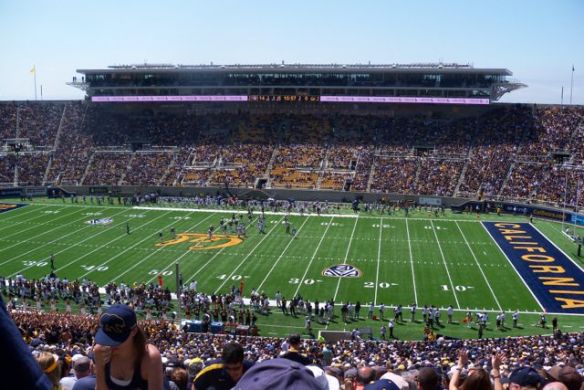
cal_memorial-13-student_side-wide

Press box “floating” above stadium bowl

What was once a single, dark concourse with water seemingly dripping from every crack and opening is now two: the swank lower club level (which I didn’t visit) and the regular concourse, which now lines up with the elevation at Gate 6. The result is that large areas were opened up, allowing natural light coming through the arches to flood the concourse. It also creates numerous scenic vistas of other parts of the campus and the Bay. As the morning fog receded, I was able to see all the way to San Francisco and the Golden Gate Bridge.

The main concourse is 30-45 feet wide depending on where you are. Concession stands alternate with much improved restrooms everywhere you look. Blue tiles of different shades mark the restroom locations, while the concession stands are adorned with names like “Oski’s Place” and “The Fault Line”. Oski is, of course, the beloved bear mascot at Cal, whereas “The Fault Line” playfully notes that it’s located right on the Hayward fault.

Walking through the concourse, it’s hard not to notice the many expansion joints dividing roughly 100-foot sections of the stadium. These joints and piston shocks will help absorb motion in the event of a major earthquake, with as much of six feet of travel allowed. Flexible conduits are located in areas with expansion joints, which should reduce the chances of data or electrical disruption. Concrete columns are spaced every 20 feet, giving an appearance that the structure is overbuilt.
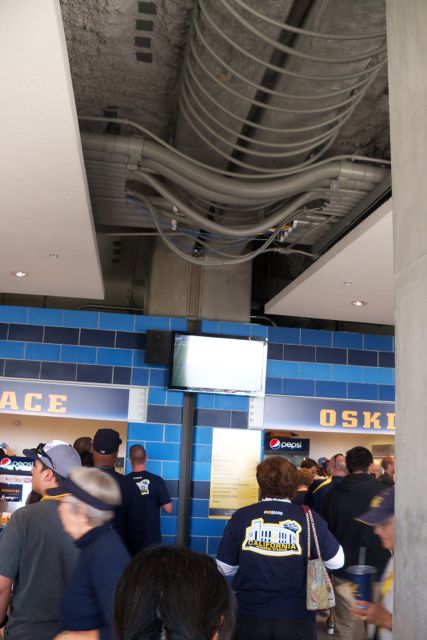
cal_memorial-18-expansion_joint2

Expansion joint with additional support for utilities

Lines for food were long towards the north and south ends of the stadium. Between the 20 yard lines the lines aren’t so bad. Crowds will figure that out by the end of the season. The fare was pretty standard, with a regular hot dog and a Saag’s polish on the menu. Prices were cheaper than at pro games, but noticeably more than at other college venues I’ve been to. Top Dog has three stands on the East upper rim, and those had 20 minute lines from the looks of it. The club most certainly has pricier options.

The only obvious change to the east bowl was the replacement gold aluminum bleachers, matching the rest of the stadium. Padded seat cushions with backs were available for rent. Down near the field where I sat, four rows were ripped out and replaced with ADA-compliant wheelchair locations. The old south tunnel is now just access to two ADA restrooms, from which security had a hard time shooing confused fans. The new Field Turf playing surface was also lowered four feet, which helps sight lines immensely. Way up above the field, Tightwad Hill is still there, with its spectators almost close enough to touch.

On the north side the tunnel remains intact, allowing for a pre-game procession through the campus into the stadium. A ceremonial ribbon-cutting ceremony was held, with Walter Haas III doing the honors in memory of his father, the much-loved former CEO of Levi Strauss, one-time owner of the A’s, and philanthropist whose name is emblazoned on Cal’s arena, a staircase at CMS, and the business school (which faces the north entrance Gates 1 & 2).
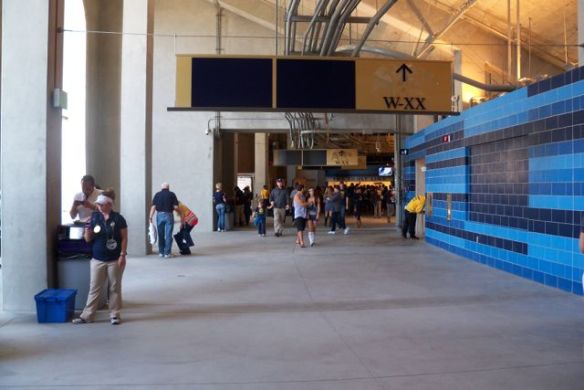
cal_memorial-20-concourse1

Much improved main concourse

Just about all of the flat areas of the Berkeley campus are packed with academic buildings, athletic facilities and other structures, making open space rather scarce. There was some question going into the planning and construction phases for CMS about whether or not there would be places for fans to mingle or even tailgate before games. Some effort has been made in this vein by creating plazas outside the arched façade with tents for additional concessions or grills. It’s not quite the same as tailgating, yet these are spaces that can find a purpose in the future.

All told, Cal and HNTB did a wonderful job of holding true to the idea of maintaining California Memorial Stadium’s architectural and structural integrity. There’s no telling if Cal will be a good football team anytime soon. Nevertheless, Memorial Stadium is a beautiful place to watch a game and a reminder of how stadia don’t have to be overly utilitarian. It’s worth a visit.

What is this?

Sometimes, when I’ve arrived early at the Coliseum, I’ll walk over to the Pak ‘n Save on Hegenberger to grab some beers for tailgating, or a water/soda and some snacks to take into the game. Inevitably, the walk usually involves walking past the portable football seats used for Raiders games. This area next to the B Lot is even more of a mess these days due to the construction of the Oakland Airport Connector, which runs parallel to Hegenberger as it terminates adjacent to the Coliseum/Airport BART station.

When I was walking back to the Coliseum, I noticed this thing that looks like a lifeguard stand or tennis umpire’s chair. It has male and female markings and arrows pointing is if to separate the sexes into two lines. What is this for, and what if anything does it have to do with Raiders games?

I don’t get it.

Update 1:20 PM – The stand is for ensuring that security lines are properly separated between men and women. Sounds like fun. Thanks to all who answered.

“Oakland Loves Its Sports Teams” Press Conference on 8/27

Post to the Save Oakland Sports Facebook page earlier tonight – The City of Oakland is putting on a press conference/rally in Frank Ogawa Plaza on Monday, August 27 at 11:00 AM. Here’s the description of the event:

Mayor Quan – joined by regional elected officials, business leaders and sports fans – will share details on the “Oakland Loves Its Sports Teams” Week.

The “Oakland Loves Its Sports Teams” Week will salute the Oakland A’s and Oakland Raiders for being irreplaceable civic treasures that add significantly to the economy, identity, pride and culture of Oakland, Alameda County and the entire East Bay region.

Gotta show the teams some love, especially when both have leases that run out after their respective 2013 seasons. The blurb is right about one thing: the teams are irreplaceable.

Note – It appears that I have been taken off the S.O.S. email chain. Perhaps they chose to close ranks.

Oakland, Raiders, NFL have their own secret meeting

The Trib’s Matthew Artz reports that Oakland had another secret meeting, this time with the NFL about a new Raiders stadium in the Coliseum complex. Unlike the MLB-Oakland meeting, team ownership was on hand in the form of Mark Davis. Not much was revealed about the nature of the meeting, though we can guess that the NFL wanted to know more about how the feasibility study is going. The Raiders have chosen to be the only team to sign on with the Coliseum City project, which the City is pushing as a second downtown, anchored by one or more sports franchises.

Coliseum City/Oakland Live!

Coliseum City/Oakland Live!

What I’d like to know is how much the City and the Raiders are on the same page. Mayor Jean Quan seems to be pushing for a stadium-cum-convention center, with the stadium part possibly having a retractable roof. Does Davis also want that, or does he simply want an outdoor football stadium? The latter would presumably be much simpler to accomplish. The former would be much more expensive and risky, though it sets up the possibility that there could be more revenue streams to help pay off the new complex.

The NFL is no stranger to this process, as anyone who’s followed the exhausting saga of the Minnesota Vikings can attest. They hold the purse strings, and while I’m doubtful that the league will hand Oakland a fat nine-figure investment for a second Bay Area stadium, the NFL and the Raiders are at least going about their due diligence. We won’t know anything substantial until the feasibility study is released, which probably won’t happen until the end of this year or after the football season.

Another thing I’m interested in is how Raider fans feel about the team playing inside a retractable dome. I’ve seen 4 NFL games in domes, including one at Cowboys Stadium while the roof was closed. Even if the roof is open, it doesn’t feel like an outdoor game. And being in an enclosed space doesn’t guarantee that the stadium will be noisier. Arrowhead Stadium is one of the loudest stadia in the NFL and it’s almost completely exposed to the elements. Raider crowds at the Coliseum are among the most boisterous in the country, and the “sealed” environment of a dome can sometimes sap that energy. At other times a dome can enhance crowd noise (New Orleans). It’s one of the many issues the Raiders and Raider fans will need to discuss going forward, as the team and the league have made it clear that the Coliseum as it stands is not a long-term solution.

P.S. – Artz mentions that the Coliseum complex is 750 acres. It’s actually 100 acres plus the Home Base and Malibu lots, pushing the publicly-owned stadium complex to more like 120 acres. 750 acres is the size of both “redevelopment zones” on either side of 880, including the Coliseum complex.

News for 8/10/12

We’re overdue for a news roundup. Now seems like a good time for one.

From BANG’s Joe Stiglich:

Last week’s visit to Oakland and San Jose by Bud Selig’s three-man panel foreshadowed this.

Update 1:04 PM – Stiglich has a writeup with quotes from Wolff, such as:

“It’s up to the commissioner’s office,” Wolff said. “… This is a process that unfortunately is taking longer than I hoped, but it’s a fair process.” 

Other news:

  • Janet Marie Smith, who oversaw the construction of Camden Yards and the renovation of Fenway Park, is moving out west to Los Angeles to take a similar role with the Dodgers. If her previous work is any indication, she will keep it classy all the way. [Dodgers press release]
  • NHL Commissioner Gary Bettman has set a deadline of September 15 to wrap up labor negotiations before the league imposes a lockout. The NHL and NHLPA are always playing catchup with the other leagues in terms of CBAs. They imposed a 57% player share in the last agreement as other leagues were dropping towards the 50% mark. Now the NHL wants to drop it to 46%. It’s going to be a long winter. [AP]
  • A developer is proposing a ballpark for the Tampa Bay Rays in the Gateway area of St. Petersburg, just over the bridge from Tampa. St. Pete’s stance has been to not allow the Rays to get out of their lease at Tropicana Field unless a new stadium were conceived in St. Pete, not Tampa. No financial details were available. [Tampa Tribune/Michael Sasso]
  • The 49ers and the City of Santa Clara settled a lawsuit with a County oversight board. $30 million in redevelopment money was at stake. In order to keep local school budgets balanced, the 49ers won’t get the $30 million for several years. Seems fair. [SJ Mercury News/Mike Rosenberg]
  • Get used to metal detectors at NFL games starting this season. [Oakland Raiders]
  • Speaking of the Raiders, they are using the league’s new 85% measure to determine sellouts this season. The way it works, a team has to sell out 85% of its non-premium seats by the usual deadline (normally Thursday for a Sunday game) in order for a game not to be subject to a blackout. The catch is that any tickets sold between the 85% and 100% marks are subject to higher revenue sharing. Teams like the Raiders and Bucs chose to use the new standard, the Bills and Jags went with the old standard, which required all non-premium seats to be sold by the deadline.
  • The City of Industry approved a deal to buy 600 acres within city limits for up to $26.7 million. The land is where the somewhat-forgotten Ed Roski/Majestic Realty stadium would be located. The parties still have to scramble to find a proper replacement for now-evaporated redevelopment funding. [Inland Valley Daily Bulletin/Ben Baeder]
  • MLB’s postseason schedule has been released (knock on wood). [Biz of Baseball/Maury Brown]

More if it comes.

You’ve got to be kidding me, Santa Clara

From the Department of Absurdity…

It appears that the only way to get a football stadium built in California is with some legislative help.

According to the LA Times, Senator Elaine Alquist (D-Santa Clara) is set to gut an existing education bill and replace it with language that would provide the 49ers stadium project with the $30 million in redevelopment funds that are currently in dispute. Apparently the City and team are nervous enough that they can’t wait for the hearing, which starts tomorrow in the Capitol.

As the article notes, both LA stadium projects used legislative muscle to make the process easier. I suppose the good news is that at least in Oakland, replacing one football stadium with another should make any stadium proposal go more smoothly, and without these procedural gymnastics.

Not every idea is a good one

Over the weekend, the Santa Rosa Press Democrat’s sports columnist Lowell Cohn entertained a concept for privately-financed stadia at the Coliseum for both the A’s and Raiders. Put together by Sacramento developer Rick Tripp, the plan is neither new nor novel. In fact, we’ve heard it here several years ago, when the Lew Wolff trying to build a ballpark first north of the Coliseum and later in Fremont. The venue(s) would be paid for by a combination of surrounding area development entitlements and stadium revenues such as naming rights and concessions. During the housing bubble in 2005, it sounded like a decent plan since it wouldn’t have required a bond issue or  new taxes on Fremont’s or Oakland’s part. Of course, once that bubble burst, such a plan was no longer feasible.

Tripp revives that plan and adds a wrinkle in that “unconventional” sources such as real estate brokerage fees are also used. Tripp admits that he hasn’t lined up all of the necessary money, some of which could come from Middle East financiers. He has also pitched his plan unsuccessfully twice – first in San Diego for the Chargers, then in his hometown, Sacramento, for the Kings’ railyards arena. In both cases, his respective bids were rejected. No explanation is given as to why, but I have a few guesses as to why which I’ll get to in a minute.

Before that analysis, first let me turn your attention to a small article which also surfaced over the weekend. The Arizona Diamondbacks are pushing to have ownership of Chase Field changed from one public entity (Maricopa County) to another (City of Phoenix). The point? To allow the D-backs to exert more control over Chase Field’s revenue streams, which are currently somewhat split between the team and Maricopa County. The team pays $4 million per year in rent and maintenance costs, a decent amount compared to other leases throughout baseball. No new money is being raised by virtue of the D-backs’ proposal, and it might net the team a few more million per year. That’s enough to make the request worthwhile. It’s of utmost importance to team ownership that it gain control over as much of its local revenue stream as possible.

It’s in that light that if you read Tripp Development’s San Diego stadium proposal that you can see why it didn’t pass muster. The plan, which included a $900 million NFL stadium and a $400 million arena, would charge $15 million per year to the Chargers and $10 million per year to a relocated NBA team. Given the somewhat similar cost between a ballpark and an arena, let’s suppose that the A’s would lease a new ballpark from Tripp for $10-12 million a year. That’s three times as much as the D-backs, a team that is at best a mid-market franchise and is trying to scrape up every bit of revenue it can. Worse, the terms have the A’s (or Raiders) with precious little control of stadium revenue except for games. While it sounds nice that the A’s would get a “free stadium”, their inability to control revenue streams would leave them only marginally better than they are now, especially in years when attendance isn’t impressive. It’s a deal that, if presented to either Lew Wolff or Mark Davis, would be politely declined by both. It’s not something that would be approved by either the NFL or MLB. Similar lease terms helped allow the Seattle Supersonics to leave the Emerald City, and they’re making it easy for the Warriors to look across the Bay towards San Francisco – even though the price tage for a new arena will be huge.

Now, that isn’t to say that Tripp’s concept is bad. If you’re an Oakland-only partisan or someone who doesn’t scratch the surface like Cohn, it might sound great. And at least Tripp is being fairly transparent about the substance of the deal, whereas we have few clues about Oakland Mayor Jean Quan’s Coliseum City plan other than federal transit money or the exotic EB-5 visa program (neither of which will provide much money to build any stadia). The problem is that so much revenue has to go towards paying off the project that it severely limits the amount that can go to the tenant teams. That puts the teams at a handicap relative to their division and league competitors. Both owners and the leagues are going to agree to deals that give them the highest levels of revenue and control. A large mortgage for the A’s is somewhat mitigated by the fact that it can be deducted against revenue sharing. Any deal that doesn’t give the team revenue control is inferior, even if a high-revenue/control deal means creating greater risk (see: 49ers).

Moreover, while the plan doesn’t say redevelopment explicitly, it’s effectively a redevelopment plan when it talks about entitlements. That may be the most risky thing of all. Tripp and his investors probably have a target in terms of real estate sales and fees associated with those sales that will help pay back the debt ($90-100 million per year if separate football and baseball stadia are built). If they don’t hit those targets because of an Oakland real estate market that trails the rest of the Bay Area, what does it mean for the teams? Investors want to counterbalance risk with return and protection if possible. With limited government help, the risk may be excessive. Remember that former New Jersey Nets owner Bruce Ratner faced several delays in trying to move the team to Brooklyn, which eventually forced him to sell the team and the development to Russian billionaire tycoon Mikhail Prokhorov. Bailout guys like Prokhorov don’t grow on trees.

Tripp’s plan is the first of many such proposals for Coliseum City, and he admits that he’ll know if it’s workable in 18 months, around the time several studies regarding Coliseum City are due. If nothing else, his proposal should stimulate discussion within Oakland about how Coliseum City can get accomplished – not just to keep the teams in place, but to allow them to thrive. For any team to stay in Oakland the financial terms need to make the teams more than merely competitive. As long as the teams face revenue limitations from any proposal, they’ll keep looking for better deals elsewhere. That said, if Tripp is able to successfully get commitments from one or both teams, he’ll deserve extreme kudos. Third time would be the charm, I guess.

News for 7/4/12

Stuff to read while you’re getting the BBQ going.

  • Late Tuesday, the 49ers successfully fought to keep $30 million in redevelopment funds out of the County’s hands until at least July 27, when another hearing will be held to determine the fate of the money. While the team was lawyered up, the County’s oversight board had no legal representation for the hearing in Sacramento. The issue is whether or not the $30 million (originally $42 million) at stake is considered an “enforceable obligation” between the 49ers and the City of Santa Clara. If it is ruled an enforceable obligation, the money should be safe to use for the stadium. [San Jose Mercury News/Mike Rosenberg & Steve Harmon]
  • AEG pulled out of a plan to help build and run a new Sacramento arena without the Kings as a tenant, effectively killing the plan outright. The next move is the Maloofs’, as they could apply to move from Sacramento before the end of the 2012-13 season (which is entirely expected). Will Mayor Kevin Johnson concede defeat and push for a different initiative, such as a stadium? Perhaps, but the teams that KJ would be interested in (A’s, Raiders) would have to show their own interest. So far they haven’t. [Sacramento Bee/Ryan Lillis]
  • Oakland’s Uptown was profiled in an All Things Considered segment as a positive example of how redevelopment can revitalize a neighborhood, while the death of redevelopment could halt further progress. [NPR/Richard Gonzales]
  • Another article from the Chronicle takes a stab at figuring out what will happen to Oakland’s three pro sports franchises. As usual, Mayor Jean Quan lacks specifics, instead using grandiose phrases such as “Staples on Steroids” to describe the Coliseum City project. She also seems to be gravitating further towards a retractable dome concept-cum-convention center, which new partner AEG would certainly champion. Careful hitching your horses to the AEG wagon, Madam Mayor. As we saw in Sacramento, AEG will ditch a city posthaste if they see no future there. Plus, all of the secrecy behind Quan’s supposed “secret committee” working on Coliseum City doesn’t help when it comes to taking her seriously, as she recently took a huge hit to her credibility with new data released about her “100 blocks” policing plan. [SFGate/Vittorio Tafur, Matthai Kuruvila]
  • Cities are looking for ways to resurrect redevelopment, and one popular one emerging is the establishment of revitalization zones via state legislation. The zones would have similar tax increment and bonding powers as redevelopment agencies did, plus they would be enshrined by state law. SF Assemblyman Tom Ammiano is pushing for the creation of an infrastructure financing district to serve the America’s Cup development along the waterfront. The problem with this method is that eventually any law passed by the Legislature still has to go to Governor Jerry Brown for approval. Brown has been steadfast in opposing any kind of old-school-style redevelopment for the past year, making it hard to see him signing any legislation that could undermine his redevelopment clawback efforts. [Sacramento Bee/Dan Walters]
  • Added 4:30 PM – Today’s the halfway point of the home schedule. Because the first two home games were played in Japan, the Attendance Watch box on the right has shown multiple representations of attendance, one with the Japan games included and one without. Projected over the rest of the season, the total 81-game attendance (with Japan) would be 1,733,521. The total 79-game attendance (without Japan) would be 1,599,938. ESPN and other statistics aggregators usually include the Japan games in their attendance tables. Based on games sold, the A’s consider today’s game #39. Attendance tends to pick up throughout July and into August, just before the school year begins, then drops off, the variance depending largely on the team’s record. At this juncture, three teams already have surpassed the A’s projected season attendance (both figures): Philadelphia, Texas, and the NY Yankees.

More as it comes.

Goodell LA memo: League has leverage, not teams or cities

We now have terms for how a NFL franchise could land in Los Angeles, thanks to a Roger Goodell memo revealed by the LA Times’ Sam Farmer. The memo went out to all 32 teams, a handful of whom could be relocation candidates: Rams, Raiders, Chargers,  Jaguars, Bills. Bullet points are fairly straightforward:

  • The NFL and the owners as a collective decide which team(s) relocate. No team is going to unilaterally decide to move. This makes sense because the NFL holds the purse strings for up to $1 billion of the stadium project (based on where it’s located).
  • While the league acknowledged the AEG’s Farmers Field and Ed Roski’s City of Industry concepts as potential stadium sites, Goodell left open the possibility of other sites. Recently, Dodger Stadium re-emerged as a potential site.
  • The NFL prefers two teams in LA and will require a new stadium to have space to host a second team.
  • Expansion to a 34-team league is not currently in the cards, which means that in all likelihood, the first team to be in LA will be a relocated franchise.
  • Franchises interested in relocation will have from January 1 to February 15, 2013 to apply for relocation.
  • A team like the Raiders would have to have to explain why it would make more sense to move to LA instead of sharing a stadium with the 49ers.
  • All avenues to get a venue in a team’s existing marketed would have to be explored/exhausted.
  • Arrangements would have to be made in advance for an interim venue while the new stadium is under construction.
  • Any franchise relocation would require a 3/4 approval of the 32 owners.

It’s a fairly clearcut process, and for the teams that may be involved, as fair as it can get. The Rams could be considered in the lead due to the state of their negotiations with St. Louis. The Bills have a $200 million refurbishment deal on the table that the NFL would prefer over relocation. The Jags aren’t going anywhere for at least a year or two while new ownership is still in its honeymoon period. The Raiders are working with Oakland/Alameda County at the moment, whereas the Chargers have failed at every turn to get something done in San Diego. The approval process will extend well beyond the six-week period, but it’s somewhat poetic that the applications will occur at the same time as the playoffs: the futures of the applying franchises will be at stake.

49ers get restraining order for $30 million transfer, hearing on 6/3

A Sacramento judge has given the 49ers a temporary restraining order, preventing Santa Clara County from doing anything with the $30 million of redevelopment funds that remains in dispute. Furthermore, a hearing to determine what to do with the funds will be held on Tuesday.

It strikes me as strange that the State Controller is involved in many of these disputes, figuring out who gets what and when. In this case, it’s going straight to the courts, with little or no Controller involvement. If it sounds like there are no clear rules, you’re probably right.