Dead-market team

If you haven’t seen it yet, make sure you read USA Today baseball writer Jorge Ortiz’s team capsule of the A’s. And I mean read all of it. There are some choice quotes from Billy Beane, like this one on trading Cahill/Gio/Bailey:

“We’re not doing it to be mean,” says Beane, aware of the trades’ impact on the team and its shrinking fan base. “It’s not like I come into this office like I just jumped off the stage of Wicked with a green-painted face and go, ‘How can I trade my guys?’ We do it because we have no other choice.”

Cue someone in the RF bleachers pasting a giant, green-tinted, smiling Beane face on Elphaba. Or maybe Brad Pitt’s face? It’s hard to tell them apart these days.

Then there’s ESPN Magazine cover boy Brandon McCarthy, who may have displayed a little too much of his trademark candor when he said this about how the A’s operate:

“It makes team-building and the competitive aspect that much harder here,” says right-hander Brandon McCarthy, the A’s likely opening-day starter. “It’s not even being a small-market team. It’s being a dead-market team.”

Merde.

Later in the article, Wolff provides two crucial pieces of information that I had not known previously.

  • Moving the team to San Jose should increase revenue $80-100 million annually.
  • The TV rights deal with CSN California runs 25 years with an opt-out at 15 (2024).

In last October’s post titled “$230,000,000“, I attempted to estimate what the A’s revenue model could look like if they moved into Cisco Field in 2015. I figured it would be $64 million more than they get currently. Clearly, Lew Wolff is aiming higher, though he may be using a lower 2010-11 revenue estimate of $150 million or thereabouts to make the comparison (which would fall in line with a +80 million target). In any case, he and the rest of the business side seem to have a pretty good idea of where they’re going.

The A’s TV rights deal with Comcast, which unlike most other recently negotiated team TV deals, did not have its numbers or length revealed, is of similar length to others negotiated by the Rangers, Angels, Astros, and Mariners. I hope the deal isn’t a flat, non-escalating deal, because if it is the A’s will surely be forgoing revenue during what should be considered their competitive window from 2015 through 2020 and beyond. The flipside of that is that at least it’s comforting to know that the A’s are locked in somewhere for at least 15 years. That’s a lot of time to build brand equity, and it’s a damn sight better than the broadcast musical chairs the A’s had to deal with during the pre-cable days.

Comparison of current and future AL West TV rights contracts

I had theorized that the A’s were getting $15 million per year via their cable deal, though I’ve been too lazy to actually verify this. Based on the actual revenue the A’s report or the Forbes reported figures, I can’t see how it’d be much higher than $20 million. Either number is a pittance compared to what the division foes are getting, and will be even less competitive once the M’s negotiate a new deal in the near future. While the A’s can’t control what other teams get and appear to be locked in with CSNCA, they should at the very least have the opportunity to get the $80-100 million Wolff claims he can get via a new ballpark. Because if he can’t, Brandon McCarthy will be more correct than anyone would’ve had the temerity to suggest. For all intents and purposes, the A’s will be in a dead market. Or as he said towards the end of the article:

“It’s a major issue,” says McCarthy, who also has pitched for the Rangers and Chicago White Sox. “I think it’s one of those things that’s crippling this franchise. I’ve never seen anything like this where something like that could just become the rolling avalanche of things not being the way they should. A decision has to come.”

No fan wants to hear this type of thing, whether they’re in Oakland, San Jose, or Springfield. It belies the optimism that spring should bring. But whether you believe McCarthy is simply regurgitating the team line or he’s a blunt, independent thinker as he’s repeatedly shown, he’s right. Something needs to happen. Hopefully McCarthy will stay healthy enough to get a nice payday next year, even if it isn’t with the A’s.

P.S. – McCarthy and Dallas Braden were interviewed by The Rise Guys this morning. Good audio.

Cespedes and a new ballpark

For Billy Beane, 30 is apparently the magic number.

Jason Giambi left the A’s for the Yankees after his 30th birthday as a highly prized free agent.

Miguel Tejada was not offered a potentially “insulting” deal when his arbitration years were up, allowing him to switch coasts to Baltimore. When he took the field in an Orioles uniform for the first time, he was a month shy of 30.

Assuming that Yoenis Cespedes stays with the A’s for all four years of his newly inked $36 million deal, he will be 30 years old when he becomes a free agent after the 2015 season.

With Lew Wolff’s admission that a 2016 Cisco Field opening is more likely than 2015 given the delays and necessary steps remaining, that puts Cespedes quite possibly gone from the A’s when the time comes. Or does it?

It’s really all a matter of value. If Cespedes really is the “Willie Mays of Cuba” then two things are possible. Either he’ll be too expensive to keep and he’ll be signed by a big market team to a huge deal (Pujols, Fielder), or he’ll be a strategic signing by Beane to have a marquee talent on hand for a new ballpark opening. Keep in mind that the San Jose ballpark is practically guaranteed to be more hitter-friendly than the Coliseum.

I figure that if the A’s can sign Cespedes and keep payroll below $100 million in 2016, they’ll do it if he’s performing. By that point Michael Choice should be in his arb years, as will Grant Green and most of the new young pitching talent the team has waiting in the wings. For a guide to how this might play out, look at how the Twins’ and Marlins’ payroll decisions are progressing. Both teams have committed well above $90 million before the low service time guys are signed. As cheap as many fans think the Wolff/Fisher ownership has been, ask yourself this: Are they cheaper than Jeff Loria or the late Carl Pohlad? Or Mike Ilitch during the Tiger Stadium years?

Right now 2015-16 seems so far away that’s it feels silly to project in this manner, especially the way Beane can trade guys at the drop of a hat. But we know that’s what the front office has to do, whether Cisco Field opens in 2015, 2016, or not at all. As long as we’ve stolen a slugger with real potential out from under many far richer teams, I’m taking the little victories whatever way I can get them.

Strategery

The architectural firm HKS has some wins to crow about. The Dallas-based company designed Lucas Oil Stadium and Cowboys Stadium, hosts for the last two Super Bowls. Now they’re backing two Hail Mary attempts for the Bay Area NFL teams. A month ago an SFGate report had San Francisco planning commissioner Mike Antonini working with HKS and an unnamed investment company on a last ditch attempt to convince Jed York to keep the team in San Francisco. Today, Matier and Ross report that HKS has signed on to put together the Coliseum City plan with the hopes of keeping one or all of Oakland’s franchises in place.

To get the project going, Oakland is getting ready to authorize $3 million for a series of studies that will have to done on the entire Coliseum area, not just the complex. I wrote about this in detail last December. HKS won the winning bid, in conjunction with Oakland-based JRDV and Forest City, to master plan 750 acres of land on both sides the Nimitz. The project is split into two areas: Area 1 (Coliseum complex, BART, and surroundings) and Area 2 (nearly everything west of 880 to the airport). Knowing how much money goes into these types of studies, they’ll need every penny of that $3 million to complete the work.

Coliseum City/Oakland Live!

Based on the previous work these firms have done, I figure the responsibilities will be divided along these lines:

  • HKS – Design for the iconic stadium(s) and hotel
  • JRDV – Master planning and integration
  • Forest City Enterprises – Actual development

All of these pieces are important. HKS will work on the anchors for the project, and they have potential access to investment groups should things move along. So does Forest City, but their aims are lower since they’re focusing on ancillary commercial spaces that will have to be sold and/or leased to other tenants. JRDV provides the framework and the glue. Their responsibility is to make it work with Coliseum BART, figure out how to backfill parking that will be lost to construction, and make the whole thing look attractive. Their local portfolio is extensive, including plans for Uptown around the Fox Theater and San Jose’s San Pedro Square Market. Nothing JRDV has done in the US is as large as what’s being proposed for the Coliseum area, making this new project a special challenge.

As I wrote two months ago, this process is expected to be deliberate. Anyone expecting a new Coliseum complex to rise like it was being built in Shanghai is due for disappointment. The RFP lays out the time commitments the winning bidder will have to make to get through the entirety of the project:

  • 25 project meetings with city staff
  • 8 community workshops
  • 12 public meetings with the Planning Commission and City Council

The Coliseum area has an advantage in that it shouldn’t need a new EIR for a replacement or refurbished arena or a replacement football/baseball stadium since those uses are already in place. New EIRs will be needed for any other new construction. That would include:

  • A third sports venue, such as a baseball stadium alongside a football stadium
  • High-rise hotel
  • Commercial development, including office towers or a mall

In addition, the entire plan will need its own EIR. It’s all about impact, and if you introduce new elements such as the visual impact of a high-rise hotel or additional commercial traffic not associated with Coliseum events, it all needs to be studied. Likewise, a third venue will have to be studied simply because of the possibility that events could be held in the arena, ballpark, and football stadium simultaneously. That’s a lot of people and a lot of cars. There will have to be plans to figure out where all of these people will park since much of currently undeveloped Coliseum complex land will be claimed for future development. Lastly, there will need to be alternatives to show what impacts would occur if some of these concepts don’t come to fruition.

This is how big things get built in California. There’s a very good chance that none of it will ever get built. Oakland and Alameda County will have to be in lockstep to make this happen, and their collective resources are extremely limited. It’s telling that Oakland is footing the bill for this but Alameda County is not. They’ll need more resources to execute this plan to any successful completion. If they aren’t get on the same page, it’ll be Oakland’s $3 million down the drain.

Nothing from nothing

First, a hat tip to two great legends who left the world much too soon.

If you haven’t done it already, read Nina Thorsen’s KQED interview with the Trib’s Oakland reporter Angela Woodall. Then read Ray Ratto quick opinion piece at CSN Bay Area.

Then sit back and consider what happened. If you’re struggling to come up with anything to describe it, you’re not alone. Because nothing actually happened. No forward progress, all spin, posturing, and gesticulation. Oakland fakes like it’s doing something, then shrugs its shoulders when nothing happens. MLB says nothing and does roughly the same. San Jose tries to do something and is blocked by MLB and the Giants.

I’m going to follow the Coliseum City project because it’s my duty. As long as the City of Oakland and Alameda County make plans for it to any degree, it’s worth covering. I don’t think it has legs. I’ll explain why:

  • Unless there’s a public financing component, a Coliseum ballpark will have a very difficult time paying for itself.
  • MLB wanted a downtown, waterfront site for an A’s ballpark. The Coliseum fits neither criteria.
  • The “City” part of Coliseum City will require its own large public investment. It is by design its own redevelopment district. Oakland will try to leverage existing and future TOD (transit oriented development) grants to help developers, but it’s a pittance compared to the overal cost (<5%). For instance, a 4-star, 800-room, full service hotel would cost $160 million to build, based on a $200k per room construction cost. That leaves out the other retail and commercial development costs. How much of that will the city/county have to subsidize to lure a developer?
  • The Raiders appear to be entirely site-agnostic in their search for a new stadium.
  • The chance that the NFL will award two $150 million G-4 loans to the Bay Area teams instead of spreading the love around to LA, Buffalo, and Minnesota is slim at best.
  • The Warriors are going to play Oakland and San Francisco off each other to get the best possible deal.

With so much uncertainty and so many variables, who is going to take the lead and make that heavy first investment? Private developers won’t do it unless the teams are committed first as the anchors. Teams won’t do it unless they can get something to help them pay for their new venues or give them revenue down the line. That’s the very least they should get considering the amount of construction upheaval that the project would create. The city and county can only act as facilitators. They don’t have the money to shoulder much of the development cost.

Ratto indicates that Oakland is actually playing for the Warriors and Raiders at this point, with the A’s practically out the door. That’s pretty much what I’ve been saying for years. Sadly, Oakland would be best served trying to make the best play possible for only one of its tenants. Otherwise, it might half-ass the efforts for both. Based on what we’ve seen coming out of Oakland so far, it’s quite good at half-assing. Or in the A’s case, no-assing.

Official: Victory Court is dead

And that’s how the drive for a downtown Oakland ballpark ends – with a whimper.

vc-f

Yet another dream dies.

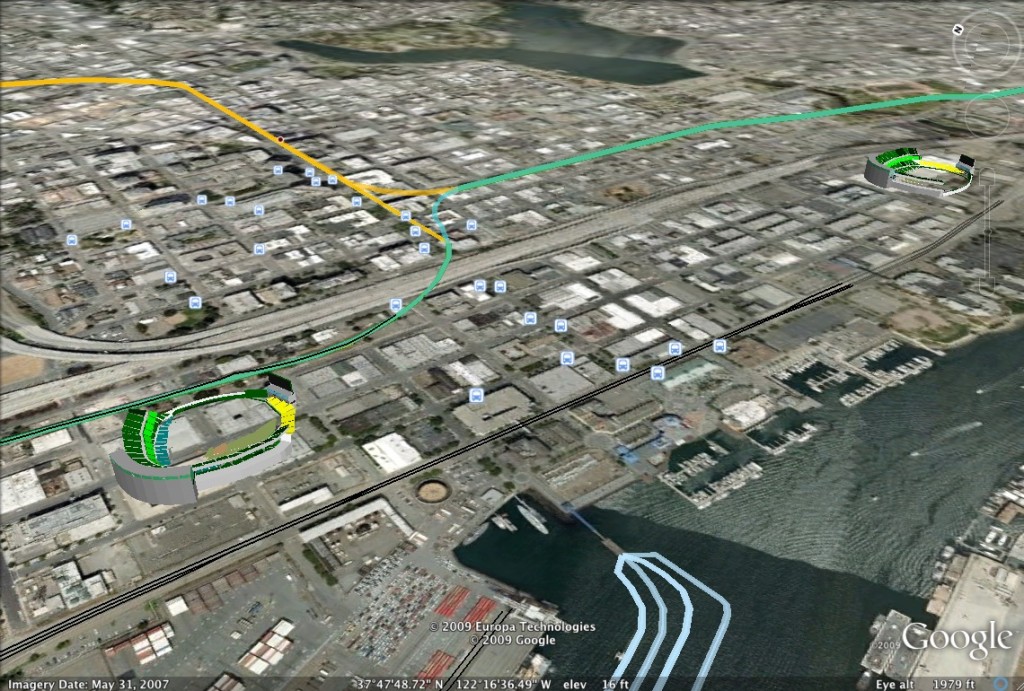
The Trib’s Angela Woodall reports that as a result of redevelopment cuts, the Victory Court ballpark site is now officially dead. We called it before the New Year, so it’s no surprise. But wait, weren’t there two sites near Jack London Square?

oak-aerial-1024x691

Left: JLS North. Right: Victory Court

JLS North was dropped quickly. Perhaps it was too expensive to acquire. Or maybe there weren’t enough business interests pushing for the site. Whatever the reasoning was, it wasn’t disclosed. Now Victory Court has also gone quietly into the night with little explanation by those who pushed for it.

Let’s step back through memory lane on Victory Court. Our time writing about it, your time reading about it, gone forever:

I guess it’s Coliseum City or bust. Or something.

At FanFest

I’m in, credentialed and good to go. Line wrapped from the arena entrance down through the north VIP parking lot. Gates opened at 10 sharp. I’m heading to the clubhouse tour right now. At 11 I’ll meet folks inside the entrance and to the right, where the Warriors inside ticket booth is.

20120129-101407.jpg

Update 12:50 – The retired player panel (Rudi, Tenace, Blue, Hatteberg, Justice) fielded a question about a move to San Jose. Many boos rained down. Rudi spoke up, saying that the Coliseum was ruined by the return of football (followed by applause) and a plea that the A’s need a ballpark, whether it’s in Oakland or not. Very diplomatic answer.

20120129-154156.jpg

20120129-154303.jpg

20120129-175320.jpg

Forbes loves the Warriors

As part of Forbes’ annual analysis of the NBA, staff writer Tom Van Riper put out a piece on our hometown heroes, the Golden State Warriors. Much of the info in the article has been dealt with elsewhere, such as the differences between Chris Cohan and the Joe Lacob/Peter Guber ownership group, or the latter’s interest in a new arena in San Francisco. More interesting and revealing is this tidbit about the new TV deal negotiated between the Warriors and Comcast:

That agreement paid the Warriors approximately $50 million up front—enough to take the sting off the purchase price—and roughly tripled the annual rights fee to over $25 million from $9 million. The agreement is for 18 years, with provisions to periodically renegotiate along the way.

Indeed, the $50 million probably did help pay down debt associated with the franchise purchase. Plus they didn’t take too much upfront, as $25 million per year is a healthy amount for an NBA team – though far less than the $150 million per year the Lakers are getting. No matter how bad the team gets (and they’re still bad despite a new coach this year), the Warriors remain an attendance and ratings bonanza. So hats off to Lacob and Guber for working the numbers. The TV deal runs well past the end of the new CBA, though it’s likely the team will option out and negotiate a new one before the decade is out.

When it comes to building a new arena, the obstacles are clear. It’s hard to build in this state. It costs 20% more to build than in most other markets. There is no redevelopment money available, let alone other public funds. The Bay Area won’t approve a stadium or arena tax. Yet it’s clear that ownership sees the gleaming lights of SF and wants to turn them into dollar signs. The only issue is the cost of a new arena, which Forbes pegs at up to $1 billion. That may be true, especially if the arena can’t open earlier than 2018. I think that $1 billion is the line of demarcation. Anything under that it and it would be worthwhile to invest in arena. Above that and it’s prohibitively expensive.

The actual raw cost to build at Mission Bay shouldn’t be more than $750 million even in 2017. Material and labor costs shouldn’t rise that high. The additional cost would be to furnish the arena, which would be co-owned and operated with the Giants, Burdened by a high construction cost (mortgage), both parties would be motivated to sell the arena for every kind of event from tiny to large, so the club areas, suites, and auxiliary spaces would be decked out to a degree never before seen in the Bay Area. And it’s likely that given the locale, the teams would attract a third party interested in fronting some of the construction cost in order to secure the operations contract for the venue. That could be AEG, Global Spectrum (a Comcast subsidiary), or even the Sharks, who operate HP Pavilion.

Right now the Warriors are a mere renter at Oracle Arena, and not for cheap at $4.7 million per year and little access to non-game revenues. They don’t have a say on who runs the arena, which has led to allegations that SMG didn’t try very hard to bring in events. Last summer, AEG and Live Nation were set to bid on the next deal to run Oracle Arena. Can’t exactly blame Lacob and Guber for trying to maximize their investment, though building in SF as opposed to staying in and improving Oracle Arena could prove a more cost-effective decision in the long run.

A perfect spot for a new arena is Lot C near AT&T Park.

As the Warriors reach the end of their contract, SF and Oakland will be “forced” into a bidding war for the W’s. SF and the Giants will be ready with an infrastructure/development rights deal, probably at Lot C on the other side of Mission Creek. The lot measures 400′ x 514′ not including sidewalks, which should be enough for a typical roundrect or oval arena, though not wide enough for the circular bowl layouts utilized at Oracle Arena or Staples Center. (HP Pavilion is roughly 440′ square). If Lot C were used, only 800 parking spaces would be lost, which would be easily replaced by a garage and ancillary development on Lot A. Lot C has a T-Third stop right outside it, plus Caltrain is only a few blocks away.

Oakland and Alameda County’s pitch lies squarely in the Coliseum City concept. By the time the cities get to brass tacks, we should know where the A’s and Raiders will be playing in 2014 and beyond. The A’s have a long-term play, the Raiders have both short and long-term scenarios. If both teams were to sign onto Coliseum City, it’d be very easy for the Warriors to partner up with everyone else. If the A’s and Raiders are headed elsewhere, it would be difficult to convince W’s ownership to shoulder the load for Coliseum City, especially if a compelling offer were coming from across the bay. I’ve advocated in the past for a downtown Oakland arena or one at Victory Court, but the cost to make that happen would probably be higher than the already city-owned lots in SF, so that’s not happening.

All the while, David Stern (or his replacement) would be pumping up the “need” for the Warriors, just as he’s done in practically every other city. The Cohan-era Warriors were analogous to the Autry-era Angels, in that they were generally undervalued and have great potential. Lacob and Guber intend to make good on the potential, preferably both on and off-court, though they’ll settle for off-court at least in the near term. If that path leads across a shiny new east span of the Bay Bridge, so be it. At least they don’t have territorial rights standing in their way.

“We were in denial”

Last night I caught much of the Oakland City Council/Redevelopment Agency special session, which was held to discuss the impending shutdown of ORA and CEDA, the City’s economic development arm. Plenty of angry citizens and city employees were on hand to voice their displeasure with the 105 layoffs and cutbacks to numerous programs and nonprofits. It was an alternately sad and angry meeting, and the presence of Occupy Oakland protestors didn’t help advance the discourse.

The Council passed a resolution in support of SB 659 (Padilla), a bill requesting a two month “stay of execution” of RDAs. It appears to be symbolic, as numerous legislators have said that it’s unlikely that the bill will make it out of committee and Governor Brown would reject it if it ever landed on his desk.

Of the Mayor and City Council, only Councilmember Libby Schaaf actually pegged the situation down cold. She said that the City Council was in denial about the future of redevelopment. Mayor Jean Quan tried to deflect any criticism early on by saying that the City had set aside the $40 million “ransom” payment and was planning to move forward with reduced scope redevelopment, as many other cities and counties were. Quan also mentioned that the City had heard in November (probably around the time of the oral arguments) that there was a possibility that RDAs throughout the state would be shuttered. Puzzlingly, the Mayor and Council did not make any contingency plans at that point or at any other time through the end of the year.

Worse, Quan has had limited discussions with the public employees unions about the impact. Today on KQED’s Forum, host Michael Krasny asked about those limited and belated discussions. Quan replied that she made a call to a union rep the night the Supreme Court’s decision to shutter RDAs was handed down, plus one meeting last Saturday and one other meeting between City Administrator Deanna Santana and SEIU on the 9th. That’s it. Things really got testy at the session when Councilmember Nancy Nadel asked Santana if she would be willing to take a paycut from her $278,000 salary. Santana didn’t answer directly and said she’d have to consult her attorney. To the City’s credit, they already done 10% across the board cuts in the last budget cycle. Unfortunately, that didn’t take into account the redevelopment shutdown. Now, just as last year, the City is looking at three different budget scenarios and will vote on one to put forward including redevelopment shutdown-related impacts. It’s also in a special kind of flux as it has 450 redevelopment projects that it is waiting for the State to determine whether some or all of them can move forward.

Callers on Forum echoed many of the sentiments of commenters at the session last night. The City was late to react, took things for granted, had their heads in the sand, etc. And that’s where it gets me. There is a clear pattern of behavior here. On three very disparate issues: Occupy Oakland, the budget post-redevelopment, and the state of the sports franchises, the City has routinely and consistently been late to react and lacking in its planning efforts. It has also waffled on occasion, something directly related to confusion that comes from the lack of planning. That is simply pathetic. Oakland needs clearer, more focused leadership now more than ever. Its residents deserve that. Forget the sports franchises for a moment. There are life and death, real quality-of-life issues at stake here. Hiding and not having an ongoing dialogue with your employees and constituents is thoroughly inexcusable.

During the radio interview, Quan was quick to mention Oakland’s place on the NY Times’ 2012 45 Places to Go list. Which is great, one of the mayor’s jobs is to sell the city every chance she gets. At no time during that hour or during the session last night did the fates of the sports franchises come up. No surprise there. When people say that Oakland has more important things to do than worry about pro sports, there is substance to that argument. That’s not a sign of weakness. That’s an acknowledgement of reality.

P.S. San Jose voted Tuesday to shutter its own redevelopment agency. The lion’s share of cuts that needed to be made were done six months ago.

More FanFest info

Today I and a half-dozen other bloggers got our info package via email from A’s Media Relations and Broadcasting coordinator Adam Loberstein. We’ll have the 1 PM hour dedicated a press conference with several A’s players and prospects. Here’s the schedule for FanFest on Sunday, January 29:

1:00 p.m.          Blogger/Interview Room Opens

1:15-1:30 p.m.   A’s Manager Bob Melvin

1:30-1:45 p.m.   Shortstop Cliff Pennington and pitcher Brandon McCarthy

1:45-2:00 p.m.   Outfielders Josh Reddick and Seth Smith

Smith replaced pitcher Brad Peacock. Maybe I’ll ask the OFs which one will kneecap the other first to get more PAs (I keed!). Because of this part of the event, I’d like to put the meetup between 11 and noon, inside the East entrance to Oracle Arena. I will be arriving at 9 to set up early and get a feel for the event. Plus, as BANG’s Joe Stiglich notes, Lew Wolff will be around from 9 to 10:30 throughout the event to answer fan questions via one-on-ones. Sign ups will occur from 9 to 10:30. Now that should be interesting, and well worth getting there early to watch.

Please comment with the following:

  • Questions for Melvin or the players
  • Whether or not the meetup time works for you, suggestions if it doesn’t
  • Whether or not you’re up for anything after FanFest, including a tailgate

The best thing to come out of this is that if this event goes well, it’ll be the first in a series of blogger events throughout the season. Now that sounds great and is something to look forward to.

Moneyball nominated for 6 Oscars, my DVD extras review

Today the Academy of Motion Picture Arts and Sciences announced that Moneyball was nominated for six Oscars. The film received four nominations in roughly the same categories that it received Golden Globe nominations:

  • Best Picture
  • Best Adapted Screenplay
  • Best Actor: Brad Pitt
  • Best Supporting Actor: Jonah Hill

Unfortunately, Moneyball didn’t win at the Globes, though that could be chalked up to the Hollywood Foreign Press not caring much about an American film about an American sport like baseball, instead favoring The DescendantsHugo, and The Artist. The latter two films were set in Europe or were produced outside of Hollywood. That’s not to say that those movies aren’t deserving, far from it. All three of those films are more deserving of Best Picture than Moneyball.

The other two nominations were technical: Editing and Sound Mixing. While not as showy as Hugo and The Artist, I think Moneyball has a shot at both of those awards. Real footage of the 2002 season was seamlessly integrated into the film, and the sounds of the game are better and more realistic than in any other sports film I’ve seen/heard.

Deleted scenes

  • Billy Tells Art: Play Bradford – Ambivalent. Leaving the scene in would’ve shed light on Mike Magnante’s issues, which weren’t covered in great depth in the movie. On the other hand, Beane comes off as mean, calculating, and unsympathetic. That’s probably not what they were going for, even if there’s some truth to it.
  • Tara and Billy Dinner – Was this the only deleted scene featuring Kathryn Morris? I knew going into Opening Day that her scenes were left on the cutting room floor. As much as I like Morris as an actress, it’s better that the character of Tara Beane is not in in the film. Some obsessives on the big screen do better with a good wife as emotional support. The Moneyball Beane is not one of them.
  • Peter Offered GM Job – Should’ve left it in. Another great bit of repartee between the two leads. Plus it’s closer to the actual truth.

Billy Beane: Re-Inventing the Game – Part epilogue, part Cliffs Notes version of Moneyball the book. More for the casual/non-A’s fan. A’s fans know this inside and out. Still good to have quotes from Michael Lewis, Aaron Sorkin, Beane. Plus props to the unseen Paul DePodesta. Includes a jarring, unwelcome interview with Alex Rodriguez, who arrogantly touts his “character”.

Drafting The Team – Emphasizes that many actual/former ballplayers were cast in player roles. Nice interviews with Stephen Bishop (David Justice) and Ken Medlock (Grady Fuson).

Moneyball – Playing the Game – My favorite featurette in the package. Covers set design, costumes, and cinematography. I really loved Wally Pfister’s (Christopher Nolan’s go-to cinematographer) explanation of how and why he shot the movie the way it was shot with lots of shadow and on film instead of digital video. When the A’s finally leave the Coliseum for a new ballpark somewhere, Moneyball will always be a reminder of how good the Coliseum could be.

Adapting Moneyball – A little back-and-forth among the team of screenwriters and the producer Rachael Horovitz. Watch it and read Roger Ebert’s recent blog post, which has a little inside baseball about how the script(s) came together.

The notable feature missing from the package is a commentary track, whether from the director or actors. The featurettes are a good substitute, but I really wanted a commentary to get a lot of the small details. That’s okay, maybe there’ll be a collector’s edition down the road. If the A’s hadn’t won a World Series in my lifetime, I might feel a little more bitter about how the 2002 season ended. But think about it for a second. One of our favorite teams of all time was documented in a bestselling, critically acclaimed book and a lovingly crafted movie adaptation. We’ll have that forever. How many teams get to have that? Nick Hornby’s Fever Pitch was a great memoir of his lifelong love of the Arsenal soccer club. The British film adaptation was not bad, though it strayed far from the book. The American adaptation was so terrible that the miracle of the Red Sox finally winning couldn’t salvage it. No, I don’t expect Moneyball to win the Best Picture Oscar. Is it the best baseball movie of all time? Most definitely. And that’s good enough for me.

P.S. – As of yesterday, Moneyball has made $106 million in domestic and foreign box office revenue. Someday the A’s payroll might actually approach that number.