Taking stock as the post-redevelopment era begins

It’s never too early to declare winners and losers that were made as a result of today’s earthshattering news.

First the losers:

  • Backers of the Victory Court site. The site was heavily dependent on tax increment (redevelopment funds) to buy the land and pay for improvements. Now that’s out of the question.
  • The City of Oakland. Strategically, it chose to sit back and wait for the originally passed “pay-to-play” ransom plan, which was scuttled today. Now they not only have no way to do redevelopment, they’re stuck trying to figure out how to fill in major holes that have just opened in the City’s budget that were filled by a large redevelopment operating budget.
  • San Jose Redevelopment Agency. As far as old school redevelopment goes, the City is now handcuffed with no way to raise funds. Of course, the City had already been choking the life out of SJRA by finishing several projects, laying off staff, and not taking on new projects. One word: prescient.
  • Affordable housing advocates. Not directly related to stadium building, but it’s a big point of emphasis for redevelopment backers. And consider this: any large mixed-use plan including residential development in any major city in California would require an affordable housing component. Who’s gonna subsidize that now? Already, San Diego is looking for a legislative means to bring back a scaled down version of redevelopment with a focus on affordable housing.
  • Oakland Raiders. Any options the Raiders may have been considering elsewhere in Bay Area (aside from the Coliseum and Santa Clara) have to be considered nonstarters at this point.
  • Redevelopment agency employees. Many agencies had planned for the “pay-to-play” scenario. This is armageddon. Good luck to them.
  • Anyone with a downtown gentrification initiative. Those projects are now for the birds.

The winners:

  • Lew Wolff and Baseball San Jose. If Wolff and his people were secretly rooting for redevelopment to wither and die, they certainly weren’t showing it. But the decision today has such wide ranging, powerful effects on municipalities throughout the state, that’s it’s easy to envision Lew Wolff sitting in his office, thinking, Okay, that narrows the field. With the MLB panel’s report distributed prior to today’s news, they probably laid out several scenarios, and the owners have to be aware by now the ramifications – if not by the panel’s report, then by the news reports. And that plays right into Wolff’s plans. If there was ever a tipping point event for a decision on San Jose, this is it.
  • San Jose Mayor Chuck Reed. It was Reed who oversaw the winding down of SJRA and the creation of SJDDA (SJ Diridon Development Authority) to sidestep the state raid. There may be a legal challenge against SJDDA, but where will it come from? The State doesn’t have the resources to start going after dozens, if not hundreds of redevelopment agencies. Santa Clara County might, but it seems the County got what it wanted by having redevelopment eliminated. Everything else is a matter of negotiation. As noted before: prescient.
  • San Francisco 49ers and Santa Clara. They got their tasks done before the end of the year. Now it’s a matter of selling suites and seat licenses, plus getting the Raiders on board.
  • Your local municipality’s General Fund and local schools. While the State will get a portion of the newly realized tax increment, part of it will be returned to cities, counties, and school districts. For cities with very large redevelopment areas such as San Jose and Oakland, this could actually mean a windfall of sorts, or at least a way to shore up their budgets. How much will it help? That’s for the bean counters to figure out.
  • Governor Jerry Brown. The beautiful irony of this situation is that Jerry Brown used redevelopment in Oakland as a stepping stone to get him back in power in Sacramento. Now he’s killed redevelopment. That’s an experienced politician.

Too early to tell:

  • San Francisco Giants. The death of redevelopment may tip MLB in the A’s favor. Then again, it may not. One thing to consider: the Giants overtures towards the Warriors about getting an arena in Mission Bay may be negatively affected by the ruling.
  • Backers of the Coliseum City plan. The Coliseum is part of a separate joint-powers agreement which allows the Coliseum Authority to raise money for its own projects. The track record isn’t great (Mt. Davis) but the power remains. Still, Coliseum City came about as part of a major planning and redevelopment initiative in and around the Coliseum and Airport. Now at least half of that project has been rendered irrelevant, which could have cascading effects on the Coliseum. On one hand, the Coliseum could be considered one of the only places with land where something could get done. On the other hand, the Coliseum is still pretty much limited to contributing site and infrastructure improvements, with little ability to contribute directly to any new facility or refurbishment. It’s also at the mercy of private developers to flesh out Coliseum City, which given the area, is definitely not a given.

It was hard enough getting something built in California with the state of the economy. Now, if you don’t at least have something already underway or an existing facility or land from which to base improvements, you may as well not show up. Redevelopment as an industry is over. Now bring on the new industry of “creatively” financing traditionally redevelopment-oriented projects.

Official: Redevelopment is DEAD

This story will be updated throughout the day as analyses and reactions come in.

News links:

Added 3:37 PM – A brief blurb of my interview with KQED-FM is now up.

Added 3:40 PM – Fremont Mayor Bob Wasserman passed away today at the age of 77. Condolences go out to his family.

.

The Supreme Court just came down with an 83-page ruling on the legality of ABX26 and 27, the redevelopment killing and reforming bills passed during the summer budget battle. Here’s the nitty gritty:

We consider whether under the state Constitution (1) redevelopment agencies, once created and engaged in redevelopment plans, have a protected right to exist that immunizes them from statutory dissolution by the Legislature; and (2) redevelopment agencies and their sponsoring communities have a protected right not to make payments to various funds benefiting schools and special districts as a condition of continued operation. Answering the first question “no” and the second “yes” we largely uphold Assembly Bill 1X 26 and invalidate Assembly Bill 1X 27.

Assembly Bill 1X 26, the dissolution measure, is a proper exercise of the legislative power vested in the Legislature by the state Constitution. That power includes the authority to create entities, such as redevelopment agencies, to carry out the state‘s ends and the corollary power to dissolve those same entities when the Legislature deems it necessary and proper. Proposition 22, while it amended the state Constitution to impose new limits on the Legislature‘s fiscal powers, neither explicitly nor implicitly rescinded the Legislature‘s power to dissolve redevelopment agencies. Nor does article XVI, section 16 of the state Constitution, which authorizes the allocation of property tax revenues to redevelopment agencies, impair that power.

A different conclusion is required with respect to Assembly Bill 1X 27, the measure conditioning further redevelopment agency operations on additional payments by an agency‘s community sponsors to state funds benefiting schools and special districts. Proposition 22 (specifically Cal. Const., art. XIII, § 25.5, subd. (a)(7)) expressly forbids the Legislature from requiring such payments.

Matosantos‘s argument that the payments are valid because technically voluntary cannot be reconciled with the fact that the payments are a requirement of continued operation. Because the flawed provisions of Assembly Bill 1X 27 are not severable from other parts of that measure, the measure is invalid in its entirety.

In short, the Court ruled that redevelopment was created by the legislature, so it can be taken away by the legislature at any point. This is the worst possible outcome for redevelopment agencies all over the state. They are effectively dissolved and have no mechanism for reconstituting themselves.

What does this mean for the various cities? Let’s do a roll call:

  • San Jose Redevelopment Agency is done. Dead. The agency owed the City $80-90 million and that’s gone. Start the procession.
  • San Jose Diridon Development Agency exists in a sort of gray area. Its charter is to oversee development in its defined area and it controls land, but it is not expressly a redevelopment agency. We’ll see if it gets (and withstands) any legal challenges in the future. As long as Lew Wolff maintains his stance that he can pay for the rest of the land/infrastructure and, more importantly, follows through on that pledge, the ballpark project is safe. Unfortunately for Wolff, the price tag continues to grow.
  • Oakland’s plans for Coliseum City and Victory Court have to go back to the drawing board, because they were largely dependent on ABX27 passing so that they could continue operation. Now that redevelopment is dead, they’ll have to come up with extremely creative ways to fund their infrastructure projects, and considering how large they are ($250 million for VC, a similar or greater amount for CC) there’s no telling how they’ll do it. That $36 million reserve that Mayor Jean Quan was crowing about? That’s all they have at this point.
  • Santa Clara is safe simply because they got a bunch of contract and lending stuff done before the end of the year. Now their only worry is the fact that their Stadium Authority is liable for $850 million in loans, despite assurances from the 49ers and NFL that they’ll take care of debt service.
  • Sacramento is in a slightly more advanced position than Oakland, because they’ve been exploring alternative ways to finance a Kings arena, such as selling advance parking revenue.
  • The downtown LA football stadium, Farmers Field, was not dependent on tax increment or redevelopment funds. It was to be paid for by increased convention center use and other events at the domed stadium.
  • The City of Industry football stadium was originally highly dependent on redevelopment money (mixed use). I had heard that the funding mix had been altered in light of the new political realities. It seems that with each passing month this project slips further into oblivion.
  • San Diego’s football stadium was also expected to use redevelopment funds. It’s hard to see how they’ll pull it off now.
  • Escondido’s AAA ballpark plan for the Padres is dead.

The only hope redevelopment has now is to lobby hard in Sacramento to reform it through the legislature. At this point, there’s no telling how or when that will happen. During the oral argument, the justices talked about a system in which projects would be voted on by their communities. That may be the future of redevelopment, not the mostly unchecked power of the past. It’s a new day in California. Good luck getting your stadium built.

Who said there’s no news at the end of the year, eh?

Note: I did an interview with KQED-FM shortly after the ruling was handed down. Hopefully part of it will show up later today or tomorrow.

P.S.: I have to clip something off the last Baseball Oakland post, full of sunshine and unicorns:

One final point about the money that would be used for Oakland’s plan. Much of it would come from redevelopment funds. Some of you might be concerned that the state will all destroy redevelopment agencies. However, I asked Fred Blackwell about this at the end of the press conference. He explained that, based on the expected upcoming ruling of a lawsuit filed by California’s cities, redevelopment agencies will continue to exist as normal and everything around ballpark financing would go as planned. If the cites lose, then they will have to make a payment to the state. Blackwell says that Oakland plans on making its payment and still can issue the needed bonds to complete its proposed projects. So, any concerns about the death of redevelopment agencies should alleviated.

Everything’s gonna be fine. Right?

Reminder: Athletics After Dark interview

I just finished my interview with Athletics After Dark‘s Dale Tafoya. It lasted a little less than a half hour, which is how long AAD’s episodes usually run. The episode is up. Enjoy.

Update 12/27 5:40 PM – A report at MLB.com has Lew Wolff saying there is no movement on the stadium front yet. Yet.

Update 9:58 PM – Susan Slusser gets Peter Magowan’s take take on the matter. There’s also a poll.

Results of the poll so far:

Rosenthal: A’s not on January agenda, push forward anyway + Nightengale scoop

I’ll let Ken Rosenthal’s words speak for him:

In mid-November, I reported that baseball was trying to accelerate a decision on whether to allow the A’s to relocate to San Jose and that a meeting between commissioner Bud Selig and San Francisco Giants officials would take place within two weeks.

That meeting still has not occurred, according to major league sources. The Giants remain adamantly opposed to relinquishing their territorial rights to San Jose and the South Bay region. And the Athletics’ situation will not be on the agenda at the next owners’ meetings in January, sources say.

There is a twist to this. As I understand it, 20 days prior to any owner’s meetings, any owner can bring up any issue and put it to a vote. For a vote on the A’s territorial rights to be on the agenda, that request would have to be made by December 22-23. I don’t know if that was done, but I have heard that the infamous “blue ribbon report” (yes, the one we’ve been waiting over 1000 days for) was made available around the time of the GM Winter Meetings. That report would be good reading over the holiday break before getting into back to business and making a decision in January. I don’t expect this report to be available to the public, only to The Lodge. (Side note: I’ve generally gone away from the “blue ribbon” moniker as it paints the process as more formal than it may actually be.)

Despite the uncertainty regarding the scheduling of the decision, Rosenthal paints a picture of Beane and Wolff as moving forward confidently. Something has to give.

Update 12/24 2:42 AM – In an interview with Susan Slusser, Billy Beane continues to say that “he believes a decision is coming soon.”

Update 9:17 AM – Another similar article from MLB.com’s Jane Lee.

Update 11:49 AM – Now, a tweet from Bob Nightengale

All signs and top MLB# sources say that the #Athletics will be granted permission by Feb to move to San Jose.

We now return you to the regularly scheduled roller coaster ride.
Update 2:18 PM – Joe Stiglich picks up the Nightengale scoop and runs with it.

FanFest makes a comeback

The A’s have announced that there will be a FanFest prior to the 2012 season, and this time it’ll be a real event! FanFest 2012 will be held at Oracle Arena on Sunday, January 29, from 10 a.m. to 2 p.m. If you’re a season ticket holder or have made a deposit on season tickets for the 2012 season, you can RSVP for free tickets. If not, tickets are $8 for adults, $5 for kids. Parking is free.

In the past the A’s have struggled to get a corporate sponsor for the event, so it’s good to know that CSN California is doing the honors this time around – and hopefully for years to come.

Why Oracle Arena? According to the schedule, a Monster Energy AMA Supercross event is being held on January 28 at O.co Coliseum. Nothing like seeing hills of dirt instead of lush green grass to harsh one’s mellow.

The long slog to the South Bay

Last week’s news that VTA may get BART to the South Bay as early as 2016 was certainly welcome, though many important steps remain. In the spring, federal New Starts funding has to materialize for the extension to move forward. Fortunately, the fact that work is already underway on the separate-but-linked Warm Springs extension should help the Silicon Valley extension’s case. As we’ve discussed previously, the South Bay extension has been split into two parts to help its chances of getting funding for the entire project. As a result, the first part extension to Berryessa (the flea market) is scheduled to be completed by 2016-2018. The second part, which runs through downtown San Jose and up to the airport, has no completion date at this time. FYI, Phase 1 is about the same length as the Dublin/Pleasanton extension from Bay Fair.

The 10-mile Berryessa extension (Silicon Valley Phase 1) is in addition to the 5.4-mile Warm Springs extension

Terminating BART in Berryessa leaves no clear solution for ferrying fans from BART to the Diridon Station area, where the ballpark would be. Any highway-based bus routing is circuitous. Running on city streets would be a shorter trip. Either way it’s at least an extra 20 minutes after leaving BART even if it’s a direct bus with no additional stops. A natural BART-to-light rail transfer in Milpitas would take 40 minutes, though it would shave off a few minutes of BART time. Keep that in mind when looking at the following table of travel times, comparing BART, Caltrain, and Capitol Corridor.

Caltrain and Capitol Corridor trains arrive at ballpark. BART is more frequent but would require a 20-40 minute transfer (at least in the near term). Caltrain and Capitol Corridor times are published. BART times are estimates except for Coliseum.

What would take a shuttle 20-40 minutes to bridge the gap between Berryessa and Diridon would probably take only 5-6 minutes if BART went all the way to Diridon. Alas, that’s not in the cards until several years after Phase 1 starts operation. One interesting observation is that Capitol Corridor is somewhat competitive timewise with BART when heading all the way down to San Jose. Unfortunately, fares are much more expensive than BART.

There’s never been a doubt that just about any Oakland site is more convenient for much of the Bay Area and the existing East Bay fan base than San Jose. Even with BART coming to San Jose, it would seem that trips averaging an hour or more plus a transfer would be prohibitively lengthy for many fans. The flipside to that argument is that both the Giants and A’s in their current locations aren’t all that accessible from the South Bay, so if MLB were to place the two teams so that they could grab the largest potential audience for the MLB product, having the Giants in SF and the A’s in SJ would make the most sense.

Even if A’s management were to earn back much of the goodwill lost over the last decade, long trips from the East Bay will surely cause a reduction of fans from that region, making it all the more important that the A’s replace those lost or less frequently attending fans with South Bay fans. Certainly there are Sharks fans who make the trek from the East Bay now, but going to 2-3 games per week per homestand is a lot less rigorous than 6 games per week. The A’s have recently had among the lowest season ticket rolls in MLB (7-8,000), so replacing them may not be such a huge task. It goes to show that even if the A’s get the green light for San Jose, there’s plenty of work left to do.

More from TLR

Tony La Russa was at The Game’s studios in SF this afternoon with Brandon Tierney and Chris Townsend. Tierney asked about the state of the A’s, and here’s what TLR said:

Well, I think economically it’s not a fair playing field. That’s (the A’s) the glaring example. It’s not the Cardinals at $100 million and the Yankees at $200 million because $100 million is a lot. You can win with that.  So what you hope is that it becomes more economically fair, and I know there’s some noise that it could be built in Oakland – the new ballpark – around Jack London Square. I don’t know if that makes sense, I mean I don’t see the corporate support. So it’s about San Jose and I don’t know what MLB is going to say.

You know, the Giants have been great to ARF (TLR’s Animal Rescue Foundation), I want to make (it) clear about that. I don’t want to get Larry (Baer) and the Giants upset at me, but they got the San Jose territory because Mr. Haas was just really nice. Unless it comes –  something where the A’s can make some money – they can’t compete.

Listen to the interview. It’s fantastic and has more about TLR’s desire for the A’s to be able to compete economically, fairly. I’ve mentioned this before and I’ll say it again: the guy is plugged into the economy. Why? Because companies are huge benefactors for ARF. When corporate giving goes down, ARF can suffer just like any good cause. So yeah, he definitely knows what he’s talking about.

Speaking of ARF, TLR came on to promote a series of ARF events happening in the new year. There’s a Comedy Night on January 6 hosted by Dana Carvey, a concert called Stars to the Rescue on the 7th, and a 2011 season retrospective on the 8th. All of the events will be held Walnut Creek’s Lesher Center for the Arts.

It’s a bargain, I swear

You know what I like the most about Friday’s Oakland press conference? They snuck in a very, very important detail and no one noticed.

Sometime after we heard that the Victory Court EIR hadn’t begun (which was verified, yes) a bit of info started floating around the interwebs about Oakland offering and presenting to MLB a “$250 million package” for the Victory Court site. There was no sense as to the substance of that package. Some questions I had about it:

  • Would it be all of the land up to Oak Street?
  • Would it include all infrastructure (on/off-ramps, parking, pedestrian improvements)?
  • Would it provide some money for construction?
  • Would it require redevelopment-based or tax increment financing?

The answers to those from what I gather:

  • Yes
  • Yes
  • No
  • Yes

When Victory Court was initially presented last December, Oakland officials steered far away from any kind of guess as to the cost of preparing the site, especially land acquisitions. I made a WAG of $100 million just for the land and some indeterminate amount of infrastructure. Now we know that the price just to get Victory Court ready for the A’s by November 2014 is $250,000,000. I don’t know about you, but to me that’s an absolutely staggering amount for 14 acres and infrastructure. A ballpark site should never cost that much. Even if redevelopment were to continue as-is into the distant future, it’s difficult to conceive of any amount of new, growth-based economic activity happening around Victory Court that could come close to paying off the cost of acquiring the site. Keep that price tag in mind when considering the following list of stadium site costs (note – does not break down public vs. private shares and does not include stadium construction cost):

  • Diridon: $50-70 million, plus $25-30 million in infrastructure
  • China Basin: Final cost $87 million, including land and infrastructure
  • Atlantic Yards (Brooklyn Nets): $100 million
  • New Yankee Stadium: $300 million including garages (considered grossly inflated)
  • Miami/Orange Bowl: $60 million including garages
  • Target Field: $90 million including infrastructure

Sense a pattern? Around $100 million is the prevailing rate. Yet Victory Court is 2.5 times that amount, approaching the astronomical figure for the eternal ripoff that is New Yankee Stadium. Why didn’t anyone pay attention to the cost of Victory Court? Simple. Oakland presented another site with an even more outlandish vision, Coliseum City. Of course, the price will also be more outlandish, but no one’s talking about that. And with that presentation, they gave a handful of people that whiff of hope a dog-and-pony shows brings, even though there’s very little substance to it.

Retreat!

On Friday there were actually three big news stories that could affect the A’s future for some time to come. Naturally, there was the Oakland press conference that amount to very little, followed up shortly thereafter by the trade of Trevor Cahill to Arizona for prospects. The biggest news, however, may be not directly related to the A’s at all. After the Angels’ blockbuster signings of Albert Pujols and C.J. Wilson, it was revealed how Arte Moreno is going to pay for them: a new TV contract with Fox Sports worth $3 billion over 20 years.

Think about that. $150 million per year for the next 20 years. The previous Angels TV contract (also with Fox) was worth $50 million a year, which already probably tripled what the A’s were getting via TV. Now they’re getting ten times as much as the A’s. They’ll get more from TV than the A’s get from all sources save for revenue sharing.  Jonah Keri wrote in September how the Rangers’ big TV deal with Fox Sports (20 years, $1.6 billion) made the Rangers poised to become another dynasty, and then the Angels come along and blow that out of the water with a deal worth nearly double. The Angels can practically service their entire payroll just with TV, radio, and a little bit Central Revenue money, which makes every ticket sold, every hot dog served pure gravy. And because the Angels have historically had among the lowest ticket and concession prices in the majors, they now have massive headroom to raise those prices and the obvious justification to do so.

Forbes’ 2010 revenue figure for the Angels was $222 million. For the 2011 season, that probably edged up to $230 million. You may recall that I wrote about $230 million being a revenue target for the A’s – in 2015.  The Angels hit that mark this year, and will absolutely blow past $300 million in the future thanks to the new TV deal. The next edition of Forbes’ list could have the Angels jump from #9 to #3 or even #2, past the Cubs, Red Sox, Mets, perhaps even the Dodgers. (Don’t worry about the Dodgers though, they’ve been court-approved for a new TV deal that will zoom past the Angels at around $4 billion over 20 years.) That’s scary. It doesn’t portend well for the A’s in the future. Seattle is just as much in a pickle. The Bay Area is home to 7 million residents, with less than half “devoted” to the A’s. The Seattle Metro has 3.5 million residents. The DFW Metroplex has 6.4 million. The LA-to-Riverside MSA has nearly 18 million. It would seem that TV deals tend to scale based on the number of households in each market, factoring in some level of fan interest. It also helps if there’s competition. LA’s chief cable provider, Time Warner, partnered with the Lakers to start their own RSN starting with the NBA’s 2012-13 season. The numbers for the deal look familiar: $3 billion over 20 years. That competition doesn’t exist in the Bay Area, where Comcast, Fox Sports, and the Giants partner on CSN Bay Area and Comcast wholly owns CSN California.

Given the massive amounts of money being thrown around, there doesn’t seem to be any practical way for the A’s to compete. In the October article I wrote that the A’s would have to double media revenues to compete, they might need triple or quadruple. Even then they’ll be way behind the Rangers and Angels. The best way to effect change might be for the A’s to start their own RSN, though that’s a huge gamble since running a network isn’t exactly cheap and the A’s aren’t the kind of ratings bonanza that’s attractive to advertisers. Plus there will be the immediate friction from Comcast, though in the end I’d expect it to be a ploy to get a better deal at CSNCA. Until then, if you’re the A’s braintrust what do you do? Sure, you work diligently for the stadium and you’ve been trying to improve your station in terms of media revenue. But despite your best efforts, with the new deals for rival teams threatening to make them Yankees equivalents of the West, the long rebuild strategy more than makes sense – it may be the only way to go.

oakland-presser1-120911

City Administrator Fred Blackwell talks about the Coliseum City concept. The only thing missing was a white flag.

Now let’s circle back to yesterday’s press conference. It was accompanied by a letter to MLB from Mayor Jean Quan (PDF). The letter affirms the City’s commitment to the A’s and outlines the support it can provide for its (now) two sites: Victory Court and Coliseum City. Here’s what was written about Victory Court:

Based on updated analysis, the City believes that the costs associated with the Victory Court ballpark project entitlements, land acquisition, and completion of site improvements and infrastructure have changed substantially since its earlier estimates and that those costs remain in the $250 million range. Although the mix of funding sources has been modified, the City remains confident that it will be able to deliver on its commitment to fund each of those elements. With regard to timeline, we believe we can deliver a site, which includes land assembly, full entitlement of the Ballpark project, and completion of infrastructure by November 2014.

The City claims that a new ballpark would be ready for the 2016 season. But that’s wrong. Assuming they were able to assemble the land and infrastructure pieces, construction would take 24-30 months from the ready date. That puts the opening of the Victory Court ballpark at 2017, not 2016. Remember, this is only one year after Victory Court was unveiled, with Quan saying when she got the mayor gig that Victory Court could be “fast-tracked“. Does 2017 sound like fast-tracking to you?

Beyond the problem grasping the schedule, there’s a major problem with the $250 million. City says that the “mix of funding sources has been modified”, which may be code for a reaction to the coming changes in redevelopment. Regardless, it’s clear that the money for this project would come from redevelopment, which means that the bulk of it would come from some form of TIF (federal grants? Don’t make me laugh.). Pushing the completion of the project out to 2017 suddenly becomes convenient. Why? The state’s plan to redirect “excess tax increment” would run for as much as the next five annual state budgets, with the system reverting back to normal once the budget crisis ends. As 2017 approaches and developers start to move on speculation near an approved-for-construction, vetted-by-MLB Victory Court site, property taxes should rise, which means that funding for the $250 million land/infrastructure piece should materialize. But there’s a fundamental flaw with the plan. Does anyone honestly believe that redevelopment will simply go back to normal and the state’s budget woes will be fixed in the next five years? The money to be realized from redirect redevelopment funds is only a small fraction of what’s needed to bridge the budget gap. Already, Governor Brown is pushing hard for new taxes next year and massive automatic budget cut triggers thanks to ongoing monthly revenue shortfalls. Then there’s the looming possibility that redevelopment will be abolished or transformed into a form that requires a new tax structure and local ballot measures.

Now on to Coliseum City. Exactly one year ago, I wrote an analysis of the Coliseum’s plans to build a new stadium for the Raiders along with ancillary development. Back then the plan looked like this:

coliseumredev2-sm

Something’s missing on the left side of the drawing.

The new version:
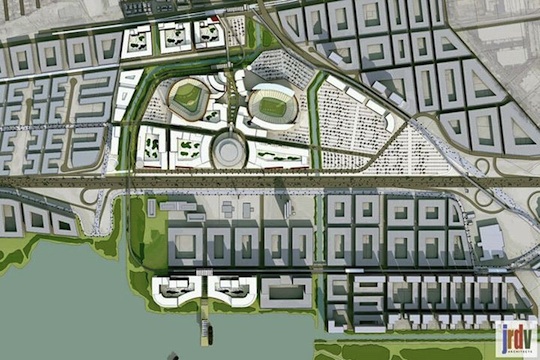
coliseum-city1-sm

Coliseum City with third venue

Most of the immediate ancillary development has been moved to in-between the venues and along 880. The scope has gotten much bigger. At 750 acres, the new initiative requires two specific plans, one for each side of 880. Coliseum City (at least the immediate area) is conceived of as three venues plus L.A. Live. It would require all three tenant teams to pony up most or all of the cost for their new or improved venues, with the possibility of ancillary revenue to help pay the bills. City is pitching the concept as having two big advantages over other cities or sites: No EIR required and land already owned by the City. While it’s correct that the environmental process should be streamlined, I think that having a third venue will require at least some form of EIR since planners have to account for the possibility of three events happening simultaneously and the impacts that would occur from that kind of situation. As for land, okay. And? The Coliseum has already been dismissed by MLB, so why pitch it as a feasible site now? Nothing has changed to explain how anyone can (not) pay for a privately financed ballpark there.

When I got word of the Friday event, I was curious, then suspicious. First of all, why do this on a Friday? What was the rush? Obviously, it was a reaction to the news that the Warriors are exploring an arena deal at China Basin. Here’s the irony of the situation: While the Giants are exploring with the Warriors a way to leave Oakland, Oakland has been consulting with the Giants on ways to derail the A’s efforts to move to San Jose. Strange bedfellows, indeed. Oakland’s strategy has turned into having a viable backup plan if San Jose doesn’t pan out, in which case not being able to deliver by 2015 or 2016 doesn’t matter since the A’s have no other choice in the Bay Area.

Very few members of the public were present since there was little advance notice. City could have drafted a resolution that would have been discussed at a future City Council session, but decided not to. Instead it was a short press conference with a short Q&A. That’s what it’s come to. A feeble punt of a letter. Even Quan’s letter ends on an odd note:

We are advocating for the A’s to remain in Oakland because we believe that sports franchises can lead to economic growth. So long as a team creates jobs and enhances economic development in the City, then we will encourage them to remain in Oakland. My advocacy for keeping the A’s is not about baseball or a particular sports franchise, it is about doing what is best for the City. I am convinced that Oakland has the best weather, transportation, fan base and sites available to MLB.

It’s all about what the City gets out of it. It’s not about the franchise. That’s refreshingly honest. Yet in the same paragraph Quan touts the sites, process delayed and shaky as they are, as the best. It’s this kind of fragmented, incongruous argument that melts under even the lightest scrutiny that’s had me so frustrated lo these many years.

With that, we have two big cases of retreating. The A’s know the new economic landscape, what steps they have to take to address it, and what shortfalls they face even if they achieve their immediate goals. Oakland has been flailing with its incoherent strategy, not revealing details or taking important steps. When I spoke to Doug Boxer yesterday, I told him that showing progress on an EIR matters. Milestones matter. He said it didn’t matter since the decision rested with one man (Bud Selig), and that the average fan doesn’t care. I was flabbergasted. What’s the point of having a Facebook operation if the average fan doesn’t matter? Why even have a press conference? He’s right about one thing, that there are no parties involved in this mess with clean hands. I came away saddened and I felt like a little bit of my soul died. Thankfully I had a few beers and nice conversation with LeAndre, then went to a friend’s donation party later that night. I could have drunken myself into a stupor, but I chose to ease up because I wanted to write this long article. Because I’m sick of the bullshit. It needs to stop. We need to move forward. Maybe the end is coming soon, maybe it isn’t. I’m not sure if I want to keep writing this blog if things don’t or can’t change. They say it’s always darkest before dawn, right? It’s pitch black right now.

Oakland 12/9 Press Conference

First of all, thanks to Nina Thorsen’s excellent start-to-finish coverage @KQEDNewsLive. She was tweeting like a madwoman while I was stuck in transit. Hopefully I’ll get to hear the audio soon so that I can comment more thoroughly. Bear with me, I’m at the Trappist celebrating LeAndre’s new job at Lucasfilm with him over beers (wow!).

Here’s what we know:

  • The Victory Court EIR is not done. Not even started.
  • The City is presenting two site options, Victory Court and the new Coliseum City. The Coliseum has an RFP out for planning and redevelopment of the Coliseum area on both sides of 880, and Coliseum City is basically the plan.
  • Mayor Jean Quan and Let’s Go Oakland’s Doug Boxer emphasized the positive economic impact of either plan.
  • Quan positions either site as feasible if MLB, the A’s and Warriors are willing to play ball.
  • Quan has talked to the Giants. They have said they could delay San Jose for up to ten years.
  • There will be renderings of Coliseum City released soon. I’ll put them up when I have a chance.

After the meeting we spoke to Let’s Go Oakland’s Doug Boxer briefly. He was very straightforward in his assessment:

  • The litigation aspect is a very real threat for the A’s.
  • The two Oakland sites are being pitched not only as alternatives to each other, but also as alternatives to San Jose if that plan doesn’t come to fruition.
  • I asked him if he was disappointed that there was no progress on at the state of the Victory Court EIR. He said yes but also understood why – the City is only dealing with itself until MLB commits to Oakland.
  • There are no innocents among the various parties (A’s, Giants, Oakland, San Jose, San Francisco, MLB) involved in this mess.

Honestly, this came off pretty much as I expected. The Coliseum City plan makes sense since the City is putting resources into it. A new/revamped arena and ballpark can slot in as alternatives to a Raiders stadium in the planning work, so it’s like killing two birds with one stone. Other than that, it’s a terribly disappointing bit of news. There has been no action on the EIR front, and virtually nothing has happened in the last 2.5 years, yet Quan is characterizing the Oakland options as doable by 2016. Oakland’s track record doesn’t back her up. It all sounds like a bunch of fronting, and everything else I’m hearing outside of Oakland indicates that the City is not going to get the chance to prove itself. I’m not sure Oakland deserves it.

Added 2:34 PM – The Trib will have a live chat today at 3:30 to cover today’s news. Participants will include reporter Angela Woodall, BANG senior editor for community involvement Martin G. Reynolds, and the ever popular Dave Newhouse.

Added 4:05 PM – Two new pics of Coliseum City.

coliseum-city1-sm

Overhead shot has ballpark on north lots. I assume the green strip running from left to right (north-south) through complex is the easement for the sewer interceptor.

coliseum-city2-sm

Close-up shot shows hotel between ballpark and stadium