More from TLR

Tony La Russa was at The Game’s studios in SF this afternoon with Brandon Tierney and Chris Townsend. Tierney asked about the state of the A’s, and here’s what TLR said:

Well, I think economically it’s not a fair playing field. That’s (the A’s) the glaring example. It’s not the Cardinals at $100 million and the Yankees at $200 million because $100 million is a lot. You can win with that.  So what you hope is that it becomes more economically fair, and I know there’s some noise that it could be built in Oakland – the new ballpark – around Jack London Square. I don’t know if that makes sense, I mean I don’t see the corporate support. So it’s about San Jose and I don’t know what MLB is going to say.

You know, the Giants have been great to ARF (TLR’s Animal Rescue Foundation), I want to make (it) clear about that. I don’t want to get Larry (Baer) and the Giants upset at me, but they got the San Jose territory because Mr. Haas was just really nice. Unless it comes –  something where the A’s can make some money – they can’t compete.

Listen to the interview. It’s fantastic and has more about TLR’s desire for the A’s to be able to compete economically, fairly. I’ve mentioned this before and I’ll say it again: the guy is plugged into the economy. Why? Because companies are huge benefactors for ARF. When corporate giving goes down, ARF can suffer just like any good cause. So yeah, he definitely knows what he’s talking about.

Speaking of ARF, TLR came on to promote a series of ARF events happening in the new year. There’s a Comedy Night on January 6 hosted by Dana Carvey, a concert called Stars to the Rescue on the 7th, and a 2011 season retrospective on the 8th. All of the events will be held Walnut Creek’s Lesher Center for the Arts.

South Bay Stuff

January is getting closer. We might actually hear some good news. We should hear one way or another.

The Merc’s Tracy Seipel exposed Stand for San Jose as a farce. I’ve written enough about them. Read down in the Facebook comments for a statement from the plaintiff Eileen Hannan, who is now crying foul as she claims she was ambushed by Seipel in her questioning. If you can’t take the heat… Just a reminder, the A’s coming to SJ doesn’t necessarily mean the little Giants have to leave. If that happens, the decision will be made by the big club in SF, the owner.

On a sad note, Tony Lima, the artist responsible for all of the hand-painted artwork at San Jose Municipal Stadium, is in failing health due to cancer. His work was always endearing, sometimes whimsical, and helped make the family friendly atmosphere at Muni.

The Orioles announced changes to Camden Yards to enhance the fan experience, including a new centerfield viewing area, dropping the height of the rightfield wall a little, and six sculptures of great O’s of the past.

Sports Business Journal’s Daniel Kaplan reports that the 49ers sold a “low nine figures” share of the team to a Silicon Valley exec in order to help finance the Santa Clara stadium. In a followup, he thinks it’s someone at Facebook though he can’t confirm it. If the Raiders want to build their own stadium, they may have to do the same even though they’ve been selling off shares for some time.

Later today – a BART article.

It’s a bargain, I swear

You know what I like the most about Friday’s Oakland press conference? They snuck in a very, very important detail and no one noticed.

Sometime after we heard that the Victory Court EIR hadn’t begun (which was verified, yes) a bit of info started floating around the interwebs about Oakland offering and presenting to MLB a “$250 million package” for the Victory Court site. There was no sense as to the substance of that package. Some questions I had about it:

  • Would it be all of the land up to Oak Street?
  • Would it include all infrastructure (on/off-ramps, parking, pedestrian improvements)?
  • Would it provide some money for construction?
  • Would it require redevelopment-based or tax increment financing?

The answers to those from what I gather:

  • Yes
  • Yes
  • No
  • Yes

When Victory Court was initially presented last December, Oakland officials steered far away from any kind of guess as to the cost of preparing the site, especially land acquisitions. I made a WAG of $100 million just for the land and some indeterminate amount of infrastructure. Now we know that the price just to get Victory Court ready for the A’s by November 2014 is $250,000,000. I don’t know about you, but to me that’s an absolutely staggering amount for 14 acres and infrastructure. A ballpark site should never cost that much. Even if redevelopment were to continue as-is into the distant future, it’s difficult to conceive of any amount of new, growth-based economic activity happening around Victory Court that could come close to paying off the cost of acquiring the site. Keep that price tag in mind when considering the following list of stadium site costs (note – does not break down public vs. private shares and does not include stadium construction cost):

  • Diridon: $50-70 million, plus $25-30 million in infrastructure
  • China Basin: Final cost $87 million, including land and infrastructure
  • Atlantic Yards (Brooklyn Nets): $100 million
  • New Yankee Stadium: $300 million including garages (considered grossly inflated)
  • Miami/Orange Bowl: $60 million including garages
  • Target Field: $90 million including infrastructure

Sense a pattern? Around $100 million is the prevailing rate. Yet Victory Court is 2.5 times that amount, approaching the astronomical figure for the eternal ripoff that is New Yankee Stadium. Why didn’t anyone pay attention to the cost of Victory Court? Simple. Oakland presented another site with an even more outlandish vision, Coliseum City. Of course, the price will also be more outlandish, but no one’s talking about that. And with that presentation, they gave a handful of people that whiff of hope a dog-and-pony shows brings, even though there’s very little substance to it.

News for 12/14/11

A boatload of news has been piling up.

  • Matier and Ross “reveal” that the real party behind the Stand for San Jose lawsuit is, in fact, the San Francisco Giants. Glad to know that Larry Baer and company are so concerned with traffic in downtown San Jose. (SFGate)
  • The San Jose Earthquakes have gotten their development permit, so they are one step closer to breaking ground. (SBNation/Quake, Rattle and Roll)
  • VTA approved $772 million for the BART-to-Silicon Valley project. This funding is contingent on federal matching funds, for which a decision is due in February. Incentives in the bidding could allow the first phase, which ends at the Berryessa/Flea Market site in North San Jose, to be opened as much as 18 months ahead of schedule in 2016. Berryessa is three miles from Diridon and there is no light rail transfer from there, so unless there is a special bus or existing routes are realigned, the best bet may be to transfer to light rail at the Great Mall. A post dedicated to this subject is due in the future. (Gary Richards, Merc)
  • Santa Clara’s City Council approved $850 million in loans for its Stadium Authority to take out for the 49ers stadium. The money won’t actually be raised unless the NFL chips in with its $150 million share.
  • The Merc’s Tim Kawakami tweets that the 49ers “might land a naming-rights deal with a green technology company…” Okay.
  • Now that Tesla is gearing up for production at the old NUMMI plant and Union Pacific decided not to use land there for a big train/intermodal yard, Fremont is looking deep into ways to redevelop the land, the same way Oakland is looking at the Coliseum area. The 850 acres in question could be developed in a mixed use manner with up to 3,000 homes. Unlike Oakland, Fremont’s tendency to think small may keep things rather humble in nature, though that could change if some sort of anchor element were part of the planning. Like, oh, a stadium. (Matt Artz, Argus. Note: Good luck to Matt on his switch to the never boring Oakland city beat.)
  • MLB may be getting ready to seize control of the Mets because the team is losing money like crazy. Let’s see, maybe a little after the Dodgers are sold in April/May? (John Harper, NY Daily News)
  • Ever wonder where money from concerts and non-game events goes? This article tries to figure it out. (Tom Lyden, FOX 9 Twin Cities)
  • Marlins ballpark news: There may be a scandal about shotty welds and falsified inspections on the retractable roof (Andres Viglucci, Miami Herald); See pictures inside and outside the stadium (Joe Capozzi, Palm Beach Post; Juan Gonzalez, Stadium Page); the Marlins are getting rid of their sideshow dance troupes of skinny girls and fat guys (Juan C. Rodriguez, Sun Sentinel)
  • Robert Bobb is back in DC after two years as the Detroit Public Schools financial czar. What’s he doing? Consulting, of course.
  • Qualcomm is changing the name of Qualcomm Stadium to “Snapdragon Stadium” for 11 days to give a marketing boost for its mobile chipset. (Terry Lefton, Sports Business Journal)
  • The NFL announced extensions of its TV deals through 2022. Changes include an expanded Thursday night package on NFL Network and NBC getting rights to the Thanksgiving night game. Combined value of all TV deals is $4.3 billion a year, enough to take care of every team’s annual payroll without ever selling a ticket. (NFL Communications, Variety)

That’s it for now.

Whither the Hornets?

On my birthday I woke up to news that the NBA and players had reached a tentative agreement to play the 2011-12 season. 20% of the regular season will be lost as teams will be forced to play a truncated, 66-game, 120 day season ending in late April. I thought this was a good opportunity to radically change the NBA schedule, which runs from Halloween to Easter with playoffs through the first week of June, to a pushed back schedule of Christmas to Memorial Day and playoffs until late July or even early August, commonly known as the dog days of summer. Oh well, they didn’t make such a change so we’re “blessed” with a rapid fire schedule with numerous back-to-back-to-back game sets. It will surely be brutal to the finish.

It’s also brutal seeing what’s happening to the New Orleans Hornets. GM Dell Demps had a deal to send superstar point guard Chris Paul to the Lakers, who would send Lamar Odom back to the Hornets and Pau Gasol to the Rockets, who would then send a bevy of players including Luis Scola and Kevin Martin to New Orleans. It seemed a fair trade last week and was assumed to be a done deal until Commissioner David Stern stepped in and killed it, citing the now infamous “basketball reasons”. An attempt to revive the deal with additional parts was also rejected, as were two attempts by the other LA team, the Clippers. The Hornets, which are owned by the league and the other 29 team owners, are completely handcuffed when it comes to making player moves and will surely field an awful team this year, whether they trade Paul by Christmas or not. The reasons for doing this are rather divergent. Cavs owner Dan Gilbert complained about not getting a piece of the Lakers’ luxury tax payment. Mavs owner Mark Cuban thought it was unfair to “take advantage” of a small market team. There were plenty of whispers that Stern wanted to stick it to superagency CAA and make Paul an example that the players can’t just dictate where they wanted to go, though that’s not what Paul was doing in this case. Supposedly Paul is being kept on the roster simply to raise the team’s attractiveness for potential buyers, even though it’s unlikely that Paul will stick around when he becomes a free agent in the summer.

A year has passed since the NBA bought the Hornets from two-time owner failure George Shinn, and there is no sign of a local buyer that could come in to rescue the team, despite the fact that the team reached its season ticket and attendance goals last year. There are a few prominent locals who could be positioned to be minority owners, but that’s not going to be enough. The NBA seems to have raised its bar to prevent undercapitalized groups from buying, such as Atlanta Hawks’ failed buyer Alex Meruelo. For the NBA to sign off on a new owner for the Hornets, the buyer will have to A) be willing to overpay for a franchise in the Big Easy, perhaps as much as $400 million, and B) be willing to absorb losses or deal with razor-thin margins in the market. It’s no wonder, then, that the Hornets are a prime relocation or contraction target.

Continuing to own the Hornets is a terrible conflict of interest for the NBA, which can’t operate the team normally while it tries to maximize value for a sale. On one hand, it wats to retain Paul as a key asset even though it’s clear he’s skipping town. On the other hand, it doesn’t want to saddle the team with a bunch of long-term contracts (read: talent) that would make the team less attractive for buyers. It’s a bad spot to be in, and it makes me scared that the league will simply throw its hands in the air and give up. I hope that’s not what happens, since there are options they can pursue:

  • Sell the team to Larry Ellison if he’s still interested. Ellison would obviously move the team to San Jose. I wrote in January that moving a team to San Jose, as much as Warriors owners Joe Lacob and Peter Guber would rail against it, could advance talks in San Francisco for an arena there, since it’s likely that an arena deal in SF couldn’t be completed for either the W’s or relocated Hornets until after the 2016-17 season. Neither San Jose nor Oakland would like it much, but the NBA would at least know there’s some cushion there. Ellison is wrapped up in the America’s Cup project, so it’s unclear if he still has interest in the Hornets. If he paid $450 million, as Lacob-Guber did for the Warriors, the NBA probably wouldn’t blink twice and would back up the moving vans for him. The problem is that last year Ellison offered $350 million for the Hornets, so why would he pay $100 million more a year later for an arguably devalued franchise? If he paid that $350 million for the franchise, and the remaining $100 million went to Lacob/Guber so that they could terminate the lease at Oracle Arena and jumpstart the process in SF, that might just work.
  • Find a Seattle-based buyer and move the team to the Emerald City. Stern played hardball with Seattle as the Sonics were on their way out of town, so it isn’t likely that he or the owners would approve such a move until an arena deal were in place. Any publicly financed arena deal up there is every bit as dead a possibility as one in the Bay Area. It’s also unclear who would surface as a potential owner.
  • Move the team to a place with a new arena, such as Kansas City or Louisville. Neither market is particularly rich so it’s at best a lateral move. Both markets have new arenas, with Louisville an arguably better hoops market. Like Seattle, it’s unclear who would surface as buyer. The Kansas City option revives the possibility of the shouldn’t-be-revisited Kansas City-Omaha dual-city franchise since Omaha also has a relatively new arena. Forget I mentioned it.

This is not how David Stern wanted to wind down his career. A labor stoppage is forgivable among hardcore basketball fans, of which there are many and I am one. There are enough stars to propel the league forward. The Hornets debacle is a different story. It’s a complete clusterfuck, and it will be expensive for the league to extricate itself from the mess. The only question is who is going to pay. Does the NBA give up on the NOLA market, a terrible PR move, then stick the buyer with the tab? Does it fold the team and give the money back to the other owners? That itself is an even worse admission of failure, given that none of the four leagues have contracted teams in the last three decades. Figuring all of this out is well above my paygrade and is why Stern has been at the helm for three decades. It’s a no-win situation for him, and for that, I don’t envy him one bit.

Ruh Roh

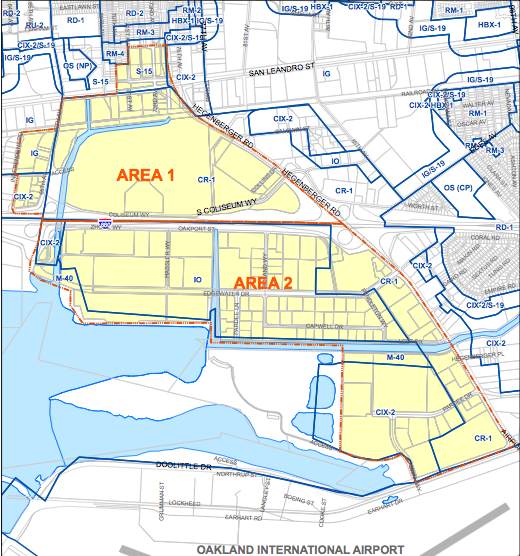
The future at the Coliseum boils down to this.

Two areas defined for the Coliseum redevelopment plan. Area 1 is called "Coliseum City". Dotted orange lines are borders, not solid blue lines (zoning).

area1-2

I’ve been reading the meat of the Oakland Coliseum Area Specific Plans RFP. It has some clearly outlined goals:

  • To maintain a world class sports and entertainment complex
  • To attract major technology or science employers to the campus across 880 from the Coliseum (a.k.a. Zhone)
  • Create jobs
  • Provide long-term benefits to the East Oakland community
  • Support the airport

During Friday’s press conference, Oakland Mayor Jean Quan revealed that six firms have submitted proposals based on the RFP. It wasn’t immediately clear if the bids were based on both areas (Coliseum City, Oakland Airport Business Park) or just one. Either way I’m interested in seeing what will happen. As I’ve written previously, the process is going to take some time to complete. This is not an environmental impact report. That, and EIRs for specific items if they are deemed large enough to require such studies, would come later. The scope is large, as it should be if it’s covering 750 acres. It includes an advisory that any consultants should plan for 25 project meetings with city staff, 8 community workshops, and 12 public meetings with the Planning Commission and City Council.

The interesting about the RFP is not that in the list of alternatives, it asks for one in which the A’s leave the Coliseum complex. In light of recent news about the Warriors being lured to SF and the possibility that the Raiders may join the 49ers in Santa Clara, what’s surprising is that there is no alternative that considers what would happen if all three tenant teams leave. At this admittedly early juncture, it seems a lot more likely that there will be only one or two teams left at the Coliseum in ten years than all three. It may be more likely that no teams will remain as opposed to the three.

In the City’s efforts to appease the Raiders, they’ve left huge openings for the Warriors and A’s to exploit if they wanted to leave. The Warriors have it good. The region is crazy for pro basketball as a product. The bar is astonishingly low for perceived success. Joe Lacob and Peter Guber (and Bob Piccinini, ahem) know that the Warrior fanbase will follow the team across the bay without batting an eyelash, and if some group of pro-Oakland fans chose to protest, they’d be easily replaced by fans in the West Bay. We’ve been chronicling the A’s efforts to stay and leave for over 6 1/2 years here, so I don’t need to rehash all of that. As for the Raiders, consider this: it was the NFL, not the 49ers, that put together much of the $850 million of financing for the Santa Clara stadium, including Goldman Sachs. Does anyone honestly think that the NFL and Goldman Sachs would do that if they weren’t going to lean heavily on the Raiders to play in Santa Clara, at least for a decade? The agreement drawn up with the City of Santa Clara supposedly has the team and the NFL on the hook for debt service, so it’s reasonable to think the Raiders will be nudged south. The NFL doesn’t give out it “G-3” loans to just anyone. It doesn’t want to do it twice in the Bay Area if it can help it, especially if another $150 million is in play for a stadium in either LA or San Diego.

A proactive, instead of reactive, government would at least explore the possibility of no teams at the Coliseum just to suss out the potential of the area post-pro sports. Pride and the lingering debt on the stadium and arena are pushing the City in a different direction that may not be very realistic. The challenges for Oakland in developing the Coliseum area are many:

  • Cost to build new stadia or significantly improve the arena have to be borne by the teams. At a half-billion for W’s or A’s and $1 billion for the Raiders, the cost gives an owner pause.
  • The likelihood for a big name employer to take the Zhone campus is slim. The City tried to pitch the campus as one of its two bids to lure the Lawrence Berkeley Labs second campus. That lost out to Brooklyn Basin Oak-to-Ninth, though LBL has delayed the announcement of the new campus location until next year.
  • With each tenant that leaves, that’s one less anchor to attract developers. Based on the number of games and usage, the Raiders should be the easiest one to let go of since they only play 10 games a year. A ballpark has 82 games, an arena 42+ and concerts and other events. That makes it doubly puzzling that they’d go so hard for the Raiders.

Let’s be clear about something. It makes sense for the City of Oakland to think about the future. They shouldn’t think with tunnel vision. The RFP mentions baseball twice, and specifically figures the Raiders in as part of the future. The City needs to work on all possibilities, not just the Raiders or a pie-in-the-sky Coliseum City development. No matter how Mayor Quan tries to spin the process in Oakland as “easy”, figuring out what to do the Coliseum 10, 20 years down the road is anything but. The plan needs to be comprehensive. As the process starts in earnest over the next year, I hope that Oakland residents start asking the tough questions. They deserve real answers. They’ll have their chance in the workshops and hearings.

Restraint of trade

It can be easy to forget that for all of the work Angels owner Arte Moreno has done to boost his franchise, the team has never won a World Series under his stewardship. Moreno bought the Angels from Disney at the outset of the 2003 season, as Orange County was still in its championship hangover. Renovations to Angel Stadium were only five years old, and the future seemed limitless. In the nine seasons Moreno has been at the helm, the Angels have gone to the postseason five times and the LCS twice. Moreno courted a PR disaster and was the butt of jokes when the team was renamed, but he emerged from that relatively unscathed as he curried favor with fans by dropping ticket and concession prices. Now Moreno has built up a huge amount of community goodwill and is cashing in two ways: by getting a new TV deal and signing Albert Pujols and C.J. Wilson. These moves are clearly designed to win that elusive World Series and perhaps to also gain parity with (if not surpass) the Dodgers. It’s a bold gambit that could pay off huge.

The Los Angeles market is defined as Los Angeles, Orange, and Ventura counties. All told, the combined population of the three counties is nearly 14 million. LA TV rights also extend up into Central California and east into the Inland Empire (Riverside/San Bernardino), adding another 5-6 million residents. Like the Chicago and New York markets, Los Angeles is shared. The Bay Area, through a series of procedural mistakes, is gerrymandered by county, five to two in favor of the Giants. Recently there has been some speculation that when the Wolff-Fisher group bought the A’s for $180 million in 2005, that price was a discount reflective of only having two East Bay counties, and certainly didn’t include Santa Clara County. It’s practically impossible to verify this kind of extremely inside baseball information. What we have to go on are the sale prices of the various franchises at different points in time. The last major sale of the Giants (to the Magowan-Burns group) occurred in 1993, for $100 million. The A’s were sold by Wally Haas to the Schott-Hofmann group in 1995 for $95 million. Back then franchises didn’t appreciate at the rate they have been over the last decade. The prices look pretty even, thus making it difficult to pin down what premium for the majority of the Bay Area actually exists.

Wolff-Fisher paid roughly the same amount for the A’s that Moreno did for the Angels two years prior. However, only a year after Moreno bought the Angels from Disney, Fox sold the Dodgers to Frank McCourt for $430 million. That figure included Dodger Stadium and its surrounding real estate so it’s an entirely fair comparison, but it’s clear that some premium was baked into the price by virtue of the Dodgers brand and presence in Southern California.

Franchise sales over the last decade

Good luck trying to find some consistency in the above table. The Brewers were sold to Mark Attanasio at the same time Wolff bought the A’s. Milwaukee is a smaller market than the Bay Area (or even the East Bay) but it has a new ballpark, which makes a big difference. The Marlins were worth less than the A’s and were subject to the same stadium issues. The Nats’ price was essentially a franchise expansion fee, done solely to get the best return for the other 29 owners and MLB as possible. As you would expect, the sale price was grossly inflated. The Rays sold for more than the A’s (and Angels) a year prior, also with poor stadium prospects in a worse market than Miami.

Given the history of franchise sales, it’s hard to argue what a proper premium would have been for the A’s in 2005 had the Bay Area been shared instead of split. $20 million? $40 million? Forbes had the Giants’ valuation at $381 million. At least a third of that could have been wrapped up in AT&T Park, some other amount related to being the team with the more established and historically larger fanbase.

With a renovated ballpark and a rejuvenated fanbase in his pocket, Moreno did what any good marketing wonk would do – shore up weak areas such as actively selling throughout the entire LA Basin and radio contracts. The freshly inked TV deal is another major step towards achieving parity with the Dodgers, a World Series win will be a crowning achievement. Wolff and Fisher, who bought the A’s for a similar amount two years later, have taken numerous backwards steps such as tarping and the constant trading of young talent. They’ve also worked on attaining better radio and TV deals and have been successful doing so. Unlike the Angels, the A’s are severely restricted in terms of where they can build a stadium, and it has done nothing but put the team in a corner while the Giants continue to enjoy near complete hegemony over the Bay Area. If the price for the A’s did not include Santa Clara County or a shared Bay Area, they are surely paying for it now with the worse economy, more difficult climate to build, and the roadblocks the Giants continue to put up to delay or stop the A’s. The team is going to take several years to repair the damage caused by all of this. If it doesn’t start soon, it may never happen.

Retreat!

On Friday there were actually three big news stories that could affect the A’s future for some time to come. Naturally, there was the Oakland press conference that amount to very little, followed up shortly thereafter by the trade of Trevor Cahill to Arizona for prospects. The biggest news, however, may be not directly related to the A’s at all. After the Angels’ blockbuster signings of Albert Pujols and C.J. Wilson, it was revealed how Arte Moreno is going to pay for them: a new TV contract with Fox Sports worth $3 billion over 20 years.

Think about that. $150 million per year for the next 20 years. The previous Angels TV contract (also with Fox) was worth $50 million a year, which already probably tripled what the A’s were getting via TV. Now they’re getting ten times as much as the A’s. They’ll get more from TV than the A’s get from all sources save for revenue sharing.  Jonah Keri wrote in September how the Rangers’ big TV deal with Fox Sports (20 years, $1.6 billion) made the Rangers poised to become another dynasty, and then the Angels come along and blow that out of the water with a deal worth nearly double. The Angels can practically service their entire payroll just with TV, radio, and a little bit Central Revenue money, which makes every ticket sold, every hot dog served pure gravy. And because the Angels have historically had among the lowest ticket and concession prices in the majors, they now have massive headroom to raise those prices and the obvious justification to do so.

Forbes’ 2010 revenue figure for the Angels was $222 million. For the 2011 season, that probably edged up to $230 million. You may recall that I wrote about $230 million being a revenue target for the A’s – in 2015.  The Angels hit that mark this year, and will absolutely blow past $300 million in the future thanks to the new TV deal. The next edition of Forbes’ list could have the Angels jump from #9 to #3 or even #2, past the Cubs, Red Sox, Mets, perhaps even the Dodgers. (Don’t worry about the Dodgers though, they’ve been court-approved for a new TV deal that will zoom past the Angels at around $4 billion over 20 years.) That’s scary. It doesn’t portend well for the A’s in the future. Seattle is just as much in a pickle. The Bay Area is home to 7 million residents, with less than half “devoted” to the A’s. The Seattle Metro has 3.5 million residents. The DFW Metroplex has 6.4 million. The LA-to-Riverside MSA has nearly 18 million. It would seem that TV deals tend to scale based on the number of households in each market, factoring in some level of fan interest. It also helps if there’s competition. LA’s chief cable provider, Time Warner, partnered with the Lakers to start their own RSN starting with the NBA’s 2012-13 season. The numbers for the deal look familiar: $3 billion over 20 years. That competition doesn’t exist in the Bay Area, where Comcast, Fox Sports, and the Giants partner on CSN Bay Area and Comcast wholly owns CSN California.

Given the massive amounts of money being thrown around, there doesn’t seem to be any practical way for the A’s to compete. In the October article I wrote that the A’s would have to double media revenues to compete, they might need triple or quadruple. Even then they’ll be way behind the Rangers and Angels. The best way to effect change might be for the A’s to start their own RSN, though that’s a huge gamble since running a network isn’t exactly cheap and the A’s aren’t the kind of ratings bonanza that’s attractive to advertisers. Plus there will be the immediate friction from Comcast, though in the end I’d expect it to be a ploy to get a better deal at CSNCA. Until then, if you’re the A’s braintrust what do you do? Sure, you work diligently for the stadium and you’ve been trying to improve your station in terms of media revenue. But despite your best efforts, with the new deals for rival teams threatening to make them Yankees equivalents of the West, the long rebuild strategy more than makes sense – it may be the only way to go.

oakland-presser1-120911

City Administrator Fred Blackwell talks about the Coliseum City concept. The only thing missing was a white flag.

Now let’s circle back to yesterday’s press conference. It was accompanied by a letter to MLB from Mayor Jean Quan (PDF). The letter affirms the City’s commitment to the A’s and outlines the support it can provide for its (now) two sites: Victory Court and Coliseum City. Here’s what was written about Victory Court:

Based on updated analysis, the City believes that the costs associated with the Victory Court ballpark project entitlements, land acquisition, and completion of site improvements and infrastructure have changed substantially since its earlier estimates and that those costs remain in the $250 million range. Although the mix of funding sources has been modified, the City remains confident that it will be able to deliver on its commitment to fund each of those elements. With regard to timeline, we believe we can deliver a site, which includes land assembly, full entitlement of the Ballpark project, and completion of infrastructure by November 2014.

The City claims that a new ballpark would be ready for the 2016 season. But that’s wrong. Assuming they were able to assemble the land and infrastructure pieces, construction would take 24-30 months from the ready date. That puts the opening of the Victory Court ballpark at 2017, not 2016. Remember, this is only one year after Victory Court was unveiled, with Quan saying when she got the mayor gig that Victory Court could be “fast-tracked“. Does 2017 sound like fast-tracking to you?

Beyond the problem grasping the schedule, there’s a major problem with the $250 million. City says that the “mix of funding sources has been modified”, which may be code for a reaction to the coming changes in redevelopment. Regardless, it’s clear that the money for this project would come from redevelopment, which means that the bulk of it would come from some form of TIF (federal grants? Don’t make me laugh.). Pushing the completion of the project out to 2017 suddenly becomes convenient. Why? The state’s plan to redirect “excess tax increment” would run for as much as the next five annual state budgets, with the system reverting back to normal once the budget crisis ends. As 2017 approaches and developers start to move on speculation near an approved-for-construction, vetted-by-MLB Victory Court site, property taxes should rise, which means that funding for the $250 million land/infrastructure piece should materialize. But there’s a fundamental flaw with the plan. Does anyone honestly believe that redevelopment will simply go back to normal and the state’s budget woes will be fixed in the next five years? The money to be realized from redirect redevelopment funds is only a small fraction of what’s needed to bridge the budget gap. Already, Governor Brown is pushing hard for new taxes next year and massive automatic budget cut triggers thanks to ongoing monthly revenue shortfalls. Then there’s the looming possibility that redevelopment will be abolished or transformed into a form that requires a new tax structure and local ballot measures.

Now on to Coliseum City. Exactly one year ago, I wrote an analysis of the Coliseum’s plans to build a new stadium for the Raiders along with ancillary development. Back then the plan looked like this:

coliseumredev2-sm

Something’s missing on the left side of the drawing.

The new version:
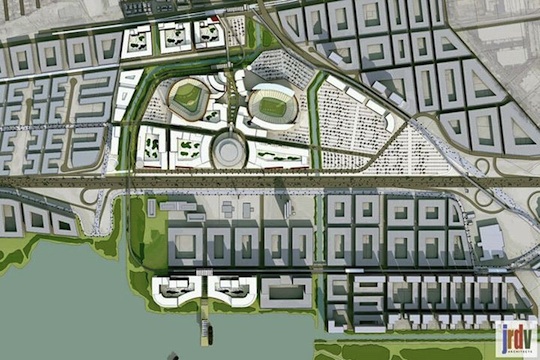
coliseum-city1-sm

Coliseum City with third venue

Most of the immediate ancillary development has been moved to in-between the venues and along 880. The scope has gotten much bigger. At 750 acres, the new initiative requires two specific plans, one for each side of 880. Coliseum City (at least the immediate area) is conceived of as three venues plus L.A. Live. It would require all three tenant teams to pony up most or all of the cost for their new or improved venues, with the possibility of ancillary revenue to help pay the bills. City is pitching the concept as having two big advantages over other cities or sites: No EIR required and land already owned by the City. While it’s correct that the environmental process should be streamlined, I think that having a third venue will require at least some form of EIR since planners have to account for the possibility of three events happening simultaneously and the impacts that would occur from that kind of situation. As for land, okay. And? The Coliseum has already been dismissed by MLB, so why pitch it as a feasible site now? Nothing has changed to explain how anyone can (not) pay for a privately financed ballpark there.

When I got word of the Friday event, I was curious, then suspicious. First of all, why do this on a Friday? What was the rush? Obviously, it was a reaction to the news that the Warriors are exploring an arena deal at China Basin. Here’s the irony of the situation: While the Giants are exploring with the Warriors a way to leave Oakland, Oakland has been consulting with the Giants on ways to derail the A’s efforts to move to San Jose. Strange bedfellows, indeed. Oakland’s strategy has turned into having a viable backup plan if San Jose doesn’t pan out, in which case not being able to deliver by 2015 or 2016 doesn’t matter since the A’s have no other choice in the Bay Area.

Very few members of the public were present since there was little advance notice. City could have drafted a resolution that would have been discussed at a future City Council session, but decided not to. Instead it was a short press conference with a short Q&A. That’s what it’s come to. A feeble punt of a letter. Even Quan’s letter ends on an odd note:

We are advocating for the A’s to remain in Oakland because we believe that sports franchises can lead to economic growth. So long as a team creates jobs and enhances economic development in the City, then we will encourage them to remain in Oakland. My advocacy for keeping the A’s is not about baseball or a particular sports franchise, it is about doing what is best for the City. I am convinced that Oakland has the best weather, transportation, fan base and sites available to MLB.

It’s all about what the City gets out of it. It’s not about the franchise. That’s refreshingly honest. Yet in the same paragraph Quan touts the sites, process delayed and shaky as they are, as the best. It’s this kind of fragmented, incongruous argument that melts under even the lightest scrutiny that’s had me so frustrated lo these many years.

With that, we have two big cases of retreating. The A’s know the new economic landscape, what steps they have to take to address it, and what shortfalls they face even if they achieve their immediate goals. Oakland has been flailing with its incoherent strategy, not revealing details or taking important steps. When I spoke to Doug Boxer yesterday, I told him that showing progress on an EIR matters. Milestones matter. He said it didn’t matter since the decision rested with one man (Bud Selig), and that the average fan doesn’t care. I was flabbergasted. What’s the point of having a Facebook operation if the average fan doesn’t matter? Why even have a press conference? He’s right about one thing, that there are no parties involved in this mess with clean hands. I came away saddened and I felt like a little bit of my soul died. Thankfully I had a few beers and nice conversation with LeAndre, then went to a friend’s donation party later that night. I could have drunken myself into a stupor, but I chose to ease up because I wanted to write this long article. Because I’m sick of the bullshit. It needs to stop. We need to move forward. Maybe the end is coming soon, maybe it isn’t. I’m not sure if I want to keep writing this blog if things don’t or can’t change. They say it’s always darkest before dawn, right? It’s pitch black right now.
Oakland 12/9 Press Conference

First of all, thanks to Nina Thorsen’s excellent start-to-finish coverage @KQEDNewsLive. She was tweeting like a madwoman while I was stuck in transit. Hopefully I’ll get to hear the audio soon so that I can comment more thoroughly. Bear with me, I’m at the Trappist celebrating LeAndre’s new job at Lucasfilm with him over beers (wow!).

Here’s what we know:

  • The Victory Court EIR is not done. Not even started.
  • The City is presenting two site options, Victory Court and the new Coliseum City. The Coliseum has an RFP out for planning and redevelopment of the Coliseum area on both sides of 880, and Coliseum City is basically the plan.
  • Mayor Jean Quan and Let’s Go Oakland’s Doug Boxer emphasized the positive economic impact of either plan.
  • Quan positions either site as feasible if MLB, the A’s and Warriors are willing to play ball.
  • Quan has talked to the Giants. They have said they could delay San Jose for up to ten years.
  • There will be renderings of Coliseum City released soon. I’ll put them up when I have a chance.

After the meeting we spoke to Let’s Go Oakland’s Doug Boxer briefly. He was very straightforward in his assessment:

  • The litigation aspect is a very real threat for the A’s.
  • The two Oakland sites are being pitched not only as alternatives to each other, but also as alternatives to San Jose if that plan doesn’t come to fruition.
  • I asked him if he was disappointed that there was no progress on at the state of the Victory Court EIR. He said yes but also understood why – the City is only dealing with itself until MLB commits to Oakland.
  • There are no innocents among the various parties (A’s, Giants, Oakland, San Jose, San Francisco, MLB) involved in this mess.

Honestly, this came off pretty much as I expected. The Coliseum City plan makes sense since the City is putting resources into it. A new/revamped arena and ballpark can slot in as alternatives to a Raiders stadium in the planning work, so it’s like killing two birds with one stone. Other than that, it’s a terribly disappointing bit of news. There has been no action on the EIR front, and virtually nothing has happened in the last 2.5 years, yet Quan is characterizing the Oakland options as doable by 2016. Oakland’s track record doesn’t back her up. It all sounds like a bunch of fronting, and everything else I’m hearing outside of Oakland indicates that the City is not going to get the chance to prove itself. I’m not sure Oakland deserves it.

Added 2:34 PM – The Trib will have a live chat today at 3:30 to cover today’s news. Participants will include reporter Angela Woodall, BANG senior editor for community involvement Martin G. Reynolds, and the ever popular Dave Newhouse.

Added 4:05 PM – Two new pics of Coliseum City.

coliseum-city1-sm

Overhead shot has ballpark on north lots. I assume the green strip running from left to right (north-south) through complex is the easement for the sewer interceptor.

coliseum-city2-sm

Close-up shot shows hotel between ballpark and stadium

City of Oakland baseball announcement today

KQED’s Nina Thorsen passed this along to me earlier this morning:

NOON CITY OF OAKLAND TO MAKE ANNOUNCEMENT ABOUT MAJOR LEAGUE BASEBALL. OAKLAND MAYOR JEAN QUAN, CITY COUNCIL MEMBERS AND ASSISTANT CITY ADMINISTRATOR FRED BLACKWELL EXPECTED TO ATTEND.

HEARING ROOM 4, SECOND FLOOR, OAKLAND CITY HALL, FRANK OGAWA PLAZA, OAKLAND

CONTACT: SUE PIPER (510) 238-7439 OR (510) 499-8933 CELLPHONE

Could it be the elusive EIR? An announcement in conjunction with MLB? To find out, I’ll be spending my lunch hour in Oakland.

Update 7:58 AM – The Trib has more on what appears to be a ditching of Victory Court for an alternative:

Quan is expected to discuss a plan for a redesigned Oakland Coliseum complex — Coliseum City — that could provide new homes for both the A’s and Golden State Warriors.

The San Francisco Chronicle reported Friday that the Warriors have held discussions with San Francisco Mayor Ed Lee and Giants CEO Larry Baer about building a new arena near AT&T Park. The Warriors also met with recently Quan about building a new arena at the current Coliseum, according to the Chronicle report.

Yikes. Coliseum City? What about the poor Raiders?

Update 11:54 AM – Running late thanks to a BART delay. Mobile apps not working the way I want. Unhappy Friday so far.