Quan, BayIG strike back with “basics” of Raiders deal

Matier and Ross reported today that the City of Oakland and BayIG, the group behind the Coliseum City project, have put together the “basics” of a deal that would include a ~$1 Billion stadium for the Raiders and development of up to 800 acres surrounding the stadium.

Now, Zach Wasserman, an attorney representing backers of a hoped-for sports, housing and retail complex called Coliseum City, says the “basic terms” of a financial deal have been worked out among his group, the city’s negotiators and the Raiders.

The big takeaway is that the City and County, which would be giving up land and paying for infrastructure costs as part of any deal, would also have to pay off the remaining $120 million in Coliseum debt. That is an enormous giveaway on Oakland’s part no matter how you slice it. Both City and County officials have insisted in the past that any large plan like Coliseum required the debt to be taken care of – preferably by the developers. If you can remember back to the “adult conversation” in December, County Supervisor Keith Carson practically hijacked the proceedings by having the first 10-15 minutes of the meeting spent on recounting the debt liability faced by the JPA.

Carson emphasized that there will be no future project if debt isn’t addressed first.

So, let’s tally up what we know are the costs of Coliseum City so far:

  • $344-425 million in infrastructure cost
  • $120 million in Coliseum debt

That’s up to $565 million in project costs, all without building a single stadium, hotel, or office building. And there’s more. Not included is the $80 million in arena debt, the responsibility for which is up in the air. In the EIR (you guys have been reading that, right?), the City states that of the 800 acres covering the entirety of the project, 535 are publicly owned. That includes the City, County, JPA, and EBMUD. The remaining 265 acres are privately owned, making those properties subject to negotiation. Most of that land is on the west side of 880, but some important pieces are right next to the Coliseum or in between the Coliseum and the BART station. Now let’s take a low market rate offer of $2 million per acre. That’s another $530 million that would be borne probably by developers, but could also be paid to some degree by the City since Oakland has eminent domain capability. No matter who pays for it, the total cost of land, infrastructure, and dealing with outstanding debt is $1.1 Billion. That’s the cost of the Raiders stadium right there, or two A’s ballparks.

The counter is that the Raiders, NFL, and BayIG are paying for the football stadium, which may or may not have a retractable roof, may have 56,000 or 68,000 seats, etc. The potential upside is 10,000 new residents, 21,000 jobs, and retaining all of the teams – though it still hasn’t been articulated how any sort of carveout for the A’s would work.

Now compare that to what Lew Wolff is offering, which is to pay off the debt on both the Coliseum and the Arena. While we haven’t seen plans, the planned development is not expected to be as expansive as Coliseum City, as Wolff has said that acquiring private property for this purpose is a bit sticky for his liking (Coliseum North being Exhibit A). Besides, even 120 or 200 acres is a lot of land.

We haven’t yet heard Alameda County’s side, and Carson is certain to raise questions about the giveaway. The City can come to terms on a deal, but without the County as a partner the deal isn’t sealed. I fully expect a sequel to the adult conversation, when all of the costs and liabilities are laid bare. If the A’s get it together in time, there may even be a sort of competitive situation with two bidders. Let the rich guys duke it out over what is purported to be high quality, valuable land. Chances are that such a discussion won’t happen until after the election. After all, there’s something fishy about the timing of this release, considering that last week Oakland mayoral candidate and CM Rebecca Kaplan took credit for “saving the A’s in Oakland” (h/t Zennie Abraham).

The bone-in, skinless stadium

It starts with this.

Kansas_City_Arrowhead_Stadium

Arrowhead Stadium prior to 2007 renovations

And ends (for now) with this.

levis-naked_remote

Levi’s Stadium prior to August 2014 opening

These two stadia opened 42 years apart, yet bear a couple of important similarities. One that is fairly obvious when you compare the two pictures is that neither has an exterior façade. The other is that they were both designed by the engineering and architectural firm HNTB. Well, sort of. As I mentioned on Monday, Arrowhead Stadium’s original architects were Kivett and Myers. That firm was acquired by HNTB to form its sports practice in the late 70’s.

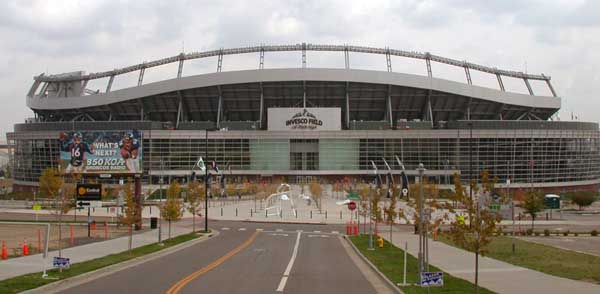
HNTB went on to do several football stadia in the 70’s and 80’s, including Giants Stadium and the Hoosier (RCA) Dome. Neither was known for being a great work of architecture, and both are now history. Until HNTB designed the Broncos’ new stadium, Sports Authority Field, it’s hard to point to any really striking sports architecture from the firm. More eye-catching examples have come in the form of minor league ballparks such as Raley Field and the twin Fifth Third Fields in Toledo and Dayton. Minor league ballparks don’t have nearly the scale and sense of mass as a pro football stadium, so it’s probably unwise to even compare.

Sports Authority Field (formerly Invesco) at Mile High, photo by Matthew Trump

Sports Authority Field (formerly Invesco) at Mile High, photo by Matthew Trump

While Arrowhead and neighbor Kauffman Stadium were highly acclaimed, notable pieces of sports architecture, they weren’t flawless. That lack of exterior façade made for cold and wet occupants, which was more of a problem at the ballpark during the spring months than at Arrowhead during the football season, when it’s customary to bundle up. The 2010 renovation of Kauffman included a large structure behind the seating bowl that provided a great deal of weather protection for fans.

At snowy Denver, there’s plenty of cover thanks to glass curtainwall. The undulating, horseshoe-shaped upper deck both saluted and riffed off the old Mile High Stadium. Even so, the most interesting thing about the new stadium is its all-steel structure, which wasn’t limited to columns and trusses. Risers that would normally be built of precast concrete were also made of steel, which allowed the Broncos to make an extra noisy, feet-stomping seating bowl much like Mile High.

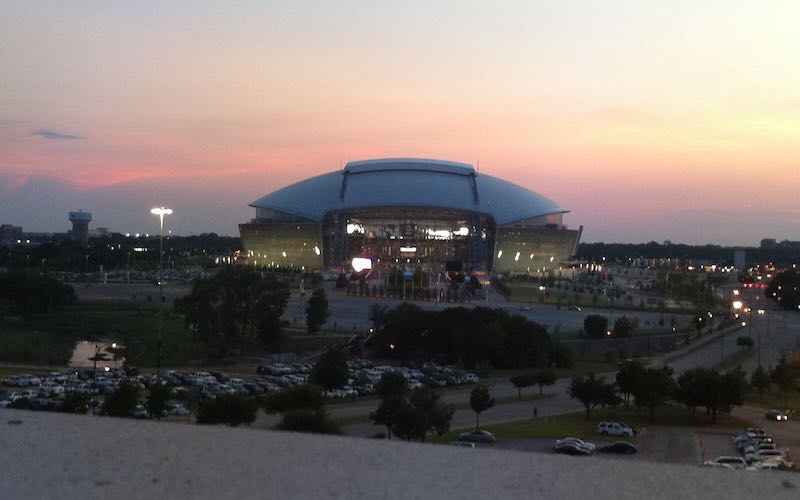
New NFL stadia over the last 20 years seemed to be constant acts of one-upmanship. Paul Brown Stadium was thought to be overly garish for conservative Cincinnati. HKS-designed Lucas Oil Stadium looks like an Indiana field house enlarged by nuclear radiation, the same way a puffer fish might have become twice the size at the Bikini Atoll. Another HKS product, AT&T (Cowboys) Stadium, is practically out of a sci-fi film and as I noted while I was at Rangers Ballpark to the east, appears ready to destroy its neighbor with lasers. The next HKS design for the Vikings looks like a crystal football cathedral.

This slideshow requires JavaScript.

As domed multipurpose stadia, the three HKS designs had to have some sort of skin. The fact that they are a bit over-the-top (360 Architecture is guilty of this too) is part of the celebration of football, the fans, and the home city. The other recently built West Coast NFL stadium, CenturyLink Field in Seattle, was built to protect fans from harsh, wet winters. But in California, is any façade necessary? Or is it just ornamentation?

At Levi’s Stadium, most of the suites are set in a single 8-story tower along the west sideline. It’s efficient packaging for sure, though it looks a lot like of the office buildings in Silicon Valley, which are similar in scale. The other three-quarters of the stadium is practically naked. HNTB and the 49ers chose to show off the structural steel that lifts up and rings the bowl. Whether that’s “enough” architecturally to work as aesthetic is largely subject to individual taste. So far most of the comments I’ve seen are to the effect of, It’s nice on the inside. Levi’s Stadium is a technological tour-de-force, and like many good technologies that come out of the Valley, is built with headroom and expansion in mind. What it lacks at the moment is a single element that makes it beautiful, unless you consider the suite tower that element. Arrowhead has the lovely, swooping upper deck at the end zones. It adds elegance to what otherwise would be character-less and overly brawny. Perhaps the signature element, a translucent image-projecting, shape-shifting material that clads the exterior, simply hasn’t been invented. Or maybe Levi’s Stadium is destined to be like many of HNTB’s post-Arrowhead work: serviceable at best, forgettable at worst.

This slideshow requires JavaScript.

Let’s not forget that HNTB also designed Mount Davis. We know that aesthetic quite well, as our Oakland home is akin to a Supermax prison. HNTB is probably known more for their engineering work than their designs. They were hired by the City of Cupertino to do the lovely cable-stayed pedestrian bridge I mentioned in my “Rethinking Coliseum City…” post. They also designed the beautiful Zakim Bridge in Boston, along with a number of interchanges and airports. None of that sounds sexy, but they are important pieces of infrastructure that have to balance aesthetics and utility, not an easy task.

I suspect that Levi’s Stadium will undergo several minor and major revisions over the next 20 years as they iron out the rough spots and seek to enhance the experience even further. Levi’s Stadium is more than a place to watch football. It’s also a platform and brand. If there are bugs in 1.0, just wait for 1.1 or 2.0. It doesn’t get more Valley than that.

P.S. – This is not intended as a review. I’ll have one of those up in a month or so.

Raiders selling field suites at Coliseum by using baseball dugouts

Update 8 PM: This is how one of the field lounges was set up.

Eric Young of the SF Business Times reported on a series of changes the Raiders instituted during the football offseason. In addition to a CRM solution from Salesforce (can’t believe it took until 2014 for this to happen), the team has also repurposed the baseball dugouts in hopes of getting some extra revenue. Dallas-like field suites at the Coliseum? Kinda…

“The Raiders have begun selling field level lounges. These seating areas, which can accommodate about 30 people and cost $30,000, are in the dugouts used by the Athletics during baseball season. Outfitted with tables, HD TVs and other amenities, the seating is among the closest to the field offered in the NFL…”

oakland-oco-coliseum

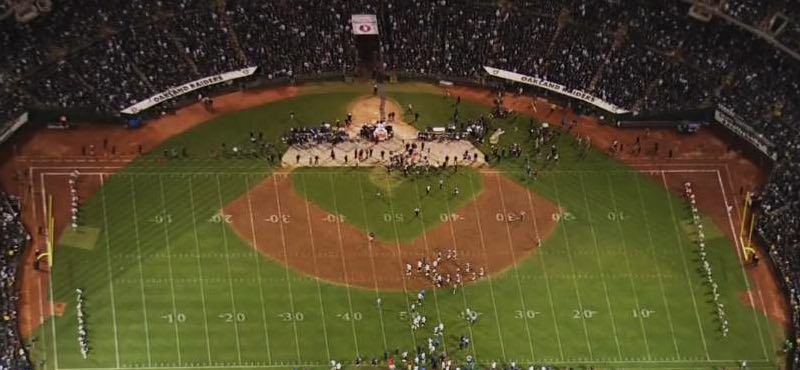
Overhead shot of pre-2014 game without field lounges

The Black Hole and its counterpart on the north end of the Coliseum are arguably the closest, lowest seats to the field of any in the NFL. That proximity has been used to great effect. The new field lounges start at either 30 yard line and end at the 10, plenty of space for 30 people and hospitality. It also helps that the suites are located along the Raiders’ sideline, the better to get a glimpse of players and coaches only slightly more than a first down away.

The dugout floor is set a foot or so below the field, so views from the dugout will be compromised. NFL guidelines place each bench between the 30’s. Since most players will be standing during each game, the suite sitters will be hard pressed to see through or above each bench to midfield or the opposite end zone. Fans in the first 8 rows of the lower seating bowl already have to deal with this. The temporary field level seats on the Mt. Davis side are set to start 3 feet above the field, so they’re an improvement. Photographers, media, and other non-game personnel usually populate the field’s outer sidelines, though not to the level of congestion as the benches. Of course, the HDTV’s will help make up for the obstructions. In the end it probably won’t matter. As SBJ’s Don Muret says:

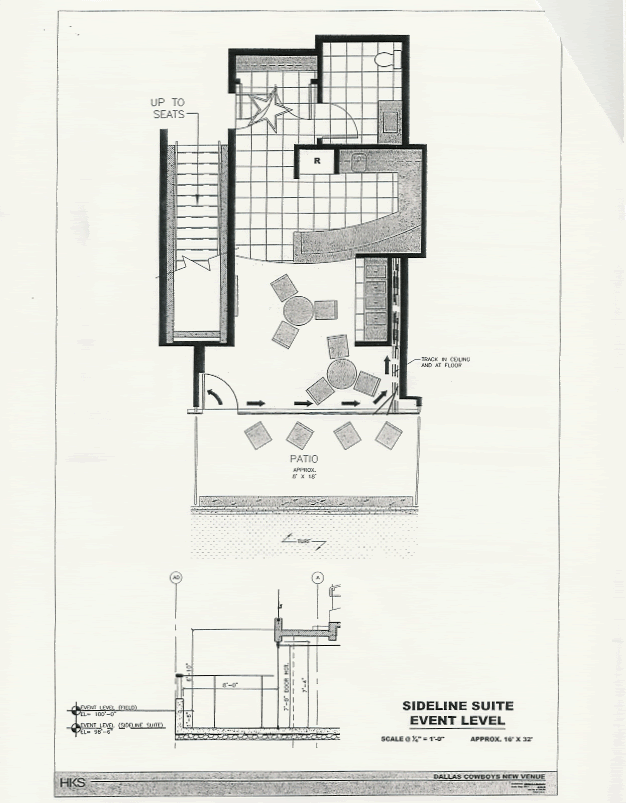
The full $30k experience will come with breakfast with the team and personal appearances from Raiders greats, which fans will undoubtedly eat up. For the Raiders, it’s a good opportunity to find out if field suites are worth the expense of building into a new stadium in Oakland or somewhere else. Somewhat surprisingly, the 49ers bucked the field suite trend by not installing any at Levi’s Stadium. The Raiders would be best off putting in seats above the suites like the Cowboys have, since there would be no compromises. Here’s the layout of one of the AT&T Stadium field suites.

Suites04


Good move? I think so. In the past the dugout was mostly used for access to the restroom and as a place for photographers to place their extra gear.


Now let’s let this spill over to baseball. Should the A’s incorporate suites like this (as in Texas, Cleveland, and Anaheim) at their new ballpark?

Part of Levi’s Stadium field being replaced after mishaps during practice

ticket-fri_night_lights

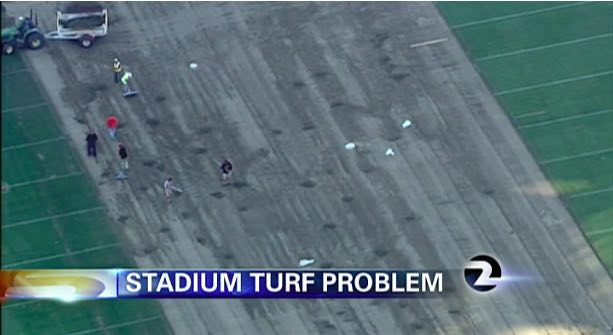
The ticket above may be rendered useless (and hopefully refundable) by Monday. That’s because Levi’s Stadium is having a bit of a grass problem. Sod that was planted in April came up in chunks and was causing falls during Wednesday’s in-stadium practice session, forcing Jim Harbaugh to relocate the session to the 49ers’ practice facility next door. Thousands of fans who attended the session went away disappointed. Today the stadium’s grounds crew began the process of replacing the middle thirdthe entirefield from goal line to goal line, first ripping out the old sod that wasn’t taking root.

Still of overhead footage taken by KTVU's traffic helicopter

Still of overhead footage taken by KTVU’s traffic helicopter

New sod is expected to take root in around 2 months, so it’s not as if there wasn’t ample time for that to occur. When the Earthquakes hosted the Seattle Sounders 2 weeks ago, I found it curious that sod seam lines were still visible on the pitch. While the field was playable for that event, it suffered mightily under the trampling of 300-lb. linemen. The grass variety in use, West Coast Turf’s Bandera Bermuda, is not considered the cause of the problem, though the 49ers haven’t officially said what the cause is. Niners Nation claims that the sand base under the sod is the culprit. To get the field ready for Sunday’s game vs. the Chargers, the team is getting more sod rolls from WCT to fill in the area around the hashmarks.

This slideshow requires JavaScript.

That sod will be extra thick at 2 inches, giving the sod a chance to stay integrated for at least this one game. That’s considered only a temporary fix, since such installations are not designed to permanently take root. After that sod is used, the entire field will be torn up and the subsoil system replaced, in favor of a revamped system that will hopefully allow the grass to grow better into the base.

I don’t think is what the 49ers meant when they advertised Levi’s as the greenest stadium in America. Tearing up, replacing, and irrigating sod multiple times over isn’t green in the slightest.

Typically stadium operators keep a small sod farm near the stadium so that bad patches can be easily replaced. It’s also common for the grass suppliers to keep a large amount (literally acres) available for customers in case of emergency.

While Bandera Bermuda is a relatively new grass variety, it isn’t untested. The surface is in use at Petco Park, Raley Field, and was used in the end zones at the Coliseum a couple years ago as a test for the Raiders. The stuff has also been installed at the Rose Bowl for UCLA’s upcoming football season, and was used at California Memorial Stadium for the exhibition soccer match between Real Madrid and Inter Milan. While the field didn’t play as smoothly and quickly as a permanent grass installation would, there were no severe complaints and most importantly, no field-related injuries. After the match, Cal Athletics worked on installing the lower-maintenance Field Turf surface at Memorial.

As seen with the soccer-vs.-football experience dynamic this week, using the same strategy at Levi’s as the one used at Cal is no guarantee of success. The players could tear through the new sod just as they did with the original grass. However, the extra weight and root structure should help the field withstand the pounding. The field is also expected to stay through the following Friday (8/29), a high school football doubleheader. By midnight on Friday the field should be shredded into oblivion, seeing that there will be three football games played there in six days. If the field doesn’t make it through this Sunday’s game, the high school games may have to be rescheduled for other locations or the home schools’ respective fields. I’ve been looking forward to Friday Night Lights, since it’s the cheapest priced event at Levi’s so far ($20) and the seating is all general admission, meaning that fans can sit pretty much anywhere that’s open (probably the lower bowl only). It would be a shame if the event were cancelled, but if the injury risk is too high, no sense in pursuing it further.

There are many growing pains associated with opening a new venue. Unfortunately for the 49ers and fans, some of them have been painful (traffic for the soccer game) or even lethal (a man died at last Sunday’s game from heat-related causes). Everyone’s a guinea pig until things are ironed out. Here’s hoping that the new field takes hold, so that the focus is on the ball and what the players do with it, instead of the surface. After all, we already have one compromised stadium to deal with in Oakland.

Davis won’t seek lease extension for Raiders

The stadium-building playbook usually involves a team owner using leverage at various points to coax a compromise out of the public officials on the other side of the table. Raiders owner Mark Davis employed this tactic three months ago he openly complained about a lack of urgency on Oakland’s part, even though Davis has done little lifting on his own in the local effort.

At the conclusion of A’s lease extension talks, JPA Board President Nate Miley said that talks had started with the Raiders for a short-term extension, presumably to allow for more time to flesh out Coliseum City. Those talks appear to have gone sideways, as Davis said today that he has no plans to extend after the end of this season. I had earlier reported that there may be an option, but the lease is only for the NFL’s 2014 season, plus the playoffs stretching into 2015 if that occurs.

Meanwhile, Davis has been pallin’ around with Jerry Jones, Magic Johnson, and others in Oxnard this week as the Raiders and Cowboys have held joint practices. Magic waxed nostalgically about Michael Ovitz’s plan to re-do the LA Memorial Coliseum. Jones gave Davis his support, no doubt with the idea that a Raiders move to LA means that the team won’t encroach upon Texas (San Antonio to be specific). There’s no shortage of media willing to buy the LA move plan, from CBS Sports’ Jason La Canfora to the BANG’s Tim Kawakami.

LA still remains a tough proposition, because of the lack of consensus on a site and the NFL’s own agenda, which may have roadblocks for Davis on the way south. It should be crystal clear, though, that most of the problems with LA can be solved with money, and when it comes time to decide, there are more than enough people there to write the checks.

For the Raiders it comes down to following the rules. The NFL’s guidelines dictate that all teams looking to leave have to give their current city at least a year of good faith negotiations before turning elsewhere. By having involvement in Coliseum City, Davis has done that. Then there’s the brief window that all NFL teams have to notify the league that they intend to move to another market. That doesn’t happen until after the season ends. Assuming that Coliseum City doesn’t get finalized in the next six months, Davis will probably provide notice.

Knowing how the JPA reacted to Lew Wolff’s and MLB’s threat to relocate the A’s, Oakland could easily go into another panic mode. That’s the plan, the playbook. For better or worse, Coliseum City is Oakland’s playbook.

Soft open becomes hard lesson for many fans at 1st Levi’s Stadium event

I didn’t attend tonight’s Sounders-Earthquakes game at Levi’s Stadium, so I can’t comment on any aspects of the experience there. I won’t get into the architecture either, even though I have seen the stadium in every stage of construction multiple times per week over the last two years. I’ll reserve those thoughts for after August 29, the date of the Friday Night Lights high school football event. That event will not only be the cheapest to get into at the stadium ($20 general admission, less than a tour ticket), it will feature a doubleheader, meaning fans can roam around the venue for six hours if they wanted to. That’s exactly what I’m going to do. Anyway, I’ll let this tweet sum up the experience inside for now:

The big mystery leading up to the game was whether or not the venue and the City of Santa Clara could handle the influx of fans. Tonight’s game was positioned as a sort of soft open, with a crowd no larger than 50,000 expected. The upper deck was closed off to cap the capacity. If the open house for season ticket holders was a dry run, Saturday night was to be the first real test. Despite advisories to come more than 2 hours early, many fans faced gridlock on the surface streets leading to the stadium. Fans who arrived in the area 60-90 minutes before the match start were often turned away as their designated parking lots filled up. As part of the TPMP (Transporation and Parking Management Plan), the lots were roughly divided into quadrants based on which direction/highway you were coming from. Arriving from the east on 237/880? The red lots are for you. From the south/southeast on 101/87? Try the green or purple lots. As Tasman Drive and Great America Parkway backed up, those going to the more remote lots eventually had an easier time getting and out. Sure, that meant an extra 15-20 minute walk, but it was probably worth it. It sure beat some fans being stuck for an hour in the parking garage across the street from the stadium. Parking inventory isn’t going to improve over the next couple of weeks, so it will be absolutely paramount for the team/City to more efficiently route fans along those surface streets. Even so, it highlights a problem with the street grid in north Santa Clara – there are no side streets. Everything’s set up in a superblock fashion, and the commercial “neighborhoods” within have no outlets besides the heavily impacted major intersections that service them. I’m sure that the TPMP will be revised to improve this performance, but there’s no fixing the street layout. That said, Great America Parkway has four lanes north and south. It should be capable of getting cars in and out of the stadium vicinity. My advice?

For some people, getting out was worse than getting in. For others it was the exact opposite. The above tweet is half-joking, but parking closer to either 101 or 237 can’t be a bad idea if you want to get in and out quickly.

Transit was another story. Caltrain and VTA have been pitching the idea of transferring people coming from SF/Peninsula at the Mountain View station, then trekking the 25 minutes on light rail to Levi’s Stadium. The circuitous route (with a small section of single track) is far from efficient. VTA wants to boost light rail ridership, so this seems like a good way to do it. It’s not the fastest way to get fans to the stadium. If they want to get fans to the stadium fast, they’d have fans disembark at the Lawrence station 3.5 miles southwest of the stadium. From there express buses would be lined up to take fans 15 minutes the rest of the way. Riders arriving via the main spine of the light rail system (from Downtown, East & South San Jose, plus Campbell/Los Gatos) had to deal with overstuffed trains and mechanical breakdowns. One train shut down at the River Oaks station and its air conditioning system went out, motivating many riders to pop out emergency windows to get fresh air.

LevisStadiumBusService

VTA’s route map showing light rail and bus service

VTA is working on an additional track siding to store more trains, which should improve capacity. That’s still not enough. A 3-car trainset holds around 500 people including standees. That should improve service frequency from the every 10 minutes service VTA was advertising but not delivering. However the problem is infrastructure. There needs to be an alternative in place to better facilitate all of the fans overflowing at the Great America Station platform. Some fans told me that they walked to other LRT stations to avoid the crowds. The agency should follow a practice it already follows when there are breakdowns or other high-impact delays: employ bus bridges. By providing an overflow option for light rail riders, VTA can ensure that more fans can make the regular or special northbound Caltrain trains. Set up bus bridges to Mountain View, Great Mall, Alum Rock, Tamien, Winchester, and Ohlone-Chynoweth. That should relieve pressure on the light rail system and allow fans going to Downtown San Jose to utilize freed up trains. Otherwise you get stories like the one from Merc sports editor Bud Geracie, who lined up for light rail once the game ended before 10 and didn’t arrive at the Tamien station until nearly midnight.

My advice to fans? If VTA doesn’t introduce redundancy, take Caltrain to Lawrence (from SF/Peninsula or San Jose) and Uber/Lyft/Sidecar/Taxi the rest of the way. Fair should be around $20 or less each way, quite reasonable if you’re in a group.

Coincidentally, there was one aspect of VTA that was working well: the express buses. The five routes, which served Cupertino, Eastridge, Gilroy, Los Gatos, and the Fremont BART station, got in and out swiftly. Fans on those buses didn’t face the overcrowding experienced on light rail. They got to the BART station as early as 10:30. Another alternative I heard a lot about was bicycle. Whether biking straight to the stadium (if based nearby) or transferring from Caltrain, the trip proved fast and trouble-free. Bike racks at the stadium were packed, indicating that some fans had been planning those routes for weeks if not months.

Capitol Corridor was running on a normal weekend schedule. Fans who rode Capitol Corridor had to leave the game early to catch a 9:30 northbound (eastbound) train, the last one of the night. For 1 PM Sunday 49er games, the schedule has been changed slightly to better accommodate fans leaving Levi’s around 4:30-5. ACE, which doesn’t normally run on weekends, will have a special train running in each direction on Sundays.

The first 49ers preseason game is scheduled two Sundays from now. That game is expected to be a sellout plus standing room. Santa Clara and the Niners have a lot of work to do to reduce the frustration and confusion experienced with this first event. I’m pulling for them, but it’s gonna be tough.

P.S. – Quick restaurant recommendation fairly close to the stadium: Gobi Mongolian BBQ at Lawrence Expwy & Tasman Drive about 1.5 miles west of the stadium. Huge weekday lunchtime crowds, fairly small weekend crowds.

Mark Davis meets with San Antonio officials

In case the Mark Davis feels like moving the Raiders to San Antonio, there’s already branding in place. The NFL even owns it.

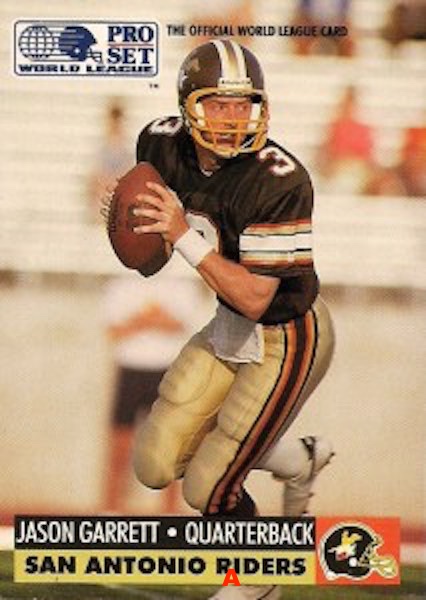
Card of future Cowboy backup QB and head coach Jason Garrett, whose career ended up far more successful than the WLAF

Card of future Cowboy backup QB and head coach Jason Garrett, whose career ended up far more successful than the late, not-so-lamented WLAF

The World League of American Football launched in the early 90’s, a half-hearted attempt to grow American football in Europe and shore up former USFL markets. Operating the league became a drain, and after shrinking to become a entirely European affair (NFL Europe), the league shut down after the 2007 season. Yet there are still reminders of the San Antonio RIDERS, only one letter removed from RAIDERS. The color scheme is 80’s-90’s awful, so it would be best if the Raiders stuck with the historical scheme, similar to the NBA Spurs.

Around the time Alameda County was approving the A’s lease, a report came out of the San Antonio Express News indicating that Mark Davis met with officials in SA over the weekend. Reached for comment, Davis said the following:

“Former San Antonio mayor Henry Cisneros is a friend and Henry suggested I take the opportunity to meet with some city officials while I was in town. I have nothing further to discuss on the topic.”

After his mayoral stint, Cisneros went to become HUD Secretary during the Clinton administration, then was taken down by a mistress scandal. Davis also met with current mayor Julian Castro, City Manager Sheryl Sculley, San Antonio Spurs owner Peter Holt, former Minnesota Vikings owner Red McCombs, and representatives from the San Antonio Chamber of Commerce. Together they toured the Alamodome and talked about San Antonio as a market.

The Houston Chronicle noted that Cisneros’s son-in-law is Brad Badger, a former Raiders and Stanford offensive lineman who now works in team’s corporate sales department. Sculley made her own statement:

“I was asked to meet two weeks ago with the owner of the Oakland Raiders, Mark Davis, and members of his staff. Mr. Davis has expressed interest in a possible relocation of his NFL team to San Antonio and we are engaged in preliminary due diligience. The agenda for this visit included a tour of the Alamodome and meetings with local business leaders.”

If Davis is going to use whatever leverage he has, the effort will have to involve making visits to San Antonio, Portland, and inevitably, Los Angeles. Heck, Minnesota leaders flinched big time just from a sighting of Vikings owner Zygi Wilf’s plane in LA. It doesn’t matter much that San Antonio is a small market. Football’s largely forgiving of that provided that there are enough regional corporate interests (Hello, Austin!) to bring in. San Antonio’s biggest problems are that the market is already a Cowboys stronghold (and Texans to a lesser extent), since the Cowboys have conducted training camp at the Alamodome on multiple occasions. Cowboys owner Jerry Jones signaled the difficulty Davis and San Antonio might face:

I wonder what Jerruh and Mark will talk about during the joint practice sessions set for August 12-13 in Oxnard?

Beyond the pre-existing teams, San Antonio faces the same problem all other prospective Raiders host cities faces: they need a new stadium. The NFL has set the whole thing up so that a team really couldn’t move permanently unless a stadium deal is in place, since the NFL provides a large amount of financing. And that piece doesn’t come until the public/team portions are committed.

I’m more curious about the reactions from Oakland, Alameda County, and Raiders fans are than anything else regarding this trip. This is how the stadium game is played, nothing more.

Alameda County approves A’s lease unanimously 5-0

After a relatively brief, much less heated discussion over the A’s lease extension than was had by the City two weeks ago, Alameda County’s Board of Supervisors voted 5-0 to approve the extension. The deal keeps the A’s in the Coliseum until at least 2018, and up to 2024 if the team chooses to stay there. Though the deal is characterized as a 10-year lease, the 2014 season runs concurrent with the new deal.

Supervisor Keith Carson asked the most pointed questions of JPA negotiator Jon Streeter, mostly about the debt and the characterization of the new lease as a better deal for the County (and City) than previous leases. Streeter noted that the more money comes in upfront, plus the A’s have to pay off the lease even if they leave the Coliseum early. Miley noted that the original A’s escape provision calls for no payoff if the team pursued a new ballpark elsewhere in Alameda County. The language was changed to Oakland only, meaning the A’s would pay full termination even if they made a stadium deal in Fremont or even San Leandro. Streeter also repeated the notion that the upcoming scoreboard project, which the A’s are paying for, means that the JPA no longer has a potentially big liability item to worry about, since the JPA has been to date responsible for the outdated, frequently failing scoreboard.

To recap the major deal points:

  • A’s stay until at least 2018, up to 2024. A’s must give at least 2 calendar years’ notice if they plan to leave early.
  • The JPA must also give the A’s 2 years’ notice if a Raiders stadium deal comes to fruition and forces the A’s to vacate.
  • Lease payments are $1.75 for this year, $1.5 MM in 2015, $1.5 MM in 2016-19, and $1.25 from 2020-24.
  • A’s will spend at least $10 million on new scoreboard system. A’s retain all revenue from A’s games, Raiders/JPA can split non-A’s game revenue as they see fit.
  • JPA sets aside $1 million per year (increasing 5% annually) to establish a stadium maintenance fund (presumably for fixing plumbing, leaks, etc.)
  • JPA will pay $200,000/year for the O.co signage caps above the scoreboards. A’s may end up replacing those caps as part of the scoreboard project.
  • A’s and JPA will continue stadium discussions on land at or adjacent to the Coliseum (nowhere else like Howard Terminal).
  • The parking arbitration matter is resolved, all claims dismissed.

The JPA and County clarified that there is $191.4 million in outstanding debt at the Coliseum complex: $106.5 million for the stadium, $84.9 for the Arena. Bonds will be retired in 2025 and 2026, respectively.

Next up is MLB’s expected approval of the lease, and the City of Oakland’s next steps in negotiating with the Raiders and BayIG over Coliseum City.

Lucas Oil Stadium

As I was finishing my Midwest trip, I had to make 4+ hour drive from Cincinnati to Chicago, where I had to return my rental car and fly out of Midway. Thankfully I had a couple places to visit along the way, the great brewers 3 Floyds just outside of Chicago and Lucas Oil Stadium in Indianapolis. Having been to Cowboys Stadium and University of Phoenix Stadium, I was eager to compare the retractable dome peers.

Lucas Oil Stadium opened in 2008, in between UoP (2006) and Cowboys/AT&T (2009). Unlike the other two, Lucas Oil Stadium was meant to be in a downtown environment, adjacent to a pre-existing convention center. The stadium replaced the old RCA Dome, the built-on-spec fixed roof stadium that lured the Colts and owner Bob Irsay one cold morning in March, 1984.

I had never been to the RCA (Hoosier) Dome, so I can’t speak to its quality as a football venue. From what I could tell, it was much like the Pontiac Silverdome, with a two-deck, football-first layout and air-supported roof. Being in Indianapolis, the RCA Dome and its successor became favored venues for the NCAA basketball tournament, since the NCAA’s headquarters are in Indy and the area is well-suited to handling large events. Indy is also home of the DCI Championships, the national drum corps (marching band) competition.

This slideshow requires JavaScript.

Like many stadium tours, this one started and ended in the team store. A flight of stairs took us from the street level to the lower concourse level. The lower concourse is split, 3/4ths of it set up in the middle of the lower deck to accommodates suites, while the north end concourse is open at the top of the lower bowl. Throughout the lower concourse are massive sponsor areas for Lucas Oil, Meijer, Stanley, and others. Huge windows illuminate much of the concourse, but the mall-like feel can’t be avoided. It’s better than the awful compromised sterility of MetLife, though that bar isn’t exactly high.

While it has a fairly compact layout, the seating bowl has few cantilevering opportunities. There are columns along the club level corners, creating some obstructed views. The one interesting feature is the press box, which is suspended from the roof above the western upper deck. The view is high up as one would suspect. At the entire press box is along the sideline, not set in the corners as is often the case with new NFL stadia.

HKS designed Lucas Oil Stadium to evoke an old field house, a nod to the team sport the state loves most of all, basketball. Bankers Life Fieldhouse nearby has the same vibe. Neither truly pulls off the homage. BLF already looks rather bloated, so you knew that getting LOS to look right at scale would be a difficult challenge. To minimize the visual impact, HKS placed the footprint slightly off the street grid and turned the stadium so that the north windows face the center of downtown Indy. The effect works when you’re close to the edifice since the façade is broken up into components, but once you see the whole thing with its peaked roof from afar, it’s ruined. There’s simply no avoiding the fact that this is a huge stadium, though at some angles it looks smaller than its peers in Arizona and Texas.

Unlike UoP and AT&T, the roof is designed to open laterally with the field (to the sidelines), not to the ends. Part of the reasoning is that much of the load-bearing structure is built along the sidelines, as opposed to the other two stadia where huge trussed arches carry much of the roof’s weight. HKS did a nice job of not over-emphasizing much of the structural work, which is the opposite of the firm’s muscle-flexing exhibition in Arlington. Again, this helps to reduce the visual scale of the building and largely works. In that sense Lucas Oil Stadium looks and feels more like a really large basketball arena than an enormous football stadium. That says a lot for an industry that has never considered intimacy much of a factor in its fan experience.

One obvious feature not at Lucas Oil Stadium is a museum, or some other nod to team history. There’s a Ring of Honor along the upper deck rim, sure. Despite the team’s general lack of success during the 30 years from roughly 1970 to 2000, there is a rich history that should be better acknowledged. Exhibits along the concourse or on the outside of the stadium would be helpful, yet are inexplicably missing. At some point Peyton Manning will have a statue outside. It would be better if Manning’s tribute was located near plaques for Johnny Unitas, Eric Dickerson, and Marvin Harrison.

Having opened towards the end of the NFL stadium boom, Lucas Oil Stadium is a perfectly good representation of the era and of Indianapolis. It has all the amenities you’d expect and has undergone numerous changes to react to the market. It is also, sadly, the product of a major subsidy from Indianapolis – as is the basketball arena. Indianapolis will always struggle with its big city-small town desires. While Indy will never be a proper big city like Chicago, at least it can be a good host. Indy knows that game inside and out.

Wake up, Oakland

“Better a diamond with a flaw than a pebble without.” – Confucius

There are any number of ways to rephrase the idiom above. Some might use “A bird in hand is worth two in the bush,” though the meaning is not the same. Voltaire coined the phrase a little more directly.

The perfect is the enemy of the good.

As I listened to Don Knauss make yet another sales pitch about the virtues of Howard Terminal (and Damon Bruce’s softball handling of it), I started to write a point-by-point rebuttal of everything he said. Then, thanks to BANG’s Matthew Artz, I read a 6-page letter from Lew Wolff to Oakland Interim City Administrator Henry Gardner. The letter outlined Wolff’s desire for a lease extension at the Coliseum before leading into the questions surrounding the future of the Coliseum.

Two pages of the letter are devoted to a section called “The Raiders”. Instead of pointing fingers at the Raiders or Mark Davis, Wolff mostly pans BayIG, the Coliseum City plan, and all of the work that has gone into it so far.

I contrasted words from both Knauss and Wolff. The Clorox CEO talked about a transformative project that could hugely benefit downtown Oakland, which it could. A similar description has been made about Coliseum City by its proponents, comparing it to LA Live among other developments. Then there was Wolff, going detail by detail about the process, the difficulty, tedium, and the obstacles. He even lashed back at “Negative Forces” agitating at every possible turn, which could be construed as a critique of Don Knauss or others allied with Knauss.

The argument, which has stretched as long as Wolff and John Fisher have owned the A’s, comes down to Voltaire’s quote. Wolff’s #1 job this entire time has been to get a ballpark. Let’s understand some of those efforts.

  • 2003 – Wolff was hired by Steve Schott and Ken Hofmann to be the VP of Venue Development. During that brief tenure, Wolff proposed building in the Coliseum’s A Lot and at the Malibu/HomeBase lots. The A Lot option went nowhere because Schott was only willing to put up $100 million for the ballpark. The Malibu option was not available because it was not JPA-owned land. Eventually the JPA bought the land in order to assemble a larger complex for what would be become Coliseum City.
  • 2005 – Wolff exercises an option to buy the team, phasing Schott & Hofmann out and bringing Fisher and numerous associates of Wolff in. Wolff soon proposes the Coliseum North (66th/High) plan, which would redevelop a large swath of industrial land north of the Coliseum complex into a ballpark and mixed-use (residential, retail, commercial) plan. The plan received great fanfare at first, but quickly died as numerous existing landowners showed no interest in selling.
  • 2006 – The Fremont Baseball Village plan is proposed in south Fremont near the Santa Clara County line. A compromise plan of sorts, the idea was to court Silicon Valley corporate interests without crossing into the Giants-held territory of Santa Clara County. Again, there is great immediate enthusiasm, this time from Fremont city leaders. This time, a combination of the Great Recession and big box stores vetoing any developments they didn’t approve of killed the plan. Another attempt in 2010 was made to put the ballpark near the NUMMI (now Tesla) factory across the Nimitz. That was met with hostility from well-heeled residents on the other side of I-680 and fell apart quickly.
  • 2009 – San Jose becomes the next plan, with a partially-acquired site downtown, major corporate and civic support, and a certified environmental impact report ready to go. Again the plan stalled as the Giants remained intransigent about their held territory. A lawsuit filed by people associated with the San Jose Giants (eventually a SF Giants-owned property) threatened the project and is still ongoing. The City of San Jose became frustrated and launched its own lawsuit in 2012 against MLB. That too is ongoing.
  • 2009 – Let’s Go Oakland launches with support of three sites in downtown Oakland: Victory Court, JLS West, and Howard Terminal. Victory Court becomes the preferred site in 2010. LGO promoted Victory Court as much as possible, backed by local developers. No significant activity occurs in 2011, and by the beginning of 2012 the site is dead due to the death of redevelopment and spiraling site acquisition costs.
  • 2012 – Not long after Victory Court goes away, murmurs about Howard Terminal becoming the new preferred (not by A’s ownership) Oakland site begin. In 2013, the Port of Oakland negotiates a settlement with SSA Terminals to vacate the site in order to consolidate facilities and kill a lawsuit against the Port. That allows the Port to look into non-maritime uses such as a ballpark, which it does in spring 2014. A new investor/support group, OWB (Oakland Waterfront Ballpark), emerges, led by Knauss and former Dreyer’s CEO T. Gary Rogers.
    While Wolff has been trying to deal with the on-the-ground demands of planning and building a ballpark, many in Oakland have been fixated on grand concepts like Coliseum City and the far-off promises of Howard Terminal and Victory Court. Even yesterday, Knauss couldn’t help but bring San Francisco into the discussion, talking up how a HT ballpark would have better weather and views than AT&T Park. Coliseum City would be a transformative project that could attract Super Bowls and give Oakland new cachet.

Oakland’s desires to become something bigger and better are completely understandable. But they’ve been so pie-in-the-sky, so big, that there’s always been huge doubts about what, if anything, the City could pull off. I’ve mentioned before that Oakland has never built anything by itself, and that it needed the County and the business community to come together to make the Coliseum work nearly 50 years ago. That need hasn’t changed, but the sense of teamwork has. In Oakland’s attempt to keep all three teams in place, it has gotten away from what got them the teams in the first place: strong partnerships and sensitivity to the teams’ needs. Nowhere is that more evident than in Coliseum City, where the County is playing the realist role in questioning the project and in looking to the A’s, while the City brings in big names with no commitments, entirely footing the bill along the way.

Oakland keeps searching for the perfect project, the ultimate solution, the one that will finally vault them past the City beyond its rival across the Bay. Some politician(s) would take credit when it gets done, a legacy-defining moment. So they keep dreaming, keep hoping, clearly not worried about the little details that need to be addressed or the problems that arise when undertaking big projects. At some point, someone in Oakland will recognize that the dreams need to be tempered with what can realistically be done, and understand the work that will be required to get it done – establishing partnerships with the teams and stakeholders for starters. If not, the teams will get frustrated and give up. Those dreams will die. The biggest pro sports Oakland will be able to get will be minor league (which for some is okay). And the Coliseum, home of six world championships, will end up unused, even more unloved, and ultimately, something generic like a shopping center. That’s what happens when the well-intended keep pursuing the ever-elusive perfect instead of understanding that good is actually pretty great.

Lew Wolff is getting ready to offer what could be a pretty good deal. If Oakland wakes up, they may be able to react in time to take it.

—-

P.S. – I’m removing comments from the site for the time being. It’s not because of the commenters or specific comments – although they can be especially inane at times – it’s because those comments and the constantly attacking spambots (which you don’t see) are causing heavy server load, for which I’ve been warned by my provider. I hope that by having no comments there will be less server load. Thanks for your patience.