Kaval Call: Part I – Howard Terminal Ballpark

When I spoke to A’s President Dave Kaval yesterday, he admitted that he had some 60 interviews recently about the just unveiled ballpark project. I wanted to talk with him sooner, but my rehab schedule is quite full these days, leaving only Friday afternoon available for me personally. Kaval called me on the dot at 1:30, and after some pleasantries I fired off a bunch of questions.

Howard Terminal at night (click for larger image)

I started off talking about lessons learned from the Peralta, er, debacle. Kaval said that the A’s have spent a year involved in community engagement, including 24 workshops and salons. This plan is “bigger than baseball” to borrow a phrase from the Sacramento Kings. It absolutely is much, much bigger. Check out the rendering above. To the left are I-880 heading towards downtown. Then there are some massive condo or apartment buildings to the west of the ballpark. Howard Terminal and the ballpark are in the middle. Then more new buildings, and finally Jack London Square, which is completely dwarfed by the scale of the new construction. To be fair, that would be the case even if the ballpark was by itself with no ancillary development due to the low-slung nature of the JLS buildings. However, this view really puts that comparison into perspective. A big key for Oakland citizens’ acceptance of this vision of the future is whether they want a big playground at this location.
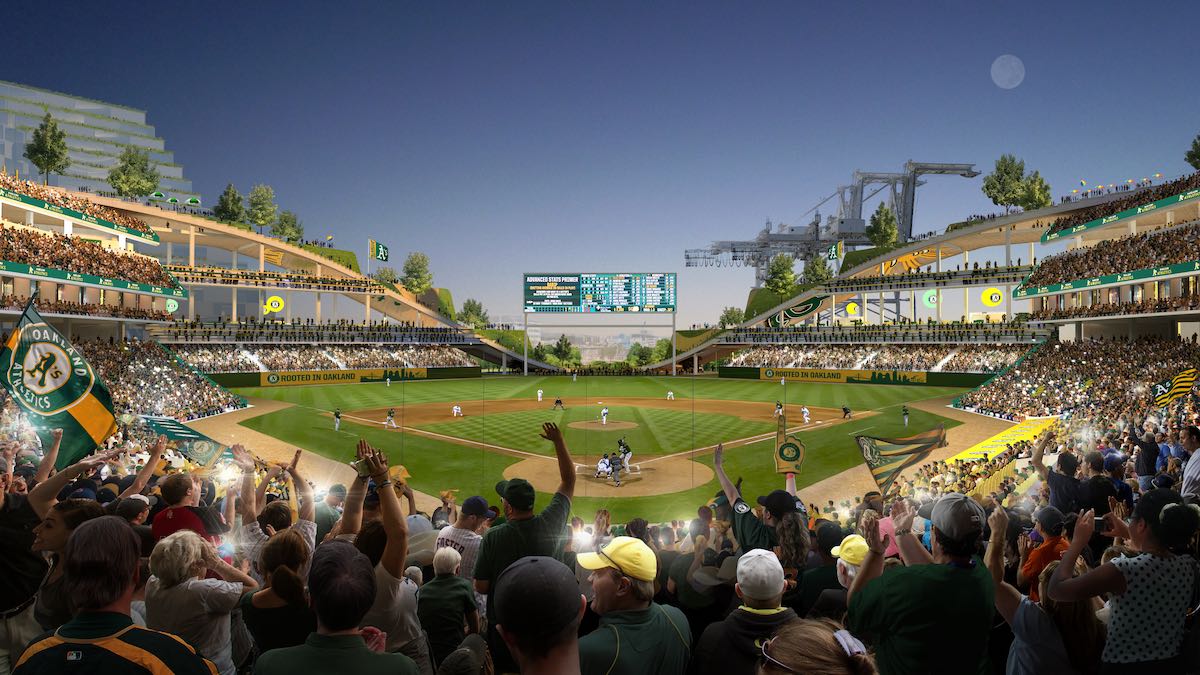
View east towards centerfield from home plate (click for larger image)

The view from down low is dynamic, if not breathtaking. That’s partly because unlike most of the retro-modern ballparks built in the recent area, the outfield is semi-closed. The ballpark is oriented so that a line running from home plate to centerfield runs close to true east, or 90 degrees if you’re looking at a compass. The Coliseum’s orientation is 55 degrees, while AT&T Park is 85 degrees. And for those who prefer a splash landing-friendly orientation, Globe Life Park is angled to the southeast at 135 degrees.

Always eye-catching are the shipping cranes beyond the right field alley. Which, if Matt Olson had his way, might be reachable via his beautiful left-handed swing. Dead center has the requisite big scoreboard, but where is the batter’s eye? According to Kaval, the A’s intend to put a retractable batter’s eye in place. I asked if it would act like a pull-down projector screen. He said that it would operate more like an airplane hangar door. The tree-lined roof deck slopes down from either foul pole. Kaval confirmed that those slopes will be navigable via walkways. I could make out the paths on the inside facing the field, but not the outer perimeter. The rooftop deck will carry a lot of standing room admissions. How much is to be determined. I suppose if the A’s could get the proper fire and seismic clearances, the rooftop could hold 10,000 on its own. The A’s advertise the ballpark as having a capacity of 34,000 seated and standing, so I imagine there’s room to play around with the mix of seating types and standing areas.

Looming in left field is large ziggurat-style building. Incorporated within that structure or adjacent to it is expected to be a reconfigured power “plant,” which may end up becoming a massive “battery” or energy storage for the City. PG&E is working on a deal to make that happen by 2022. Shutting down the production side of the plant would allow more space on the other side of the tracks for parking or a green buffer zone. The ziggurat itself looks to have more condos, which if you haven’t noticed, is shaping up to be a major funding source for the ballpark.
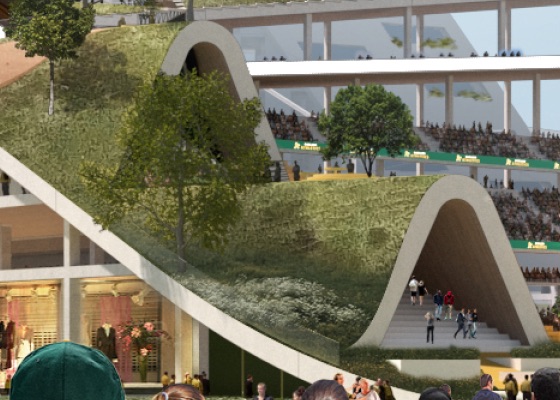
Zoomed in view of right field sloping roof deck with “hobbit holes”

The Chronicle’s Peter Hartlaub had the tweet of the week/month/year when he compared the vision to Lord of the Rings.

I got a high-res rendering to investigate this further, and frankly, the image above the tweet looks like Hobbiton – replete with hobbits – to me. It makes perfect sense. After all, the Eye of Sauron showed up a few weeks ago across the bay. Kidding aside, the rendering shows that the ballpark will have three seating levels and five different concourse levels including the undulating roof deck. Break out your smartwatches and pedometers, folks, because we’re going on a hike at the ballpark! To Mordor!

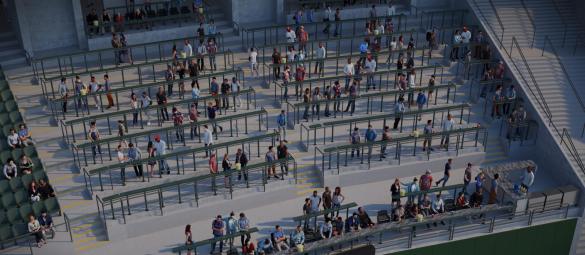
Triple-decker, you ask? I asked Kaval about this directly. He confirmed that the second and third decks will be fairly small, the upper deck having only nine rows.    A level of suites hangs underneath the second deck.

Bottom to top: field level, suites, second deck, upper deck, roof deck

Now for the big architectural reveal. You’re probably looking at these renderings, wondering what’s on the outside? Brick? Glass? Stone? Metal? The answer is…

Nothing.

At least for now it is. The goal here is for fans to be able to have a great view of the field and the ballpark’s surroundings if they turn around. It’s still an outdoor park so it doesn’t need big windows like a retractable dome stadium would. And like I’ve indicated in the past, the architectural firm, Bjarke Ingels Group, isn’t likely to do a throwback design in terms of form. So open it is. The buildings to the west are meant to help protect against the onshore winds. Kaval mentioned that some wind tunnel testing was completed. That also explains the field orientation and semi-closed ballpark structure, even if there are few exterior walls. The corners of the square will have walls for the normal functions: security, concessions, and circulation. If you’re standing at a random location on any of the concourses, you should have a 360° view.

There is that single scoreboard in center and dual ribbon boards around three-quarters of the interior rim. Obviously there’s a lot of space available for other scoreboard panels, fixed signage, player tributes, and other message boards. Some of those items will be governed by economics. Since the Coliseum’s existing scoreboards are only a few years old, I can see them being reused at the new venue. At least there won’t be tarps. On the other hand, there’s isn’t likely to be much homemade signage on display. The place is being called the “jewel box.” It’s not a corner convenience store. Or the Coliseum for that matter.

I let Kaval know that in Bay Area history there another venue which tried to be marketed as a jewel box.
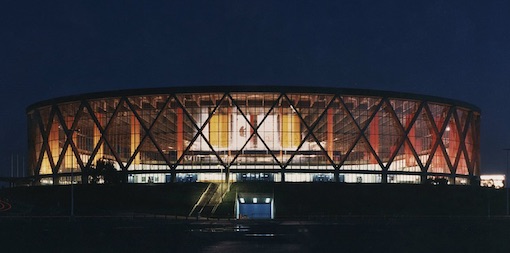
Oakland Coliseum Arena, the original “jewel box” of the Bay Area

I’m not going to rehash the history of the arena as this post has already run 1,100 words. Maybe another day.

Update 11:34 AM – After posting, I realized I forgot about the lighting design. It’s best viewed using the rendering looking west from beyond the outfield towards home plate. The designers call the roof deck the “eyebrow” of the stadium.

Lights shown as a ribbon attached to roof deck

A while back I saw some social media threads discussing ways to use existing shipping cranes or even making fake ones to use as light standards. I shook my head when I saw that as I knew that those old lighting conventions are at this point visual affectations. Light standards are a relic of the 20th century. It’s 2018. We can use LED lighting for our sports fields. It’s more power efficient than the old metal halide lamps of yesteryear. LEDs don’t require much time to warm up, are solid state, and are already in use everywhere from scoreboards to replacements for incandescent lamps to smartphones. Folks, we have the technology.


Tomorrow we’ll go into the ballpark’s setting on the waterfront, and what that entails. And if you haven’t noticed, the theme of my posts is to start with the ballpark and extend outward in my analysis.
Sneak Peak at the Coming Week

Besides monitoring Twitter and reading every article I could find, I made time to talk to A’s President Dave Kaval earlier this afternoon about the Howard Terminal and Coliseum announcement. Unlike the Wolff interview series a few years ago, this was over the phone and won’t be transcribed. Instead I’ll describe what I’ve seen so far and intersperse it with relevant quotes from Kaval.

In lieu of any assembled thoughts on the subject, I’ll lay out my plans for the coming days. Expect Part I of the Kaval Call series to come out tomorrow, with the subsequent installments coming in the next few days. I’m still jotting down my thoughts, so if you have any questions drop them in the comments and I’ll try to include my responses in the posts. Yes, there will be some comments about The Shire.

Kaval Call: Part I – Howard Terminal Ballpark

  • Shape and Style
  • Triple-Decker
  • Roof Deck and Path
  • Outfield and Views
  • Scoreboards and Technology

Kaval Call: Part II – Waterfront Setting

Kaval Call: Part III – Gondolas not BART

Kaval Call: Part IV – Coliseum Redevelopment

Huge thanks to A’s VP of Communications Catherine Aker, who asked me a couple months ago if I would be interested in interviewing Kaval. At the time I declined, telling her to let me know when the A’s were ready to announce something. As a pro would, she got back to me this week.

A’s to hold press conference TODAY at 10 AM on Howard Terminal ballpark and Coliseum redevelopment

FOR MEDIA COVERAGE

OAKLAND ATHLETICS MEDIA ADVISORY

510/638-4900 • athletics.com • @athletics

Nov. 28, 2018

Oakland A’s to Host Press Conference at 10 a.m.

OAKLAND, Calif. – The Oakland A’s today announced their intent to build a next generation urban ballpark at

Howard Terminal. The A’s also plan to pursue a second project to redevelop the Oakland Coliseum site.

The A’s will host a press conference today, Wednesday, Nov. 28 at 10 a.m. with A’s President Dave Kaval, Oakland Mayor Libby Schaaf, President of the Board of Port Commissioners Ces Butner, Oakland City Council President Larry Reid, and Alameda County District 4 Supervisor Nate Miley.

WHAT: The A’s will host a press conference to discuss plans to build a ballpark at Howard Terminal and to redevelop the Coliseum site

WHEN: Wednesday, Nov. 28, at 10 a.m.

WHERE: Oakland A’s Headquarters

55 Harrison St. – 3rd Floor

Oakland, CA 94607

MEDIA NOTE: Please check in with security on the 2nd floor

Dave Kaval will be available following the press conference for one-on-one interviews. Please check in with Erica George to schedule an interview time.

-athletics.com-

CONTACT: Erica George, 510.746.4419 egeorge@athletics.com

OAKLANDBALLPARK.COM

A’s to host Open House on Thursday; FanFest on 1/26

It’s Hot Stove League time again, and for the A’s it means something different than signing guys to huge nine-figure deals. Instead, the team will open its doors Thursday afternoon to

Apparently they’ll present or discuss both Howard Terminal and the Coliseum as potential future sites. So far I haven’t heard about any plans to use the Coliseum land to help fund Howard Terminal. I won’t be at the open house as I’ll be busy, but the Brothers August (Jeffrey and Kevin) will both be there and plan to report back. Say hi and dream about the future.


The A’s also announced that FanFest will be back at Jack London Square on January 26. I wasn’t able to make it last year due to the unfortunate timing of my health scare, but I’m feeling well enough that I might make it up for the day. Plans are in the works.


A’s to add more premium seating options

Over at NBC Sports California, Ben Ross interviewed A’s COO Chris Giles about many of the changes planned for next season at the Coliseum. Like the 2017 re-opening of the upper deck and the unveiling of the Treehouse last year, the team is introducing new and improved seat offerings throughout the lower bowl. Let’s go over what’s new.

The biggest changes will be in the seating sections inside fair territory near the foul poles. Oak Landing will be a group standing area in left field, while the Hero Deck will adorn the opposite sections in right field.

Oak Landing (LF)

Hero Deck (RF)

The A’s will be able to pitch both areas as being in home run territory, which they used to do with the BBQ Terrace sections that are being replaced. The BBQ Terrace sections encompassed only four rows above the outfield fence. Above that is the familiar walkway and the soon-to-be-converted sections. This will be a welcome addition, as the old seats didn’t sell all that well except when heavily discounted or made available in trade-ins for season ticket holders. Considering the general availability of other locations in the now-47,000 capacity Coli, these aren’t the most fetching locations. But they could prove inviting to large groups or companies that want to bring a bunch of people to a game while on a budget.

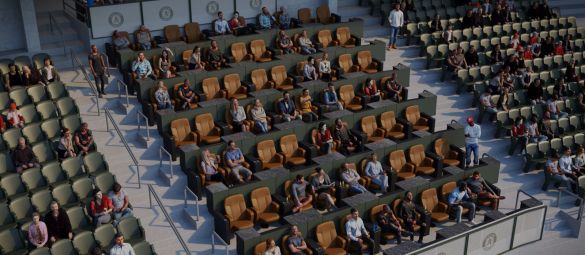
For those whose budgets are higher, the A’s are converting other lower bowl sections to more luxurious seat opportunities, with greater amenities to boot. First up is the Coppola Theater Box, a field box or mini-suite with catering and translucent privacy panels.

Coppola Theater Box

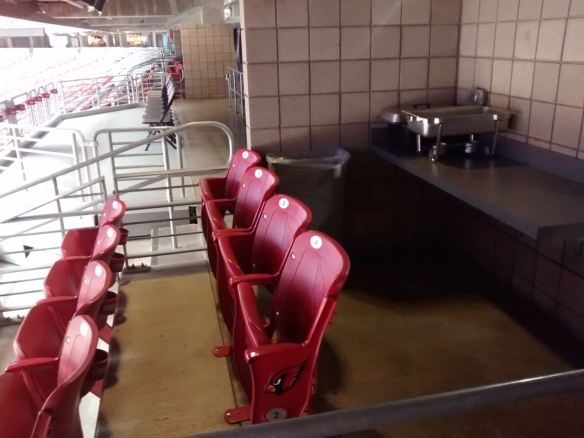
Some number of rows will be removed to accommodate these boxes, and as you can see from the rendering above, they will be located next to the stairs leading to the Plaza Level.Some sections, such as 117 and 301 or 330, probably won’t undergo the conversion. It’s safe to believe that the conversion will occur through much of the field level. Here’s what a similar field box looks like at State Farm Stadium in Glendale, AZ:

Behind the road dugout, the A’s are installing what they call  Lounge Seats. Big and cushy and replete with refrigerators and televisions, this offering is meant to mimic the creature comforts of a fan’s living room while being at the ballpark. The A’s would be smart to offer blankets for those chilly April and May night games.

Lounge Seats

The Terrace has small group tables above the home dugout, also with in-game monitors.

Terrace

Dugout Seats will also be offered. How can the A’s do this when the dugouts themselves aren’t large enough to hold the teams? The actual location of those seats will be the walkways between the dugouts and the Diamond Level seats, which until now were mostly an overflow area for players, coaches, and front office staff.

One big takeaway from these images is that the new seats and tables will take up a lot of space. From the looks of things each of the new premium rows will cover the equivalent of three rows in the regular sections nearby. Certainly there will be a price to pay for that kind of leg room. The exception to this is Oak Landing, whose standing rows will take up two regular seating rows.

The A’s are scattering these sections throughout the Coli, which promises to break up the monotonous ocean of empty seats often seen throughout the season. Still, there’s only so much the A’s can do to a place as large as the Coliseum. The upper deck closure failed, and the Treehouse converted part of the Plaza Outfield area, so that level isn’t going away anytime soon. It’s funny that a decade ago when we talked about new ballparks, it was generally agreed by many fans that the A’s should aim for 40,000 seats. Nowadays 40k is practically too big. The new premium and group offerings are yet another experiment in scarcity. We’ll see by the end of the season how successful that experiment is.

Splitsville

I guess we’ll find out about the A’s next radio home soon.

A’s schedule additional community meetings

The A’s continue their series of community outreach meetings, starting with this Saturday.

Two weeks from Sunday another meeting will be held at Oakland City Hall. While Saturday’s meeting will be focused on development at the Coliseum, the meeting on the 28th will continue the discussion about Howard Terminal. Questions about Howard Terminal are likely to be raised at the Coliseum meeting and vice-versa, so I hope that the A’s and the City are prepared. They appear to have learned some lessons from the Peralta debacle.

For now both sites are being handled separately. That may change, though not without some consternation.

The thing that concerns me is that the City should have a web page dedicated to the effort on their website. So should the A’s. Perhaps this is technically too early in the process because there is no project submitted yet, but eventually both parties will need their own information repositories for their respective efforts. Perhaps that’s why the City listed a new job posting for a project manager.

Before you ask, no, I’m not that kind of project manager as I have no relevant governmental experience. Besides, my therapeutic program doesn’t end until early next year and I imagine both the City and the Team want this work started ASAP. Nevertheless, I’m glad that steps are being made to not repeat the mistakes of the recent (and not-so-recent) past.

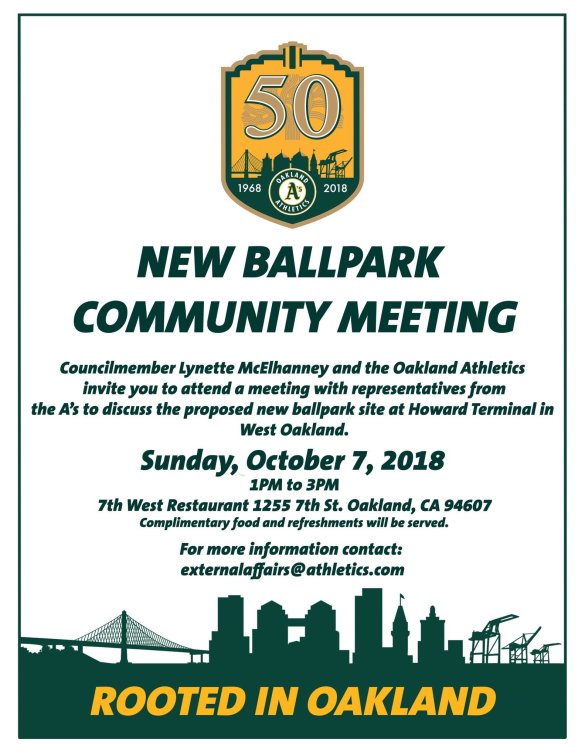
Community Meeting on Howard Terminal to be held Sunday 10/7

A notice from the A’s and the City of Oakland:

NEW BALLPARK COMMUNITY MEETING

Councilmember Lynette McElhanney and the Oakland Athletics invite you to attend a meeting with representative from the A’s to discuss the proposed new ballpark site at Howard Terminal in West Oakland.
Sunday, October 7, 2018

1 PM to 3 PM

7th West Restaurant  1255 7th St. Oakland, CA 94706

Complimentary food and refreshments will be served.

For more information contact:

externalaffairs@athletics.com

7th West happens to be only a few blocks east of the West Oakland BART station, and about nine blocks northwest of Howard Terminal. You’ll notice some railroad tracks running right past 7th West, as the Amtrak maintenance facility and a major Union Pacific rail yard are on the other side of 880.

If you’re planning to go, take notes and report back. Thanks.

AB 734 signed by Governor Brown

I figured that with the sheer number of bills waiting to be passed or vetoed by Governor Jerry Brown, he might take the entire month to sign AB 734 (D-Bonta) into law.

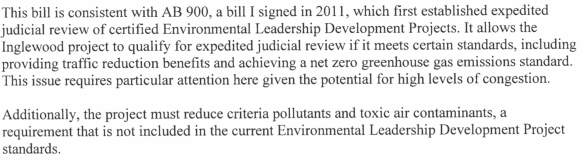
On that count I was right. There was not much worry about a veto for this and similar bills, because the issues are so local that they weren’t likely to encounter broad opposition. It is somewhat interesting, however, that the Clippers’ CEQA streamlining bill, AB 987, had former US Senator Barbara Boxer lobbying against it. At the end, both AB 734 (A’s, Howard Terminal) and AB 987 (Clippers, Inglewood) were both signed before tonight’s midnight deadline. AB 987 happens to have a signing statement from Brown, which should equally apply to AB 734 and Howard Terminal. From Gov. Brown:

While most fans and HT proponents have focused on issues such as the distance from BART and the dearth of parking and other traffic infrastructure immediately available at HT, it should be made clear that a ballpark project will have to pass certain (CEQA) standards to be approved and certified – before a shovel hits in the ground. Although the Warriors and Kings had the benefit of their own CEQA streamlining bills, legal challenges still delayed the eventual groundbreaking for Chase Center for at least a year. On the other hand, the ballpark is projected to have a much smaller capacity than the current Coliseum at 30-35,000 seats. That and smart design should help the project meet some environmental standards. As for the usual arguments about gentrification and displacement (mostly of industry) that will likely come up, I’ll just say that I’m glad this discussion is finally taking place.

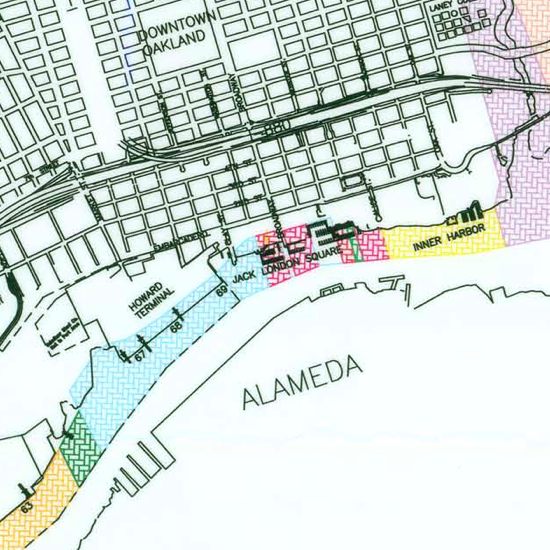
Tidelands Trust map of Howard Terminal and Jack London Square area