We’re going into our 12th year with the blog.
— newballpark (@newballpark) March 30, 2016
And just to cheer everyone in the East Bay up, there’s this:

Why won’t I acknowledge #11, or the 11th anniversary? Umm…

Pffft.
We’re going into our 12th year with the blog.
— newballpark (@newballpark) March 30, 2016
And just to cheer everyone in the East Bay up, there’s this:
Why won’t I acknowledge #11, or the 11th anniversary? Umm…
Pffft.
The Merc reports that the 49ers have withheld more than $5 million in rent from the City of Santa Clara.
Yawn.
The team is due a rent “reset” that could eventually lower its annual payments from $24.5 million, a figure that includes operating costs. The 49ers like to claim that it’s the highest rent in pro sports, though most leases don’t include operating costs, usually an eight-figure item on their own. Even with those costs removed, it’s still a pretty high rent payment. That doesn’t mean anyone should be sympathetic to the Yorks. Forbes had the team’s revenue and operating income for the 2014 season at $427 million and $123.7 million, respectively.

The 49ers believe the rent on this place is “too damn high”
That said, the system, and the very nature of these lease agreements puts teams in a negotiating advantage from jump. If a lease is about to expire, or if there’s a clause that allows for renegotiation, chances are the team is going to take advantage of it. Let history be a guide.
All of that happened since the turn of the millennium.
In a more charitable world, teams and their incredibly wealthy owners would hold to their contracts, instead not even waiting for the ink to dry. That’s not the world we live in. So we can grouse more about certain owners we disdain as opposed to others we hold in higher regard. It doesn’t matter. This is how teams operate. Since these facilities have such huge mortgages and most of them are publicly owned, it’s the municipalities that get the worst of it. Exactly what can the cities do, anyway? Evict the teams? Cities can and should fight for what they can, but remember that in the end, they’re not supposed to be the winners. The teams are. The deck is stacked against the public.

Admittedly, the following is at best only tangentially sports related. Normally I keep notes like this on my personal Facebook page. This time I felt I should post it here, simply because there are a few lessons to learn from it, especially when interacting on the internet. Don’t worry, this is not turning into a personal blog. I’ll have a real sports stadium/business post tomorrow.
—
Last night after the Knicks-Suns game we crowded into a garage elevator. An elderly white couple hurried in as I held the doors open.
“Floor?” I asked them.
The woman replied, “Four.”
Then she looked at me, paused as if to correct herself, and said, “Cuatro.”
I pressed the appropriate button and looked over at my younger brother, who smiled a little.
When we reached the fourth floor the doors opened and the couple exited the elevator.
After the doors closed everyone remaining in the elevator, including the rest of our crew and some strangers, laughed hard. We went to level five.
Now, as a Filipino, I do occasionally get mistaken for Mexican. My Spanish surname means I sometimes get mail from Latino special interest groups. But I am not offended by this, just as I am not offended by that lady. How would she know? It can be difficult. I could have gotten confrontational or corrected her in a condescending manner. Would that be helpful? Probably not. An elevator is not the place for lectures about race.
My reaction was not about that lady, but about the difficult nature of racial discussions. Even the most trivial, inconsequential exchanges can blow up because of misunderstandings. And while there are still issues with institutional racism and disgusting behavior (Trump rallies), white folks are caught up in a sort of verbal paralysis regarding race and that sucks for them. Not as much as actual practiced racism, but it sucks.
So please, don’t mind if I laugh about it every so often. I’m just coping with the absurdity of it all.
– Brown person.
It nearly hit 90° in the Valley of the Sun this week, so you know that spring training is rapidly approaching. Pitchers and catchers report to Fitch Park today, though many of them and the position players have already been working out in preparation for the season.
The A’s haven’t announced any changes to Hohokam, the renovated stadium they moved into a year ago after decades at Phoenix Muni. Most of the big-ticket items were taken care of the first go-around. It’s a spacious, comfortable place to watch and should remain so for years to come. The biggest change I know of is not the facility but rather a new way to get to it, or at least close to it. Valley Metro finished the first phase of its Mesa extension last August, stretching to Central (downtown) Mesa. The station at Main Street and Center Street is the closest to Hohokam, 1.7 miles directly south of the stadium.
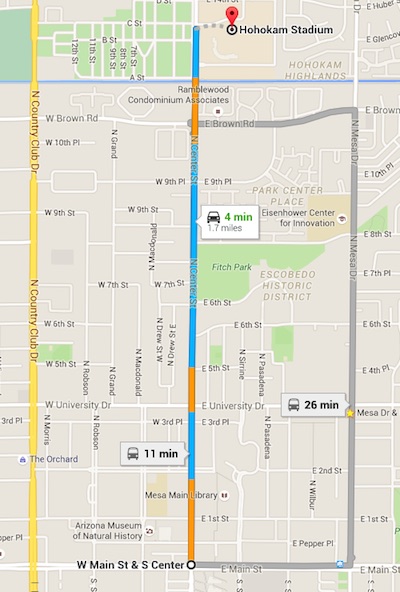
1.7 miles from the Center & Main light rail station to Hohokam
That distance is probably a bit too long to walk for most. Credit to those who do. Alternately, Mesa’s Downtown BUZZ free shuttle operates Monday through Saturday between Main Street and Brown Road, the major street just to the south of Hohokam. BUZZ runs all the way out to the Cubs’ Sloan Park if you’re interested. There’s also Valley Metro Bus 120 ($2 ride), which runs on Mesa Drive and Brown Road, stopping south of Hohokam. Pedicab would be a good option if it were available. And remember, if you go early you can visit Fitch Park along the way in the morning, catch a couple workouts, then head over for the 1 PM first pitch.
Speaking of Fitch Park, the City of Mesa announced that it renamed the unfortunately monikered “East 6th Place” at Fitch to “Athletics Way.”
@Athletics 6th Pl in #Mesa will now have a new name! #PressConference @ 2pm @MesaAzgov @MesaDistrict4 pic.twitter.com/mSlP4TYNyb
— Mesa Channel 11 (@MesaChannel11) February 16, 2016
The “Dead End” sign has to stay because it’s factual.
One difference for the A’s is the addition of two night games:
For those two you’ll have to drive/cab/rideshare.
—
For those driving everywhere or taking Uber/lyft to ballparks, there aren’t many changes of note. There are no new ballparks to speak of. There probably won’t be one until the Brewers decide to leave Maryvale.
Scottsdale Stadium is getting a new scoreboard. The new LED board is sized 24′ x 40′. That’s not as large as Hohokam’s jumbo 26′ x 56′, but it’s still a massive improvement over the old traditional scoreboard/postage stamp video combo.
—
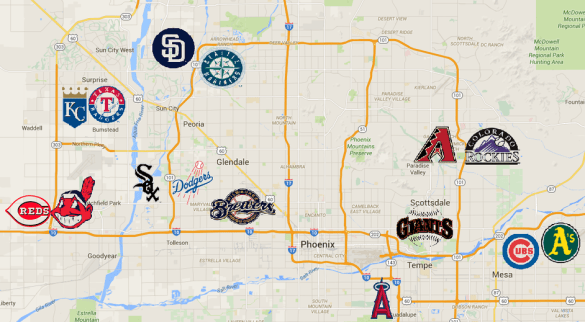
Map of Cactus League parks from Royals Review
If you’re touristing down to Arizona to catch a weekend’s worth of games or longer, chances are that you’re staying in one of four places:
All four of those locations are fairly close to the eastern bunch of Cactus League parks (Salt River Fields, Scottsdale, Tempe Diablo, Hohokam, Sloan). The five West Valley parks (Maryvale, Camelback Ranch, Surprise, Peoria, Goodyear) are a good 15-25 miles away from the preferred cluster of hotels. You shouldn’t stay in the West Valley unless you intend to spend most of your time at one of the facilities or you’re staying with family in, say, Glendale or Peoria.
If you’re getting around the Phoenix area, it’s best to look at just the area as basically two freeway loops. The largest is constituted by I-10 to the south and Loop-101 acting as the west, north, and east perimeter, about 15 mile x 20 mile rectangle. Camelback and Peoria are close to the west segment of Loop-101, while Surprise is way out beyond, and Goodyear is on the way out to LA. The Maryvale neighborhood is somewhat sketchy, though it shouldn’t matter since the Brewers’ home schedule is all day games. Meanwhile, the east cluster is nice and compact, with all ballparks within roughly 5-10 miles of each other. The other freeway loop is Loop 202, which covers a 10 mile x 20 mile section known as the East Valley, including Mesa, Chandler, and Gilbert. I-17 runs north to Flagstaff, whereas US-60 comes from the northwest, merges with I-10, then heads east towards New Mexico. The funny thing about driving around Phoenix is that even though the area is much smaller than the Bay Area, I find that I’m less tolerant of driving long distances. Maybe that’s because I’m conditioned to driving longer distances in the Bay Area, and there are more freeways to handle those distances. It may also be Phoenix’s monotonously endless street grid. Either way I’m surprised at how the landscape affects me as a driver.
If you’re planning a trip to the Cactus League and you have questions, drop a note in the comments. I’ll be happy to answer whatever I can.
The A’s just put out a press release:
Oakland Athletics Owner and Managing Partner Lew Wolff has issued the following statement about recent comments made by Oakland Raiders Owner Mark Davis:
“It is unfortunate Mr. Davis decided to bring the A’s into his discussion about the Raiders’ stadium lease. We respect his right to explore his options in and out of Oakland, including his widely reported consideration of Los Angeles and other markets. The A’s signed a 10-year lease at the Coliseum because we are committed to Oakland. Mr. Davis has said he is fully committed to do a new football stadium in Oakland and there is nothing in our lease that precludes Mr. Davis and the Raiders from building on the Coliseum site. As we stated yesterday, the A’s are aggressively working with the city to evaluate venue sites in Oakland. Our efforts are fully focused on Oakland. Although the Coliseum remains the main focus of our venue efforts, we are also evaluating potential sites throughout Oakland. We are confident our efforts will continue to move forward and we will share our progress throughout the process.”
The Raiders agreed in principle to a one-year lease at the Coliseum, with the potential for extensions in 2017 and 2018. Specific terms were not revealed at today’s press conference, but the main reveals are that the Raiders will pay more in rent than they had in the most recent lease, and that Larry MacNeil, former 49ers CFO, was hired to work with the City/County/JPA on a new stadium deal. Davis touted MacNeil’s experience in developing Levi’s Stadium.
Towards the end of the press conference, Davis challenged A’s ownership to “commit to Oakland”:
Right now there’s 120 acres. There’s parking, there’s an arena. We like the gameday experience of tailgating on that parking lot. We don’t want to give that up. Now, there’s two teams that play in that Coliseum. One’s the Oakland A’s, one’s the Oakland Raiders. People have not listened when I said I do not mind if there are two stadiums on that site. The A’s stadium would take about 12 acres, the Raiders’ stadium would take about 15-17 acres. That’s fine with me, but I do not want to give up the parking.
If, in fact, the A’s do want to stay in the Coliseum site, they need to commit A.S.A.P. so that we can go ahead and design and take down the Coliseum, provide all the infrastructure necessary to build two new stadiums in Oakland, and two teams will then come back in and play in two new stadiums. What I do not want to do is build a football stadium in the corner of the parking lot while the Coliseum is still standing, and then once we have a brand new stadium we begin to tear down – or build a new baseball stadium – and then tear down the Coliseum, disrupting the ingress, egress, and parking, tailgating experience for Raider fans on gameday. What it’s going to take is for the A’s to make a commitment to Oakland and tell the people what they want to do.”
You mean something like this, Mark?
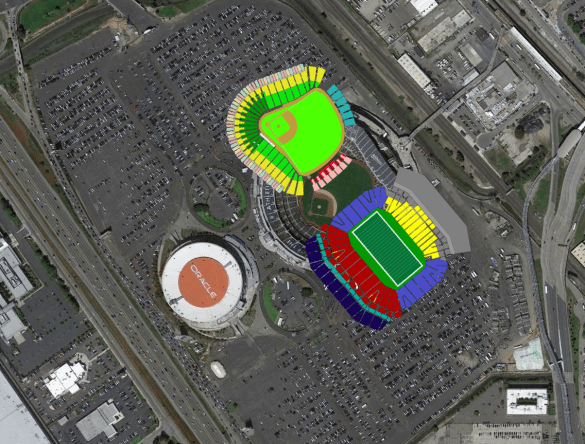
Two new venues on a slightly larger footprint than the original
The A’s response did not waver from their ongoing evaluation process:
The #Athletics official statement: pic.twitter.com/IGMDTEGbhA
— Susan Slusser (@susanslusser) February 12, 2016
Let’s, for a moment, follow Davis’s argument all the way through to its hypothetical end. He is right that he’s been consistent about this. For nearly two years he has wanted the Coliseum torn down immediately, to be replaced by either a football stadium on the original footprint, or two venues next to each other. As you can see from my drawing above, it can be done while taking up only slightly more land than the original Coliseum did. There would even be some advantages in that a grand plaza could be built between the two stadia, leading to the arena.
But is it realistic? Let’s consider how this would progress. Assuming that Lew Wolff and John Fisher could be convinced to go along with this plan, the Coliseum would be torn down and the site graded shortly after the end of the Raiders’ 2017 season – let’s call it a year from now, February 2017. From that point new infrastructure would have to be put in place, followed by actual construction. If they started by the summer, the A’s couldn’t move into their new home until the 2020 season because of a very compressed schedule for an early 2019 opening. The Raiders could potentially open in 2019, but consider that 2019 is the projected opening for the Rams’ stadium in Inglewood – and that site is ready to go, demo already completed. For all intents and purposes, both the Raiders and A’s would be out of Oakland for three years – the A’s probably to AT&T Park, the Raiders to Levi’s or somewhere else. Throughout all of this, Davis would have final say on any development on the 120-acre Coliseum site.
Is there anything in Davis’s history or actions that makes anyone believe Davis is the person to make this happen? He has no experience in development or in the kinds of complex legal and business arrangement requires. His sudden ability to rattle off catchphrases like “opportunity cost” like he just rolled out of a basic microeconomics class isn’t impressing anyone. MacNeil is a good hire, but his presence alone isn’t going to convince investors to subsidize a stadium. And Davis’s desire to stick with ingress/egress/parking as his most important issues in Oakland is downright bizarre. Preserving parking has some nobility to it and is a good way to pander to Raiders fans, especially when compared to the mess that is Levi’s Stadium parking. That argument can’t possibly impress the other 31 owners, who have demonstrated repeatedly that they want deals that improve revenue for teams and for the league as a whole. Parking is worth maybe $4 million a year in revenue. Davis has somehow neglected to talk about revenue as a rationale as every other owner seeking a new stadium has done. Raiders ticket prices will be frozen again for 2016, keeping prices and local revenues essentially flat for the several years since he took the reins. And Mt. Davis will remained tarped to boot. If the Raiders’ revenue position is going to improve, the Raiders will have to charge much higher prices at the new stadium, and in the intervening years they’ll have to test out those higher prices on fans at the Coliseum, the same way the Warriors are doing now in preparation for their new arena. Without a major revenue boost, there isn’t even a business case for building a new stadium, even a small one. The $500 million (+$100 million gift) Davis frequently talks about comes from stadium revenues. If he can’t hit the targets in those loan programs he’ll have hell to pay from the other teams’ owners and his own investment group, in large part because he’ll end up bleeding his golden goose (the NFL’s TV contracts) to pay everything off. And we still don’t know how the $300 million funding gap would be filled.
Historically, none of the old multipurpose stadia have been redeveloped in the manner Davis is suggesting. There generally was a sequence with one tenant staying in the old building while another was built next door, then the old one was demolished and replaced. That was a successful model in Pittsburgh, Cincinnati, and Philadelphia. While the Bay Area has the luxury of high quality venues that could host the two Oakland teams in a pinch, you’re also allowing them to take both feet out the door for three years. Either team (or both) could back out of any stadium deal at any time (really, please try to force a team to build a stadium when the city is providing no money for it). The only leverage Oakland has is that the Coliseum still exists and remains functional, allowing MLB and the NFL to maintain its inertia regarding both teams. Without the Coliseum, Oakland is practically a non-entity for pro sports. I’m not sure if the politicians gathered around Davis at the presser believe in Davis’s vision. The presser certainly wasn’t the venue to argue against Davis. The theme of the event was unity, even though all they were talking about was a short lease extension. Well, unless we start to see hard numbers and actual advantages for the A’s and Raiders besides preserving parking, we’re a long way from actual unity.
—
P.S. – Davis is trying to play some sort of PR game by claiming that the Raiders are “hamstrung” by the A’s lease. That’s only true if the only way to build a stadium is to do it Davis’s way. Otherwise the A’s lease can be terminated with two years’ notice. That’s it. It’s not unreasonable for the A’s to ask for some time to get their affairs in order. Unless you’re Tommy Boy, I guess.
I assume this is about a short-term lease extension, not a new stadium deal, but stranger things have happened. Press release:
Oakland-Alameda County
Coliseum Authority
For Immediate Release
February 11, 2015News Conference
Oakland Alameda County Coliseum Joint Powers Authority (JPA) to Make Important Announcement on the Future of the Oakland Raiders
3pm, Thursday, February 11, 2016 in the Oracle Arena Club
Oakland, CA – Selected members of the Joint Powers Authority and the Executive Director of the JPA will meet the media to discuss developments with the Oakland Raiders and the team’s 2016 football season (and beyond).
Media are invited to attend.
This is neither a public event nor an official meeting of the JPAWho: JPA Chair and Oakland City Councilmember Larry Reid
Oakland Raiders Owner Mark Davis
JPA Vice-chair and Alameda County Supervisor Nate Miley
JPA member Alameda County Supervisor Scott Haggerty
JPA Executive Director, Scott McKibben
What: Announcement of important development
When: 3pm, Thursday, 11 February, 2016
Where: Oracle Arena, Arena Club, Entryway adjacent to ticket booth
Being the Bay Area, and in particular San Francisco, is a blessing and a curse. We all know this from living here. Picture postcard vistas go hand-in-hand with intolerable commute times. Cultural appreciation is in a constant struggle with money overwhelming and subsuming everything. Despite the enormous homeless population and obscene rents, the fact is that those are not issues for tourists, for the NFL, or the national media. The Bay Area is as fun a tourist locale as there is the world, so it would seem natural for the Super Bowl to come here when the conditions (read: modern stadium) were right.
Although the action on the field at Levi’s Stadium left much to be desired, the act of hosting the Super Bowl went quite well. Traffic was difficult throughout the week, and the closure of Market Street was a drag for many downtown employees, but Levi’s Stadium held up well, as did Super Bowl City and various other peripheral venues. El Niño took a nice, long break to accommodate the game, perhaps a sign that the football gods hold more sway than the weather gods (the weather gifted New York two years ago as well).
Thanks again to the great people of the Bay Area and their hospitality this past week. Stellar SB experience!
— Rich Eisen (@richeisen) February 8, 2016
A year ago, a rainstorm hit the Phoenix area in the week leading up to Super Bowl 49. I checked out the multi-block event area there, thinking about SF the whole time. Phoenix has hosted three Super Bowls in the last 20 years, two since University of Phoenix Stadium in Glendale opened a decade ago. Phoenix’s downtown is well suited to host the festivities, with a convention center, arena, light rail running through the area, and plenty of hotels. For those who want more upscale digs, Scottsdale is next door. The big issue was that the stadium was 14 miles northwest of downtown, which forced a second stage to be built in Glendale. Ideally everything would be located in one fairly compact area, but that’s only possible in a few prior SB cities: Indianapolis, New Orleans, and Atlanta. Having Super Bowl 50 in Santa Clara, 40 miles away from San Francisco, proved to be a hassle but little else. There is some fervent backlash over the costs incurred by San Francisco, costs that were largely covered by the NFL and hosting committee in Santa Clara.
San Francisco proved too photogenic, telegenic, and overall too fun not to be asked to host the game again in the not-too-distant future. Fortunately for Bay Area residents overwhelmed by it all, that can’t happen any earlier that 2022. The next two games have already been awarded to Houston and Minneapolis, with Miami a frontrunner for SB 53 in 2019 and Atlanta a good possibility for the next installment. Should Stan Kroenke’s stadium open on time in 2019, it will be added to the rotation as quickly as possible, perhaps as early as 2022.
Eventually the NFL will probably go to a 10 city/year rotation as opposed to the 7-year rotation of the past couple of cycles. Replacement domes in the Twin Cities and Atlanta help, as do swank new venues in SF and LA. The success of the Super Bowl in New Jersey convinced other northern cities that they could host outdoor Super Bowls. The NFL is likely to say Thanks, we’ll go with warmer climates as Pete Rozelle intended.
I can see those last three games being hosted in the same sequence as 2011-13, depending on what upgrades the NFL asks for.
Moving forward, the success of the Super Bowl is likely to embolden those working to get a future Olympics to the Bay. That can’t happen for at least a decade and only if LA flames out in its 2024 attempt. At the very least there will be some level of infrastructure improvement thanks to BART’s expansion to the South Bay. For the Super Bowl and events at Levi’s, the venue will be accessible via both Caltrain and BART, with a light rail shuttle to the stadium. By then, who knows how horrific traffic will be? The self-driving car utopia is not as close as you might think.
There’s no telling what could happen in the next 10-15 years before a hypothetical next Bay Area Super Bowl. Chances are the tech industry will go through at least one bust cycle, probably two. The real estate bubble might burst. The Bay Area hosted the modern, overhyped Super Bowl with aplomb. It has nothing to prove. The decision to host another one will be for the next generation of leadership to decide. If we’re talking about selling the region’s soul, spare me. It’s been sold and resold more times than can ever be documented.
—
P.S. – The 49ers might want to get the grass fixed first.
Michael Oher can’t get any footing on Levi’s turf https://t.co/xjARxrlYin
— Jonathan Jones (@jjones9) February 10, 2016
2/7/17 – I originally posted this a year ago yesterday. The basic information hasn’t changed, so I’m reposting it now. This comes as the Chronicle’s Scott Ostler reported on the A’s potentially requesting light rail (a streetcar) to bridge the gap between BART and Howard Terminal. Have at it. – ML
My last article with Howard Terminal as the main subject (and not as an aside) was posted on November 15, 2014. That was nearly 15 months ago. Since then, few things have changed in the immediate area. The site remains without a tenant, short or long-term. While relationships with shipping companies SSA Marine and Matson solidified, the same can’t be said for rival Ports America, which pulled out of Oakland completely.
No site studies were completed on Howard Terminal, so in the event the site become an official relocation site for the A’s in the future, it will again come time to figure out just how much it costs and how long it will take to get the site ready. Thankfully, in Mayor Schaaf’s recent push for HT, a preliminary figure has been floated for site prep and infrastructure: $90 million. To me that sounds conveniently low, especially because $90 million is also the figure to get the Coliseum ready for the Raiders – even though we don’t know how much can or would be developed there.
Fortunately, we know that the infrastructure budget would include at least one bridge extending Market Street over the Embarcadero and Union Pacific tracks to Howard Terminal. There’s also a good chance we’d see a small parking garage to serve the stadium, probably for players, management, and VIPs such as suite holders. The actual cleanup cost is still to be determined, since we don’t have a proper sense of the footprint and placement of the ballpark in relation to the waterfront, not to mention the fate of the rest of the 50 acres.
Oakland has embarked on updating its Downtown Specific Plan. As is often the case when such updates come around, the city has chosen to expand its definition of downtown, now including Howard Terminal as part of an expanded Jack London district. This is a good move if the purpose is to recast HT as Jack London Square’s commercial flank to the west, instead of HT’s legacy as a dirty, blue collar, West Oakland port facility.

Howard Terminal and Ballpark at the far left of expanded Jack London District
The expansion makes the Jack London District quite large, extending 1.25 miles from west to east. That’s as long as a stroll from the marina all the way to 21st Street down Broadway. Or in walking distance, 25 minutes or so. To get a sense of distance and walkability, Oakland plotted out a series of maps showing rights-of-way, transit access, and walking distance from key points. Take this map, for instance:
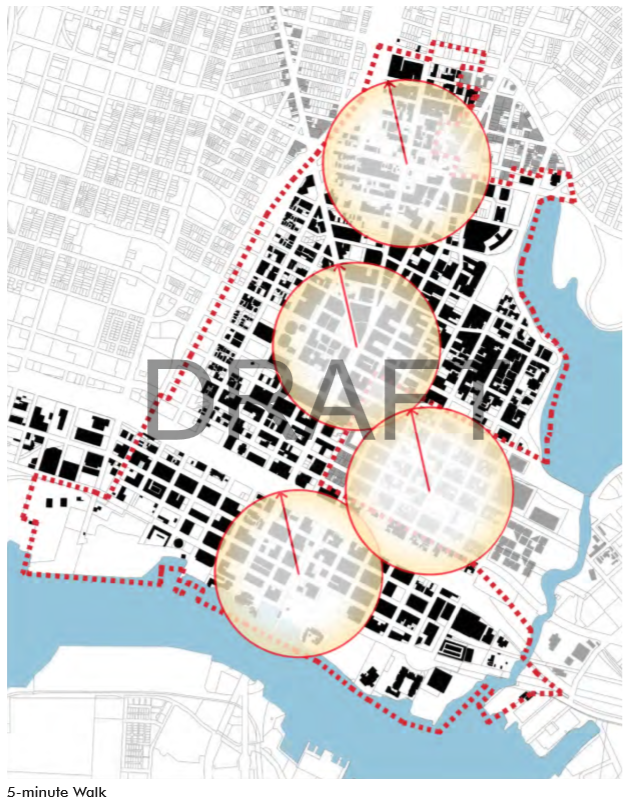
Radius of 5-minute walking distances from various points within Downtown Oakland
Based on where the the ballpark is located, it’s about 10 minutes from Jack London Square. It’s another 10 minutes to the nearest entrance for the 12th Street BART station. That’s going to require some sort transit option to bridge that distance, either via a more frequent Broadway Shuttle, the long-rumored Streetcar project, or another BART station in the vicinity of JLS. Because BART inclines from a tunnel to an elevated viaduct as it runs by 880, the most likely place for a station would be Market and 5th St. That’s a great location relative to Howard Terminal, only 1/4-mile away. There’s room and BART-owned land there for a new station. To accommodate BART’s up to 710-foot trains, the station would have to be located between Market and Brush Streets.

Gray marker on Market St denotes location of BART infill station
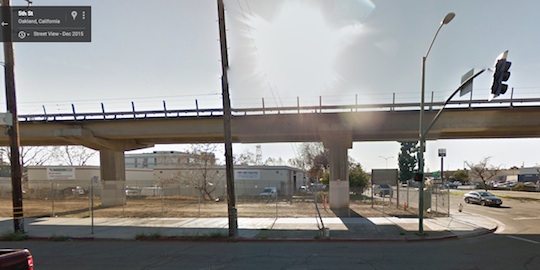
BART aerial at 5th Street and Market Street
The downside of BART at Market and 5th is that it’s 3/4-mile from Jack London Square, though at least it would be in the district (barely). A streetcar would conceivably serve more locals and non-ballpark users, but its route would run closest at JLS, again, 1/2-mile away. In a 2012 study, the streetcar’s estimated cost was $202 million. An infill aerial BART station would cost $70 million or more to construct. To me, if there’s a choice it’s a no brainer – build the BART station. But I’m not an Oakland resident, I’m an A’s fan who cares most about BART access. Citizens of Downtown Oakland who want a more comprehensive transit plan for their neighborhood may not find such an option satisfactory. The location is also not conducive to a big transit-oriented development plan, which makes it less attractive for grant funding, a possible necessity for construction.
Some may think that this infrastructure is unnecessary for the ballpark. They point to the numerous fans who walk from the Embarcardero BART station the long way along the waterfront to AT&T Park. Yes, people do that. They do it because it’s scenic. The walk from 12th Street to Howard Terminal is not scenic, whether you’re taking Broadway, Washington, or MLK. Forcing people to walk 20 minutes after taking in many cases a 15-25 minute BART ride is not convenient. It’s not up to the standards the public expects for transit availability. And it’s incredibly disrespectful to the needs of the disabled and seniors. You know what those people have in San Francisco? They have the ability to transfer to MUNI without leaving the station. Thousands of able-bodied fans do the same thing. They have the option to either walk or take transit directly to the park. That’s pretty close to ideal. Or if you want ideal access, there’s the Coliseum and the BART bridge. A’s staff are on hand at each end to help fans in wheelchairs. In upgrading ballparks, we shouldn’t downgrade access. We’re better than that.
 newballpark.org