Earlier this week, the City of Oakland presented some findings related to transportation at Howard Terminal. While some of the observations were quite sharp, many of the proposed solutions were fuzzy and ill-defined.
Take this zinger for starters:

For a year or more, I’ve heard a ridiculous mantra, No one lives at Howard Terminal, which should pave the way for all manner of changes with few complaints. Problem is that impacts are not confined to the project site alone. The surrounding area is much larger and can suffer from being in close proximity. That’s the flip side to the economic improvements often claimed in stadium projects. Sure, Howard Terminal will get a lot of jobs. Is it worth the gridlock? The CEQA process is designed to help the public make an informed decision.
Squeaky wheel gets the grease, so to speak
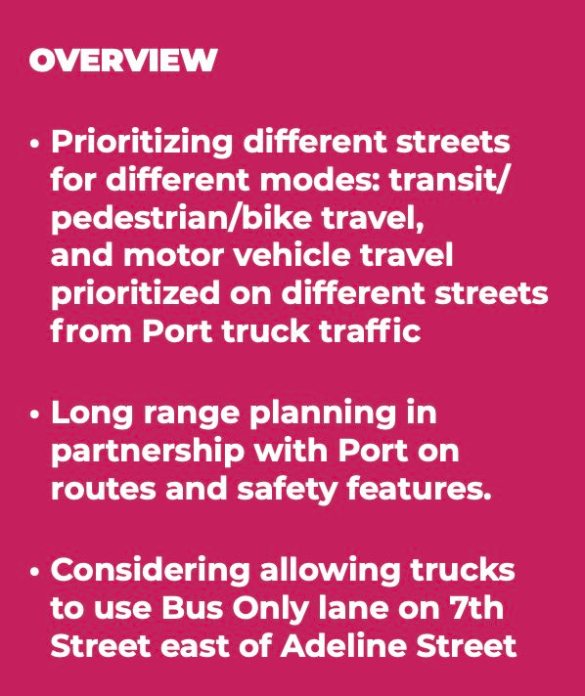
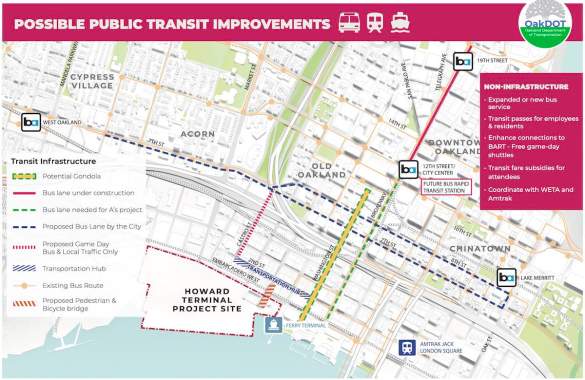
To that end OakDOT has apparently decided to attack the gridlock problem by prioritizing certain types of traffic on specific streets in the area. Embarcadero West/1st Street has train tracks right in the middle of it, forcing rail activity there to take priority. A block north, A four-block stretch of 2nd Street is the location of a transit hub. Which sounds pretty exciting, until you scratch the surface and realize that it’s mostly a staging area for BART shuttles. That’s not stopping Oakland from full-on selling the hub’s prospects:
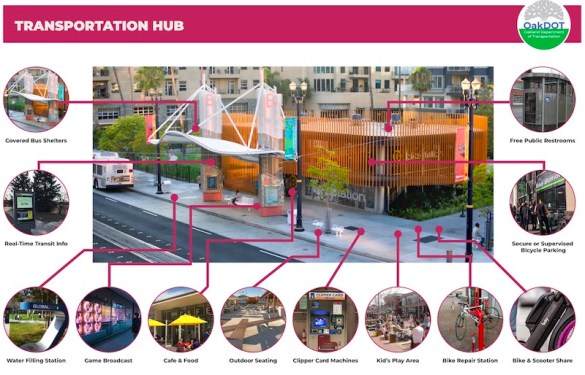
It’s Oakland’s version of the Transbay Terminal, except, not
There is talk of a potential BART stop there, though BART nixed any near term prospects. You can hope for 2050, which at the current rate of stadium aging is around the time that a Howard Terminal ballpark becomes obsolete. Bottom line, what’s planned is the stop for the bus bridge between the ballpark and BART, whether you’re talking about 12th Street/City Center, West Oakland, or Lake Merritt. Buses would line up along that stretch before turning onto a bus-prioritized Castro Street, then heading to one of the BART stations or the other parts of Oakland.
Bike traffic currently has 2nd Street as a designated route, which got the attention of bike advocates:

Strangely, 2nd Street is a designated bike route
Every redevelopment vision is going to have winners and losers, which makes it incumbent upon local government to work to protect the interests of those who can’t afford to buy their way out of the gridlock (hello, ridesharing). Keep in mind one of the bullet points above:
While BART serves a critical transportation role for communities of color, riders are disproportionately whiter than the residents around the stations
BART functions as a set of contradictions. It uses the same technology that powers metro subways, yet has less frequent, more spread-out stops and runs longer distances like commuter rail. For a long time it had those comfortable, e. Coli-infused wool seats. BART’s operational and spiritual hub is in Oakland, which makes it strange that the A’s and the City/Port are working so hard to propose a project that actively sidesteps it. Yet those contradictions make it difficult to justify an infill station nearby, as any slowdown in speed or efficiency within downtown Oakland could negatively impact ridership from the admittedly whiter suburbs.
Absent a direct connection to BART, HT proponents are pumping up that transit hub, limited as it is, and other solutions. As part of designating certain streets for certain types of travel, ballpark vehicular traffic is mostly confined to Market Street and Martin Luther King, Jr. Way.
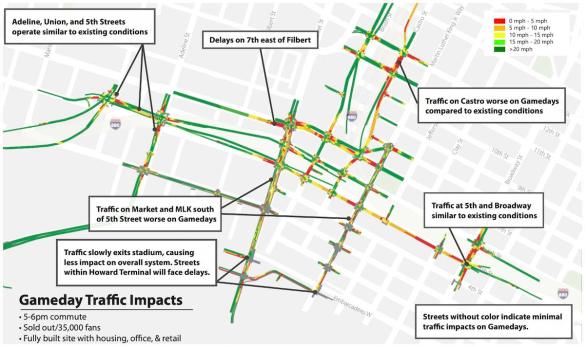
Rush hour gameday traffic map is a huge visual improvement from the old LOS (level of service) charts
You may remember that last year there was talk of a new ramp to the Adeline overpass to help route cars to the Nimitz. Evidently that idea encountered some resistance from Port interests, as there’s no mention of the ramp in the presentation. That’s probably just as well, since the ramp would mix ballpark traffic with Port traffic, which trucking companies have been fighting to keep separated for some time. It doesn’t help that the ramp runs through Schnitzer Steel, another opponent of the ballpark. Are those measures enough to satiate all concerned stakeholders? As usual, color me skeptical. Project mode splits show that with the move from the Coliseum to Howard Terminal comes a shift in cars to downtown Oakland, a duh moment but one with surprisingly minimal planning to deal with it.
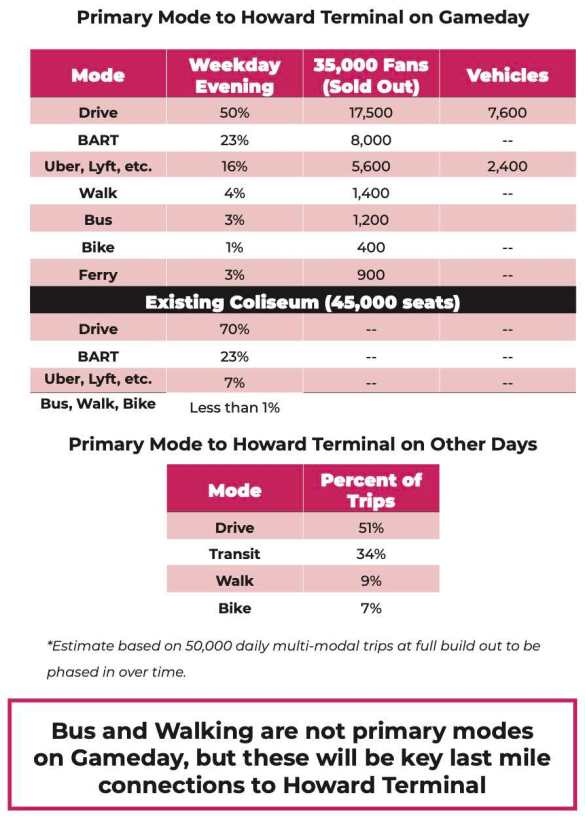
10,000 vehicles is 10,000 vehicles, no matter how you slice it. Thankfully, fewer than half are expected around the ballpark on gamedays.
Some infrastructure is planned. Again, whether that’s enough is up for vigorous debate. Consider the following legend from the pedestrian map:

The terms Proposed and Potential are the keys here. The pedestrian/bike bridge at Jefferson is Proposed. The vehicle/pedestrian bridge at Market is listed as Potential, as are some underpass improvements. Can you discern the difference?

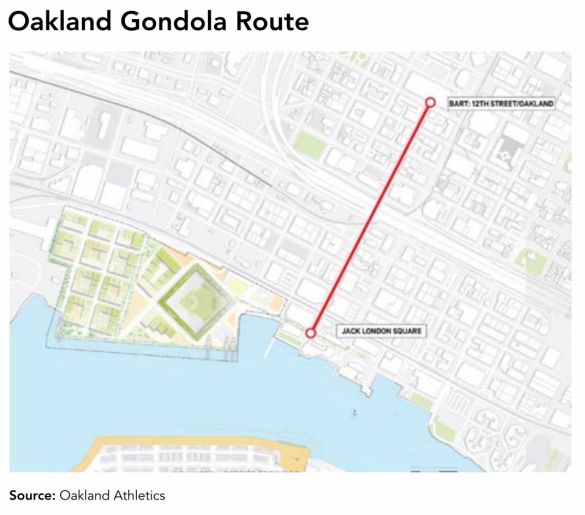
You’ll notice a passing mention of the gondola above. You haven’t heard much about it since its splashy introduction a year ago. That should tell you how much traction it has. Whether it gets traction or evaporates like most non-traditional transit proposals, there still remains a big last mile transit hole that is being addressed with little efficacy. Not much new infrastructure is planned, other than the stuff the Port interests are pushing for. The above map shows a bus rapid transit station at 12th Street, a separate project from Howard Terminal. Presumably BRT would be expanded to include HT, effectively making the hub a nice BRT stop. The disjointed nature of how all of the various transit options (three BART stations, Amtrak, ferry, AC Transit) come close but don’t actually converge is rather disturbing, more than a year after studies started. Obviously, you can’t move a ferry terminal or the train stations, but that last mile problem remains vexing. The way to resolve it, as proposed, is to throw a bunch of rules, operational costs (buses), and gridlock at it. That doesn’t sound much like progress to me. I eagerly await the end of the month, when the draft EIR is scheduled for release.






 newballpark.org