Wolff to meet with New City’s Kephart over Coliseum City on Monday

An early reason for Thanksgiving? Well, let’s not get ahead of ourselves yet. Floyd Kephart, the point man for the rejuvenated Coliseum City effort, has a meeting with Lew Wolff scheduled for Monday.

The encouraging news is that Kephart may have put together a plan to keep either the A’s and/or Raiders while paying off the outstanding Mt. Davis debt. That previously was not on the table, at least under the Raiders-centric plan.

birdseye-view_north

As of this writing, there are 58 days left in the recently-extended Coliseum City ENA. Kephart has to deliver at least one team and a master developer to sign on, otherwise CC is toast.

Or is it? Is there anything stopping yet another 3 or 6 months? Presumably the Raiders will have to decide whether to make a run for LA in January or February, when the NFL’s relocation window opens. Mark Davis, Stan Kroenke, and Dean Spanos will all be tempted to be first movers, if only to stake the first claim to LA despite the lack of concrete new stadium plans. What would happen if the relocation window and the ENA both expired with no action by Davis? Davis would be forced to work on a lease extension somewhere, whether at the Coliseum, Levi’s, AT&T Park, wherever. The JPA and the City of Oakland would prefer to keep the Raiders locked into a multiyear lease, which would buy them additional time while they waited for Coliseum City to magically pencil out. Naturally, Davis would be most comfortable with a year-to-year agreement. Inevitably, it all comes down to Davis being the first domino. Little else substantive can happen without his involvement, at least if Oakland wants to keep the Raiders within city limits.

A hidden issue for all three potential relocation candidates is the need for a practice facility and headquarters. The Chargers might be able to get away with keeping theirs temporarily in San Diego. The Raiders could also keep theirs in Alameda via a lease extension while flying down to LA for games, though the JPA may choose to slam the door in Davis’s face if he brings in the moving vans. Kroenke has vast land holdings, including that Hollywood Park purchase from earlier in the year, so if he wanted to build a facility in conjunction with the move, there’s little to stop him. However, that would take at least a year to complete with no temporary facility in place, and the NFL would prefer that these teams not use a local JC or high school in the interim.

Going back to Wolff, there’s little reason to think he’ll be significantly swayed by Kephart. Wolff already has his own designs on the Coliseum complex, so a third party would add needless complication. Kephart might have a third way that suits Wolff and New City’s investors, though it’s hard to see what that is. Perhaps if Wolff gets the complex to develop, while New City takes the area between the complex and the BART station and the “Area B” west of 880, all parties may be satisfied. It was always assumed that the $500-600 million funding gap made using all 800 acres necessary. Since the A’s would probably need only a fraction of that for the ballpark, there stands to be more wiggle room for all parties. For a project as large as this it’s not unusual to have several developers handling different sections and phases. Getting them all on the same page, making their respective contributions, and not getting too greedy – that’s the hard part.


Quakes make it official: Avaya Stadium

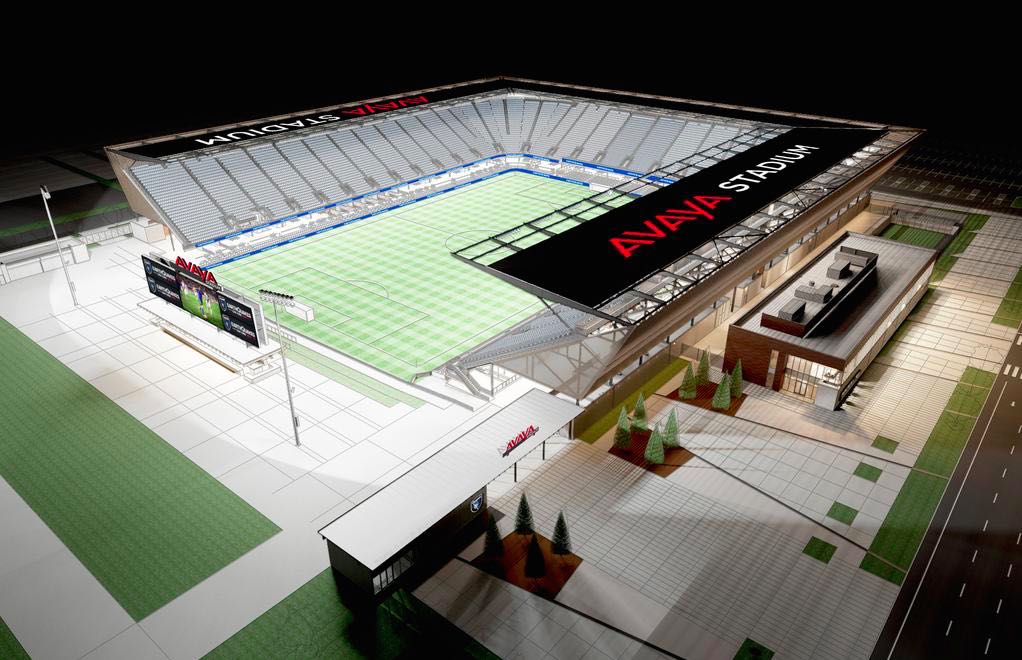
The rumor of networking/telecom company Avaya signing on to be the naming rights sponsor for the San Jose Earthquakes’ stadium launched nearly a month ago. Today it’s official. Avaya will having naming rights at the stadium at a cost of $20 million over 10 years. That’s about average for MLS stadia these days, though it pales in comparison to the $220 million, 20 year deal at Levi’s Stadium.

The Avaya logo will be prominently displayed atop the scoreboard and roof.

The Avaya logo will be prominently displayed atop the scoreboard and roof.

A few more details emerged that showed how complex the deal was.

  • The cost of the stadium grew from $60 million to $100 million. Most of that can be attributed to adding features. Originally the stadium didn’t have suites, eschewing those for club-style seating down low. As interest in such an offering grew, suites of different types were added to the structure at field level. This is similar to what happened during development of SAP Center, which was also barebones until ownership injected more money to make it a better venue. The Quakes continue to say that excavation difficulties encountered in 2013 didn’t contribute to the cost hike, but I don’t believe it. That was a lot of time and effort used to get the site ready for construction.
  • Quakes President David Kaval said that 40 to 50 companies expressed interest in naming rights, though that had to be settled after the 49ers squared away their deals in Santa Clara. Even with Levi’s being the much bigger attraction, 40-50 is an impressive number that shows how strong corporate interest is in the Valley. The 49ers and Quakes are partnering on hosting large soccer games at Levi’s in the near term, so there is crossover potential between the two venues.
  • The new scoreboards are in place, coming right on the heels of the just-completed scoreboard for the A’s at Mesa’s Hohokam Stadium. In a couple months, work should commence on the Coliseum’s scoreboard project. The projects are getting progressively larger.
  • Public stadium tours are taking place, despite the stadium remaining a construction zone. Tours take place on Thursday afternoons and require reservations. Note: No capri pants or exposed feet!
  • According to a December Bizjournals article, about $10 million from the development of the iStar site in South San Jose will go into the stadium. That should help defray some of the upgrade costs.

The Quakes have been run on a shoestring budget for several years. Since the stadium had to be privately financed, it’s no surprise. Hopefully the stadium will boost revenues to the point where the team can get more marquee players, or at least playmakers in the midfield. Wondo’s not getting any younger.

View of scoreboard from fan lot area and Coleman Avenue

View of scoreboard from fan lot area and Coleman Avenue

Avaya Stadium still has some seats to install and some buttoning up to do. Regardless, there’s a lot to look forward to next spring. I’ll be sure to take in a few games at the new stadium. The Quakes finally have the home they have sought for so long. Maybe the A’s are next.

Coliseum Authority casting a wider net for open General Manager job

With the Guy Houston hire apparently on the outs for political reasons, the Coliseum JPA still has an opening for a general manager to fill. Matter and Ross report that one candidate is Scott McKibben, a longtime newspaper industry veteran who in 2009 was tapped to run the Rose Bowl and Parade in 2009.

McKibben is also commissioner of A11FL, a startup spring football league with an unusual rule difference: all 11 players on offense are eligible receivers. That league was supposed to launch last spring, was forced to cancel for untold reasons, and may launch again next spring. Not sure how McKibben’s involvement with A11FL and other ventures could impact the Coliseum Authority gig, but I’d prefer to have a local guy who isn’t spinning plates in LA while trying to negotiate gigantic deals in Oakland.

Which brings me to Andy Dolich. He’s local. He’s visible and well-liked. He was mentioned in the M&R column. In 2012 I wrote this about Dolich:

Reading between the lines, it looks like Dolich is appealing to someone in the East Bay to become a frontman for the Coliseum City plan – if not now, when the plan has legs. That would be a great idea assuming that Coliseum City got off the ground. It’s always good to have someone who has credibility in the sports industry, a history of past successes, and local ties. In December 2010, Dolich floated the idea of a new multipurpose stadium in Oakland, one with the technology to be less of a “neither fish nor fowl” problem than the 60′s-era stadia. I deconstructed the concept and explained why it wouldn’t work. Dolich read my post and sent me an email, which led to a very pleasant exchange on stadia and arenas. I think I even promised to meet him for lunch to talk shop, which never happened, unfortunately.

The bottom line is that it’s nice to hear someone advocating for Oakland and the East Bay, even if his office is actually in the South Bay. Those putting together a Coliseum City plan wouldn’t hurt themselves by having Andy Dolich in a prominent position. To be clear, that’s probably at least a year down the road if it happens at all.

Perhaps the plan Dolich works on wouldn’t specifically be Coliseum City. He’d still be tasked with a major deal if an A’s-centric alternative plan were discussed. Dolich has been a staunch advocate of the Coliseum as the best site for the A’s and Raiders, even if his “multipurpose stadium” thinking was stretching advocacy to unreasonable proportions. There isn’t a bigger fan of the Coliseum area than Dolich, and unlike some other rumored candidates, he wouldn’t be taking the job as a stepping stone for other political endeavors. Dolich’s chief disadvantage is that he doesn’t have experience on the public side of the negotiating table, instead frequently representing teams. Then again, considering how Oakland has botched previous negotiations, maybe that isn’t such a bad thing.

If Dolich wants the job (he wanted the JPA’s PR consulting gig previously), he should be given every opportunity to get it.

OWB terminates Howard Terminal ENA, then explains why Howard Terminal is great

We’re having some dissonance here, folks. OWB leaders T. Gary Rogers and Don Knauss wrote a letter in today’s Tribune declaring that the group is terminating the ENA, effectively killing Howard Terminal on their end after A’s ownership and MLB removed the site from consideration earlier in the summer.

The relevant part of the letter is quoted below:

And, for a multitude of reasons, we had high hopes that the A’s ownership would seize on the opportunity to develop this prime 50-acre waterfront site into a ballpark and ancillary retail. It is now clear, however, that the current ownership has no intention of seeking a new ballpark at Howard Terminal, or anywhere else in Oakland for that matter.

Thus, it is with great frustration and sadness that our group has elected to release the Port of Oakland from our Exclusive Negotiating Agreement on Howard Terminal.

The rest of the letter reads like a long passive aggressive complaint against ownership, sour grapes more than anything else. Before I get into that, there’s a thoroughly unfounded allegation that “current ownership has no intention of seeking a new ballpark at Howard Terminal… or anywhere else in Oakland…”

Seriously? Lew Wolff presented a plan to redevelop the Coliseum to the JPA weeks ago. The front office is starting a reorganization with a PR hire meant to interface directly with public officials and local government. At the Coliseum, that is. Not at Howard Terminal. You’d think that a group that had publicly been happy with simply keeping the team in Oakland would’ve applauded this. Not so. In fact, they didn’t mention the Coliseum at all in the letter. Strange, right? It’s almost as if they only cared about Howard Terminal and getting their hooks into the team – but I wouldn’t want to cast aspersions on them. It’s all about keeping the team in Oakland. I’m sure that omission was purely unintentional.

Rogers and Knauss go on to mention how they’ve studied the site, they consider it viable, etc. And they can rest with that argument knowing that they never have to show any information to back them up. There’s no draft EIR published, no feasibility study, no economic impact report. Nothing public to back them up. Just their word, which some in Oakland were happy to swallow without question. Without any of that information we have little to go on but our own research and statements from the Port indicating that the ballpark would be difficult to pull off.

OWB and Howard Terminal’s backers had been in contact with MLB for the better part of two years. If they had a truly compelling case to press that could’ve allowed MLB to recommend the site, MLB would’ve been swayed at least a little. In this ongoing saga MLB’s constant indecision actually worked in Oakland’s and HT’s favor. A plan could’ve been presented that showed HT was superior to the Coliseum, San Jose, or any other site that could’ve been presented. Yet that didn’t happen. And now OWB wants to whine one more time about it. OWB referred to Wolff’s and San Jose’s court strategy as a Hail Mary when they could’ve said the same thing about their own strategy. They hoped that Wolff would get frustrated enough to sell or do something that would compel either John Fisher or MLB to consider an ownership change. Even now, they’re calling for the current ownership group to sell, a trademark attack of Quan-era combativeness. Absent a compelling story, they had their own desperate plan.

Pot. Kettle. Black.

The untold story is that the Port is losing $10 million a year for the next several years while they figure out what to do with the land. At the moment the Port is looking into providing shore power so that some types of operations can be carried out. Otherwise there are few ways to eat into that $10 million. Rogers and Knauss should consider figuring out ways to make Howard Terminal a revenue generator. 50 acres is a good start for a football stadium-cum-convention center. That suggestion’s on me, fellas.

If these businessmen truly want the A’s to stay in Oakland, they’d be best off offering assistance to the A’s than in publicly spitting in their faces at every turn. After all, they’re not spending money on the ballpark. They spent $50,000 on incomplete studies. The ballpark will cost $600 million to construct, of which they were going to pay practically nothing. The Coliseum’s not a sexy site. The plan is probably not going to look like a pie-in-the-sky fever dream that Coliseum City resembles. But if it’s offered by the A’s and has broad public support, it will be the best chance the A’s have EVER had to have their own ballpark in Oakland. Not everyone will be happy. OWB doesn’t like the Coliseum site. Wolff prefers San Jose. It’s a compromise, which is a lot better than a fantasy.

P.S. – I wrote a summary of Howard Terminal news on March 19. This was the conclusion:

That’s why I’m glad all this is happening. Someone’s gonna get to say I told you so at the end. As childish as that may sound, it’s better than not knowing.

I was wrong. We never even got to the point of knowing. Hey OWB, about your letter – Cool story bro.

P.P.S. – When the old Gas Plant at Howard Terminal had to be cleaned up, PG&E had three estimates for the project. Only one, Alternative 3, would’ve made the land developable. The other two were some form of asphalt cap to protect the land.

cleanupcost

Alternative 3, a full cleanup with hauled away toxic dirt much like China Basin, cost $4.125 million – for 1.58 acres. Scale that to 50 acres (31.6x). Now you’re starting to get an idea how much Howard Terminal would cost.

A’s let go of PR man Bob Rose, signal possible stadium-oriented change

The A’s hired Bob Rose in 2008 to be head of the team’s public relations. Rose handled many of the tasks you’d expect of a PR guy, handling inquiries directed towards ownership. He also occasionally wrote a blog called Clubhouse Confidential, which provided player profiles and reflections on the team during the season.

Today Rose was let go for reasons that were initially unclear. Then came this:

The PR department is already siloed to an extent for media relations and broadcasting, so it makes sense for the front office to have someone who can also work with public sector. For instance, the Giants have a 4-person public affairs group. The A’s currently have no group or person in that role. Ironically, Rose was the PR guy for the Giants in the lead up to the opening of China Basin.

It makes even more sense if you read into the move the need for a person to work in concert with counterparts at the Coliseum Authority (JPA) and/or the City of Oakland. Robert Bobb’s consulting group is going to handle much of the deal specifics on the JPA’s side, whether or not Coliseum City moves forward successfully. For large projects it’s common to draw up team org charts so that everyone understands their roles and responsibilities. I try to do that for every large project I work in my day job.

Org chart supplied by The Robert Bobb Group

Org chart supplied by The Robert Bobb Group

Does it mean that an Oakland ballpark is happening? Not yet. But this is a solid step in preparation for a ballpark.

P.S. – I’m curious to see if this affects media access among bloggers. I wouldn’t expect any big changes.

Newswrap 11/12/14

Liccardo is expected to carry out many of the same policies as Chuck Reed, which means the lawsuit against MLB won’t be dropped. We’ll see if that matters in the long run. For now it means little. The Ninth Circuit is expected to drop the hammer on the lawsuit sometime in the coming months, followed by a San Jose appeal to the Supreme Court.

Here’s a blast from the recent past: those blasted Maloof brothers are set to enter the pro sports ownership realm again, as part-owners of an expansion NHL franchise in Las Vegas. No date has been given for the establishment either the Vegas franchise or its companion. Both expansion franchises are expected to be in the Western Conference, which is currently two teams short of the Eastern Conference. Assuming that Seattle is the other franchise, realignment could get messy since both franchises should play in the Pacific Division. The most logical way of handling it would be to move the two Alberta teams (Calgary, Edmonton) to the Central, move Colorado to the Pacific, and add the two expansion teams to the Pacific. It would make the Western Conference look a bit different.

  • Pacific – Vancouver, Seattle, San Jose, Los Angeles, Anaheim, Las Vegas, Arizona, Colorado
  • Central – Calgary, Edmonton, Winnipeg, Minnesota, Chicago, St. Louis, Dallas, Nashville

Yes, it still sucks that Quebec City doesn’t have a replacement team. The flights from Alberta to Texas and Tennessee for division games would be brutal. Expansion would put the tally at 32 NHL teams, which is a sort of magical number from a scheduling standpoint regardless of sport. I wouldn’t expect that to grow for many years after this expansion round.

The Las Vegas venue will probably be the MGM-AEG arena, under construction along the Strip near the New York-New York casino.

The Minnesota Department of Revenue reported that the sales tax impact from hosting the All Star Game this year was $21-55 million, well short of the projected $75 million windfall. (h/t Field of Schemes)

—-

The cities of St. Petersburg and Tampa, which are rivals and neighbors the same way San Francisco and Oakland are on the West Coast, may be ready to work out a deal in which Rays ownership could scope out potential ballpark sites in Tampa. St. Pete’s Tropicana Field is the current home. There’s a long way to go before everyone’s satisfied, so don’t get your hopes up yet and follow Noah Pransky’s excellent Shadow of the Stadium blog for more details.

—–

A profile of Ron Gobbell is available at The Tennesseean. Who is Ron Gobbell? He’s the lead architect for the Nashville Sounds new AAA ballpark, First Tennessee Park. The article includes key milestones. FTP is slated to open next April 17.

——

Jon Streeter, the attorney for Keker Van Nest who negotiated the A’s new lease agreement for the JPA, today was appointed judge of the State Appeals Court 1st District by Governor Jerry Brown.

——-

The bowl game scheduled for December 30 at Levi’s Stadium has a new name: Foster Farms Bowl.

fosterfarmsbowl


The interim name was San Francisco Bowl. When the game was hosted at AT&T it went by several names, including Kraft Fight Hunger Bowl and Emerald Bowl. Foster Farms isn’t going anywhere, so maybe the name will stick around. As for the bridge iconography, well… I prefer a different logo.

chickenbowl

Interview on Swingin’ A’s Podcast

Yesterday I did lengthy interview with Tony Frye (@GreenCollarBB) of Swingin’ A’s about all manner of stadium stuff. Since it came on the heels of the election, we talked a lot about that and the Raiders. We talked a good deal about the A’s too, and I tried to show how the two are interrelated and how the teams’ fates are intertwined as long as they’re in Oakland.

Swingin’ A’s Podcast Episode 4

My part of the interview comes about 36 minutes in and runs a whopping 50 minutes.

In the interview I discuss Walter Haas and Steve Schott, the latter a subject of a Frye blog post from earlier today. I focused on Haas, partly because of some renewed interest in what he did towards the end of his ownership tenure. Take a look at some of these articles:

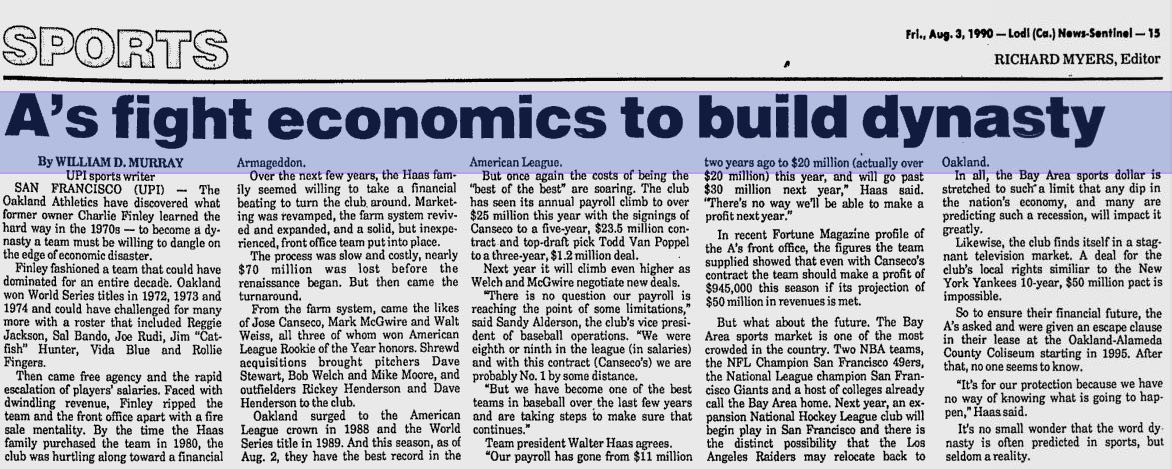
A’s fight economics to build dynasty 

haas_1990-lodi

Athletics to move if Raiders return?

boca_raton-athletics_to_move

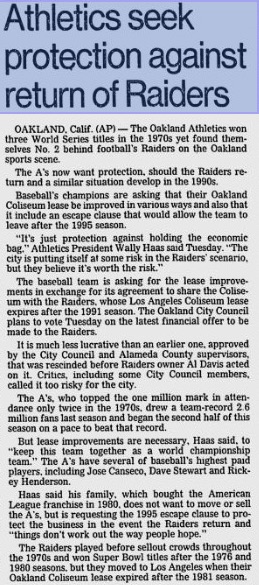
Athletics seek protection against return of Raiders

deseret-athletics_seek

While we remember Haas for his great generosity, winning teams, and partnership with Oakland, what has gotten lost was that when the winds started to swirl around the Raiders and their potential return to Oakland, Haas picked up on it early and voiced his worry about it. He soft-played it, didn’t want to make appear like he was threatening to move out of Oakland. He made it clear, however, that the team was losing money because of his family’s sacrifices. He was going to sell at some point if it got much worse, which it did. He ended up selling at a heavily discounted price because of the big debt load. Haas felt his business was threatened, so he reacted the way you’d expect a business owner to do – to try to protect his team. Some owners have taken this to unseemly extremes, and it’s unfortunate that Oakland has had to suffer the worst of that behavior from Al Davis and Charlie Finley.

I’ve mentioned this before and it bears repeating: it’s no coincidence that the A’s salad days occurred when the Raiders were gone. The three-peat A’s won the most, but turnout was not particular good and Finley whined about it frequently. With no competition from football on or off the field, Haas didn’t feel a threat. He allowed the Giants to explore the South Bay, in hindsight a strategic error on his part. Haas was as genial guy as ever existed in the Bay Area. But he was still a businessman who knew what was Priority #1 when backed into a corner.

Listen to the interview, rate it on iTunes, and give feedback here in the comments section. I had a good time talking to Tony, and I expect to do another one of these in February, after the Coliseum City ENA expires. Then we can talk next steps. For now, give this a listen.

P.S. – The day Frye asked me to do the interview, Mike Davie of Baseball Oakland wanted to be on too. He’ll have his own episode at some point with a lot of Oakland cheerleading and ownership bashing, I assume.

Davis, Raiders execs meet with San Antonio representatives in Alameda

Mark Davis is probably having a little more fun than Raiders fans these days, because even though their team started out the season 0-8 with 0-16 coming at them fast, at least Davis has a diversion. Davis took another trip to London a few weeks ago, he meets with LA boosters trying the lure the team back down near where he lives, he’s in the Bay Area for home games, and he met today with Henry Cisneros and his team from the Alamo city. Naturally, it’s all a matter of exchanging expensive lunch checks, so Davis is having a grand time while everyone else tries to get inside his head.

Prior to today’s meeting, a unnamed Raiders source indicated that the Alamodome, the last on-spec stadium in America, was considered “NFL-ready.” Clearly that means ready as an interim venue while a new one is built, which is sad considering that the Dome is barely 20 years old. Then again, the Georgia Dome is of similar vintage and that venue is considered outdated by the Falcons, so maybe it’s not that surprising after all.

The Alamodome was borne of a strategic mistake. The Spurs’ old home, the HemisFair Arena, had already been expanded once since its ABA days (by literally raising the roof). The time had come for a brand new arena. Instead of a purpose-built basketball venue, Cisneros led the charge to build a new domed stadium, which could have attracted an NFL team at some point. In the meantime, San Antonio became home to a new CFL expansion franchise during that league’s ill-fated venture in ‘Murica. When the CFL’s stateside project went bust the Alamodome was left without a tenant. A half-house configuration housed the Spurs in a manner that made a 20,000-strong crowd look sparse. The Pistons also did this at the Silverdome until they built their own arena. Eventually Spurs owner Peter Holt prevailed upon city fathers to build AT&T Center on the east side of town, leaving the Alamodome with only one tenant, a minor league football team. A few years ago, the University of Texas-San Antonio started up a new football program, so they moved in to the Dome. The only other permanent tenants is the Alamo Bowl.

Debates about the NFL-worthiness of the San Antonio market generally go nowhere. Yes, it would be one of the smallest markets in the NFL if the Raiders moved there. True, it lacks corporate strength. San Antonio is the eighth-largest city in the nation, but as a fast-growing new city it lacks the distinction of its biggest Texas rivals, let alone other major markets. Their one pro franchise, the Spurs, are the NBA’s shining example of how to run a team on a limited budget. In the market’s favor, it does know how to put on NCAA events with aplomb, and the Alamodome is perhaps the best temporary venue in the country. Good enough to be a real NFL market? Maybe, maybe not. Good enough to be a stalking horse? Definitely.

All Davis said after the meeting was:

Henry Cisneros said their job was to present San Antonio’s assets in strongest light and they did that.

In the normal stadium extortion game, this is when the home city, Oakland, would start throwing public funds at Davis. Since Oakland is in no position to do that, Davis has to try a different tack. Davis’s actions make sense when you understand that he’s trying to play three markets off each other to get the best deal possible – one that allows him to divest as little of the team and his own resources as he can stomach.

What can Oakland provide, given the weird state Coliseum City is in? The only thing nearly as precious as money… time. When Davis talked publicly about demolishing the Coliseum ASAP, he wasn’t joking. He’d like to get the Raiders into a new stadium ASAP. The easiest and quickest way is not to build a stadium alongside the existing Coliseum, but rather to demolish the old one and build on top of the old footprint. Doing so would eliminate the need to reroute power transmission lines and other utilities. More important, no EIR would be needed. When it comes to the rest of the project whether a new venue such as a ballpark or ancillary development, those phases would need an EIR. Fred Kephart is projecting a 2019 opening for a Coliseum City stadium. Davis surely wants a stadium by 2018 or even 2017 if it can be managed. That can’t happen with Coliseum City’s current projected timeline. It’s unclear if an LA stadium can be delivered by 2019. San Antonio? Texas builds stadia faster than California, that’s certain.

What about the A’s new lease, you ask? Aren’t they locked in until 2018? Nope. There’s language that accommodates the possibility of the Raiders pushing the A’s out of the Coliseum.

7.2.2. By Licensor. Licensee acknowledges that a plan may develop for construction of a new football stadium for the Oakland Raiders. Licensor shall keep Licensee reasonably informed of any information related thereto. If Licensor presents Licensee with a Raiders Construction Plan, Licensor and Licensee shall, for a period of thirty (30) days thereafter, negotiate in good faith for an amendment to this License that will account for the financial, operational and other consequences that Licensee would suffer from the construction and operation of such planned football stadium. Such negotiations shall not be necessary if the Raiders Construction Plan includes substantial demolition of the Stadium. If such good faith negotiations are unsuccessful or unnecessary, Licensor may terminate this License upon written notice of intent to terminate to Licensee, such termination to take effect sixty (60) days after the conclusion of the second (2d) Baseball Season that commences after such notice.

44.32. “Raiders Construction Plan” means a bona fide plan for construction of a new football stadium for the Oakland Raiders on current Complex property, adjacent to the current Complex property, or otherwise located sufficiently near to the Stadium such that it will materially impact Licensee’s operations, which bona fide plan must include, as pertains to such stadium project, a fully executed development agreement with a third-party developer and the Licensor for development of a new Raiders stadium, supported by a non-refundable deposit from the developer and received by the Licensor of at least Ten Million Dollars ($10,000,000.00).

The A’s are bound to at least 2018 if they choose to leave. Oakland and the JPA are not. Davis’s currency are his 51% stake in the team and the ability to dictate terms. If he can get a year ahead of projected opening dates, he could end up +$50 million in revenue just for that one year compared to staying at the Coliseum. The city that can deliver the earliest start date will definitely influence his thinking to some degree. No one in the media is talking about time, yet it’s every bit as important as site or financing model, at least in the near term.

P.S. – Davis is also playing a game among the NFL owners. Cowboys owner is on the NFL stadium committee, while Texans owner Bob McNair is on the league’s finance committee. Both owners and their respective committees will have a lot to say about potential relocations before any deals are signed. Davis could be sending a message to the Texas owners to play ball with him, or else face a San Antonio threat. It sounds like a terrible hand to play, but Davis doesn’t have much else with football’s Lodge. If he can influence them and other owners that the Raiders should be first banana in LA (despite various misgivings) it’s a hand well-played. Davis doesn’t have much to lose, plus he could help his friend Cisneros prove San Antonio’s viability. If you’re Cisneros, you don’t opportunities like this all the time, so you might as well give it a shot.

More Election Aftermath 2014: Oakland Transition Begins

Update 1:25 PM – Mayor-elect Schaaf did an interview with KQED radio today. She was tossed a few sports-related questions from Forum host Scott Shafer. After reaffirming her no-public-funding stance, Shafer got her to clarify a few things about the Raiders-vs.-A’s conflict.

Shafer: There’s a lot of pressure on public officials – mayors – that you don’t want to “lose” the Raiders or “lose” the A’s. The 49ers are now essentially in San Jose, they’re down in Santa Clara. The Giants have a wonderful ballpark on the (SF) waterfront. If you had to lose one of those teams, which one would you rather lose? In terms of the economic health of the city, which one matters me?

Schaaf: I’ve already gone on the record on this question. My first and strongest priority is keeping both teams. I believe that we can afford to not pit against one another. But as far as economic impact, our baseball team has a greater economic impact to the city.

Shafer: And in terms of what is the most likely location for a new ballpark for the A’s, what would it be?

Schaaf: Honestly, I love the idea of a waterfront ballpark in Jack London Square, at Howard Terminal, but I’m very transparent about this. Wherever somebody else’s money is gonna build a stadium – I will support that location.

The refreshing thing about Schaaf’s statement is that it sounds like she’s going to let the money (the A’s) lead the way, instead of combatively trying to force A’s ownership to comply with a concept they don’t believe in (ahem, Howard Terminal). That’s a good first step towards building a healthy public-private partnership.

Believe it or not, there are many Raider fans who believe that a football stadium can drive greater economic impact than a ballpark, despite the numbers that suggest it’s impossible (82 baseball games vs. 10 football games, 2.5 million attendance vs. 650,000). It’s good to hear Schaaf put that debate – if there ever was one – to bed.

Only two days after Election Day, current Oakland Mayor Jean Quan and Mayor-elect Libby Schaaf held a joint press conference to announce the office transition. Despite some rather forced-looking hand-holding, it’s a great first step towards improved decorum and organizational unity at City Hall, which would be a huge change from Quan’s uneven tenure. Schaaf talked about five goals for the transition and her first days in office.

It’s good to hear that Schaaf is willing to “fight like hell” to keep both teams in Oakland. A more collegial environment can only help, compared to the last four years of backbiting among Quan, Wolff, and former City Administrator Deanna Santana (remember the “lost letter” mini-scandal?). Schaaf indicated that she would call Wolff about ballpark possibilities, though I wouldn’t expect the conversation to be much more than a courtesy call.

Schaaf inserted herself into the A’s extension talks when she took some time while on the campaign trail to criticize the negotiations. Rebecca Kaplan, who got both credit and heat for leading the talks, fired back that Schaaf hadn’t asked for information on the talks before stepping onto a soapbox. Was that just the usual campaign trail opportunism, or Schaaf’s desire to be more involved? From KRON:

At the time Schaaf also said that there would be legislation forthcoming that would force more open negotiations (past talks have been notoriously secretive).  Her resolution was titled The Accountability and Transparency in High-Stakes Negotiations Act.

Recommendation: Adopt The Accountability And Transparency In High Stakes Negotiations Policy Resolution Amending Rule 25 Of The Council’s Rules Of Procedure, Resolution No. 82580 C.M.S. And Resolution No. 84758 C.M.S., To Require City Councilmembers Appointed To Serve On Boards, Commissions, Agencies, Joint Powers Authorities, (“Representatives”) To: (1) Notify The City Council As Soon As High-Stakes Negotiations Commence; (2) Provide Real-Time Reports On High-Stakes Negotiations And Annual Reports On General Business; And (3) Participate In Training Regarding Their Duties And Obligations Of Representation Within 30 Days Of Appointment

Basically, it requires the negotiating parties (the two CMs appointed to the JPA board) to keep the rest of the Council and the Mayor in the loop and inform on a regular basis. You’d think this would be standard operating procedure, and I’d ask you what cute small town you live in where this happens. In any event, the resolution passed – coincidentally on Wednesday. Now Schaaf will have the opportunity to play by the very rule she drew up. Whether or not it was politics, it should work to the public’s benefit when the time comes for real negotiations. It’s a lot better than the Mayor’s office whispering information to useful idiot types who then spew it out to a select audience.

The underappreciated part of Schaaf’s pledge is the need for a professional, permanent City Administrator. Keeping one in place has been less successful than having a drummer in Spinal Tap. There was Santana’s tumultuous reign, then Fred Blackwell stayed on the job for a month before taking a private sector position. Prior to Santana were two interim administrators, P. Lamont Ewell and Dan Lindheim. The current administrator is also an temporary hire, Henry Gardner. And we can’t forget that Robert Bobb was run out of town by Jerry Brown when Bobb pushed for an Uptown ballpark. The job is not for the meek. Bobb’s consulting firm is taking a gig with the JPA, negotiating Coliseum City or an alternative on their behalf. Bobb negotiated the publicly-financed Nationals Ballpark deal and recently helped deliver a report on a nearby stadium concept for the DC United soccer franchise. At $286 million, nearly half paid by the District, it would be the most expensive stadium in MLS by leaps and bounds. A City Manager/Administrator does far more than stadium deals, and finding qualified, experienced candidates is not easy, as Oakland has seen the last several years. Having one in place who supports the project, negotiates fairly for the City, and communicates regularly is just as important as having a Mayor on board. It doesn’t hurt to have a good working relationship between the City Administrator and Mayor. What’s particularly troubling is that the rapid turnover has exposed a brain drain problem at City Hall. Many cities promote from within to fill an open city manager position, with the advantage that an internal candidate already knows the local turf and pitfalls, no learning curve required. Gardner’s expected to leave with Quan, so to call the need urgent would not be an understatement.

Election Aftermath 2014

A wise person would’ve turned off the lights and gone to sleep early, waiting to let the election news wash over them until the following morning. Not this guy. As the various county registrars were plagued by reporting delays traced back to a vendor in Florida (that’s your first clue right there), election observers sat at their computers, thumbs properly inserted.

Eventually we got our results. Though not certified, we have a pretty good sense where everything’s leading:

  1. Libby Schaaf is the apparent winner of the Oakland mayoral race.
  2. Sam Liccardo narrowly defeated Dave Cortese in San Jose’s mayoral race.
  3. Alameda County’s Measure BB passed with 69% of the vote, approving a 0.5% sales tax hike for 30 years.

Last week Schaaf did an interview with Athletics Nation in which she discussed current efforts to keep the A’s and other teams in town, as well as her own ideas on doing things differently. She said many of the right things about the City working with greater transparency. She criticized certain aspects of the Coliseum City plan, such as the fanciful replacement arena for the Warriors (who are working on their own arena in SF). Fans of the A’s and/or Raiders will definitely seize upon this:

AN: Do you see keeping the A’s and Raiders as mutually exclusive? What are some of the challenges that go along with keeping both teams in the city?

Schaaf: There is enough room for both teams, and my clear priority is keeping both teams. But from an economic point of view, the A’s have a larger economic benefit for Oakland that should always be kept in mind. They play more than 80 games a year, compared to 10. But I just want to be clear, I’m a very proud Oakland native; my parents were season-ticket holders for both the A’s and the Raiders throughout my life.

If Schaaf is going to work via a straight economic comparison of the two sports, there’s little doubt that the regular season of baseball is far more impactful than a football season. Football’s big payoff was to come via a Super Bowl, though that’s perhaps more of a pipe dream than Coliseum City itself. If Schaaf moves towards abandoning visions of a Super Bowl or retractable roof stadium, it would lead to much more productive discussions between the City and the Raiders. The team and the NFL don’t particularly care about Oakland’s Super Bowl fantasies, and the added cost ($200-300 million at today’s rates) makes an already difficult project even more prohibitive.

Schaaf also led off by saying there’s enough room for both teams, a common refrain from many candidates during the campaign. The problem is not a matter of physical room, it’s whether or not the assembled parcels and other resources can properly pay for the bulk of two stadia. Later on in the interview she emphasizes that the venue(s) will be built with someone else’s money, which is fine as long as someone else can figure out a way to make it pay for itself and turn a profit to boot.

For now Coliseum City remains lame duck mayor Jean Quan’s baby, one covered with the stench of desperation and imminent failure. Schaaf won’t be sworn in until January, which will leave probably one week for her to determine in concert with a new city council how to proceed. She can choose to carry on Quan’s work as Quan conceives the project, leave certain processes going (EIR) while regrouping to think up another strategy, or abandon the project altogether to come up with a completely different plan. How Schaaf proceeds will largely dictate how the A’s and Raiders act, since both teams are waiting for each other to vacate. Complicating matters is the NFL’s activity, which includes a special meeting of its stadium and finance committees to further plan potential Los Angeles relocation(s). In February the relocation window officially opens, which could allow the Rams and/or Raiders to apply to move. If that happens, it’s expected that the NFL will have the procedure in place for relocation candidates to move forward.

If the Raiders leave Oakland only one month into Schaaf’s tenure, her legacy won’t be defined by it. She has worked just about everywhere in Oakland government except as part of the JPA or with the JPA. She has been a sitting council member, sure, but that’s much different from working deals the way Rebecca Kaplan did recently or Schaaf’s old boss Ignacio De La Fuente did previously as members of both the City Council and the JPA. If Schaaf allows both the A’s and Raiders to leave with the Warriors already one foot out the door – now that could be terribly damaging to her. Quan has been scrambling to keep all three teams without a cohesive plan. Schaaf doesn’t want to repeat that. The Raiders leaving would allow Schaaf to devote resources to the A’s, an idea the JPA is already on board with. If the Raiders decide to stay in Oakland and partner with Coliseum City everything remains status quo, though Schaaf will also have the new task of negotiating a short-term lease with Mark Davis.

If the Raiders choose to nix LA and work on a new stadium in Oakland, Schaaf will have to decide if it makes sense to devote more resources towards an A’s ballpark. She expressed support for Howard Terminal, yet the A’s lease and stance leave the site out of the picture. Perhaps Schaaf could work with Doug Boxer and Don Knauss to better present a plan to pay for the ballpark at HT while smoothing over the bad relationship between Quan and Lew Wolff – it is a new regime, right? However, that may be a bridge too far for a site that neither Wolff nor MLB supports. Building a stadium in California is hard. If Schaaf can guide her city towards the realization that they’ll be more productive by putting more wood behind fewer arrows, they stand a better chance at turning that dream of a new stadium into a reality. Schaaf will have to remember one guiding principle: If she’s going to plan for a stadium with someone else’s money, chances are that someone else will have a lot more say about how that stadium gets built than a publicly-built stadium.

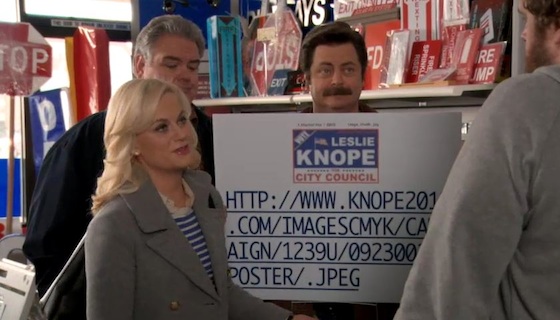
P.S. – One other thing. Without knowing that much about Schaaf’s work in her district, all the talk about her work ethic and positive attitude reminds me of fictional city bureaucrat Leslie Knope. Is that a reasonable comparison? Oakland could use Leslie Knope’s kind of determination. Maybe we’ll be able to see that now that the craziness of the campaign is over.